
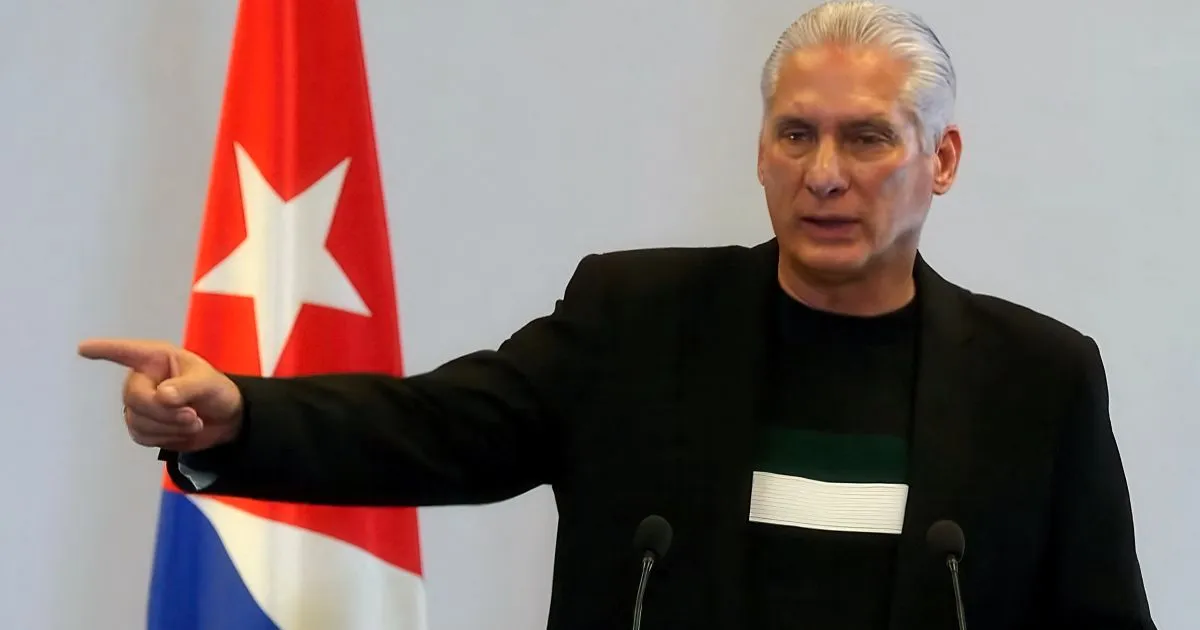
“The consistent policy of the Revolution” to which Diaz-Canel refers in the speech on March 13, where he admits the conversations that he had denied until 48 hours ago, has been based for 67 years on state terrorism to repress internal opponents and demonize Cuban exiles.
The conversations with the US, Diaz-Canel admits, “have been led by General Raúl Castro and me (Díaz-Canel himself), and collegiate by the highest structures of the Party, the state and the government”, for which in Cuba there is no differentiation of powers. These are the conversations that Cuba denied while the US assured that they have been taking place.
The conversations, Díaz-Canel assures, “have been oriented through dialogue, to resolve bilateral differences”, differences that the Cuban official tries to demonstrate only exist due to a political dispute, he does not admit that the US has been speaking out about the state of siege in which the island’s population remains kidnapped, subjected to all types of lack of freedoms and also in levels of poverty and scarcity like they had never suffered before.
“The purpose of the talks, Díaz-Canel assures, is to seek, through dialogue, the bilateral differences between both nations.”
In the words of Díaz-Canel, “the purpose of the talks is to find solutions to the problems that have been identified.” The first thing they have identified, without Díaz-Canel having been able to mention it, is that they are being forced to release prisoners. They made this announcement on the night of Thursday, March 12, assuring that it is through the Vatican, but it is really one of the conditions that the Havana regime knows, they are obliged to comply with, if they hope to have any kind of possibility to dialogue before being deposed.
It also says that “we want to determine the willingness of both parties to carry out actions for the benefit of the people of both countries, and also identify areas of cooperation to confront threats and ensure the security and peace of both nations.” The first thing that should be asked to Díaz-Canel is how Cuba, which keeps the population subjected to regimes of interruptions of the electrical service, can offer the United States some type of collaboration to the people of the United States, if Cuba is a nation that has collapsed, due to hunger, a broken health system and all of its deteriorated infrastructure. Regarding national security and peace, the Havana regime cannot make any offer either since Cuba is registered on the list of countries that sponsor terrorism due to its links with the main enemies of the United States, placing it as a focus of insecurity in the region.
Díaz-Canel says that “it has not been the policy of the leadership of the revolution to respond to speculative campaigns”, really who is speculating with his statements is precisely Díaz-Canel himself who is issuing a speech most likely dictated so as not to miss even a comma in what he must say because in these circumstances, the slightest error can cost him his permanence in that prop position that he plays.
He assures that the conversations are part of a “very sensitive process that is conducted responsibly.” It is sensitive in that, if the regime leadership does not accept any condition that the US puts on the table, the time to remain in the country without being arrested could be very limited, as well as the possibility of choosing where to go, if they are allowed.
Díaz-Canel states that “spaces of understanding are being sought to find solutions that allow us to move forward and move away from confrontation”, the only probable understanding is the departure and total dismantling of the regime. Díaz-Canel knows this, and he also knows that he is prohibited from admitting it publicly.
“Adherence to international law, reciprocity and respect for the political systems of both countries (USA and Cuba),” Díaz-Canel assures, are the principles on which the dialogue between both countries is being developed. If Cuba disrespects something and has done so for decades, it is not respecting the rights of its own citizens, denying them freedom of expression and political affiliation and repressing them for expressing their opinions. Nor does it show adherence to the norms of international law when its policies promote and carry out actions such as the trafficking of slave labor (medical brigades), it supports guerrillas and insurgent movements in many parts of the world by sending mercenaries, it infiltrates spies in the United States itself and has ordered the execution of crimes in international waters such as the downing of two civilian planes of the Hermanos al Rescate organization in 1996, more recently, the shooting down of a boat of fishing from Florida, killed by a Cuban border guard vessel, leaving 5 people dead.
By Iliana Lavastida
@ilianaLavastida
