
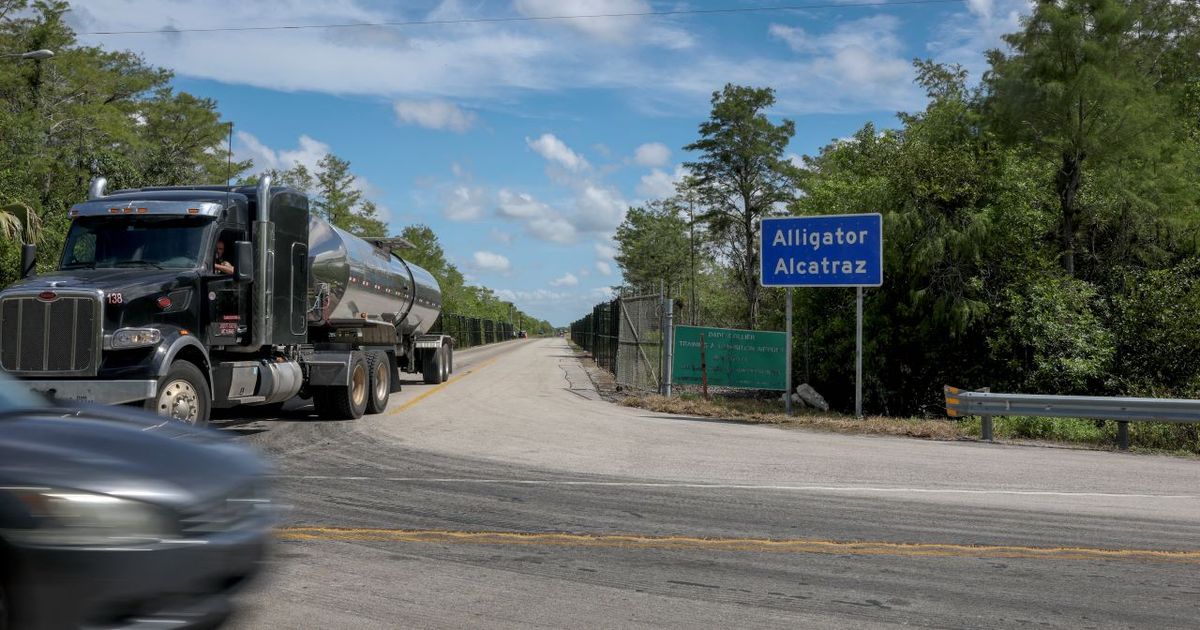
Miami – The Department of National Security (DHS) confirmed the beginning of the transfer of migrants arrested in the center known as “Alcatraz de los Caimanes” or “Aligator Alcatraz”, located in the Everglades of Florida.
This action is carried out in compliance with the court order issued by federal judge Kathleen Williams, who ruled the gradual dismantling of the center after determining that its construction and operation would cause irreparable damage to the swamp ecosystem.
Transfer in motion
State officials confirmed that the establishment will be completely empty “in a matter of days.”
Kevin Guthrie, director of the Florida Emergency Management Division, said the installation “will probably be zero individuals” very soon, but did not set a top date.
Since the issuance of the court order, volunteers who monitor the site have reported at least three buses that transported detainees outside the center.
The installation, which came to house up to 1,000 detainees at its maximum point, had reduced its population to between 300 and 350 people, according to recent reports by Democratic representative Maxwell Frost.
DHS sources indicated that the current number of detainees is around 100, all in the process of transfer to other prison complexes.
Failure compliance
The DHS declared in an official statement that, although “every machine works in profitable and innovative ways to comply with the mandate of the US people to massively deport illegal criminal immigrants,” he is also “complying with this order and transferring the detainees to other facilities.”
The agency, however, maintained its criticism towards Judge Williams, whom he described as “activist”, and regretted that the court order “would interrupt the federal government’s ability to apply immigration laws.” His attempts to suspend the ruling were rejected by the magistrate, while the federal government appeals the sentence.
Judge Williams issued a preliminary order of 82 pages that prohibits the center from receiving new detainees and orders its dismantling within 60 days.
The decision was based on the lack of justification by the Florida authorities to locate a detention center in delicate wetlands, and on the absence of an environmental review as required by the Federal Law.
Environmental impact and future repercussions
The judicial ruling responds to multiple demands filed by environmental organizations and the Miccosukee tribe.
The plaintiffs argued that the center would violate the National Environmental Policy Law (NEPA) and threaten protected species that inhabit the Everglades, such as the Florida Panther, the wooden stork, the bat with Bonete de Florida and the American caiman.
Wild life experts testified that the center’s infrastructure could force Florida’s panthers, a critical endangered species of extinction, to abandon its territory.
According to the demanding groups, the Big Cypress reserve, designated as the International Park of Dark Heaven, would suffer degradation of its night skies due to the industrial lights that remain on 24 hours.
In the midst of the controversy, the state of Florida plans to establish a second detention center called “Deportation Depot” in a National Guard installation in the north of the State.
