
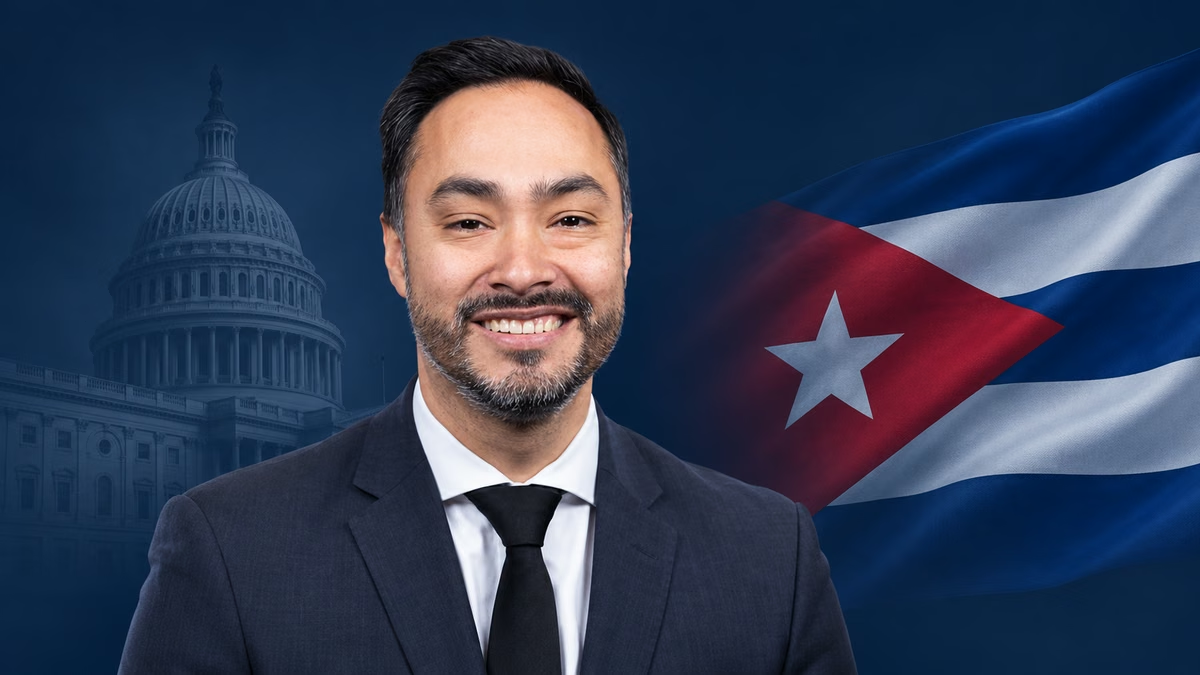
MIAMI.- Democratic congressman Joaquín Castro affirmed that his party is working to prevent a military intervention in Cuba, while President Donald Trump keeps that possibility open and maintains pressure on the Havana regime. The legislator explained his position in an interview published by the Mexican newspaper La Jornada on November 12, without specifying what actions he would promote to stop an operation.
“It is not the task of the United States to go and select a new leader or a president,” declared the representative from Texas, who questioned whether Washington would resort to an invasion to install a ruler.
Castro interpreted that the comments and policies of the Republican administration keep an intervention similar to that of Venezuela on the table. “We hope it doesn’t happen,” he said. When asked how they would seek to avoid it, he responded: “We are working on that.”
In that conversation he did not announce the presentation of a specific project, a legislative calendar or an approved measure to prevent the use of force against the island.
The controversy takes place in a single-party dictatorship that restricts political participation and punishes dissent. In its Freedom in the World 2026 report, based on 2025 conditions, Freedom House classified Cuba as a non-free country, with nine points out of one hundred and zero out of forty in political rights.
The organization describes a system that prohibits pluralism, limits independent media and severely restricts civil liberties. His evaluation indicates that the generational change that began in 2018 did not change the undemocratic nature of the regime.
Trump, for his part, presented his interest in the Cuban situation as support for those who suffered mistreatment and left the island to settle in the United States. In an interview with broadcaster Hugh Hewitt, also on November 12, he expressed his intention to address that issue during his term.
“I want to resolve the Cuba issue before I leave,” he said. The president also highlighted the Secretary of State, Marco Rubio, for his ability to deal with the issue and recalled the Cuban origin of his parents.
Asked if he would consider using military force, he responded: “I would certainly consider it.” The possibility of a week-long campaign was raised by Hewitt; In that conversation, the president did not set an operational deadline or announce an attack order.
The White House policy has also translated into economic instruments against the Cuban power apparatus. An executive order signed on May 1 allows sanctions for individuals and entities linked to the regime, as well as those responsible for serious human rights abuses and corruption related to Cuba.
The provision contemplates the blocking of assets and restrictions on entry to the US for those designated in accordance with its criteria. Washington justified these measures for reasons of national security and foreign policy.
Castro represents Texas’ 20th District and serves as the ranking Democrat on the House Subcommittee on the Western Hemisphere. From that space he has questioned the administration’s strategy towards Latin America.
In February 2025, he promoted, together with Jesús García and Nydia Velázquez, resolution H.Res.168, which condemns military action in Mexico without the consent of that country and without express authorization from Congress. The file includes its referral to the Foreign Affairs Committee. This text refers to Mexico and does not constitute a prohibition to intervene in Cuba.
On April 22, 2026, his office also submitted a complaint to the State Department, signed with Pramila Jayapal, Jonathan Jackson and Gregory Meeks. The congressmen attributed the inability of Jayapal and Jackson to meet with the American charge d’affaires, Mike Hammer, during an official visit to Havana, to administration restrictions.
La Jornada also collected the opinion of a Democratic advisor to the Senate, whose identity was not published, according to which Cuba would not be among the immediate priorities of the next Congress, which is more focused on the cost of living, health and immigration.
While the debate continues in Washington, human rights organizations maintain their complaints against the Cuban authorities. In April, Amnesty International called for the immediate and unconditional release of people imprisoned for political reasons and an end to repression against those who express critical opinions, peacefully protest or report on the reality of the country.
The entity warned that opaque and discretionary releases can keep their beneficiaries under surveillance, arbitrary restrictions and the threat of returning to prison. He also stressed that these announcements do not replace the State’s obligation to end arbitrary detentions, annul unjust convictions and compensate victims.
