
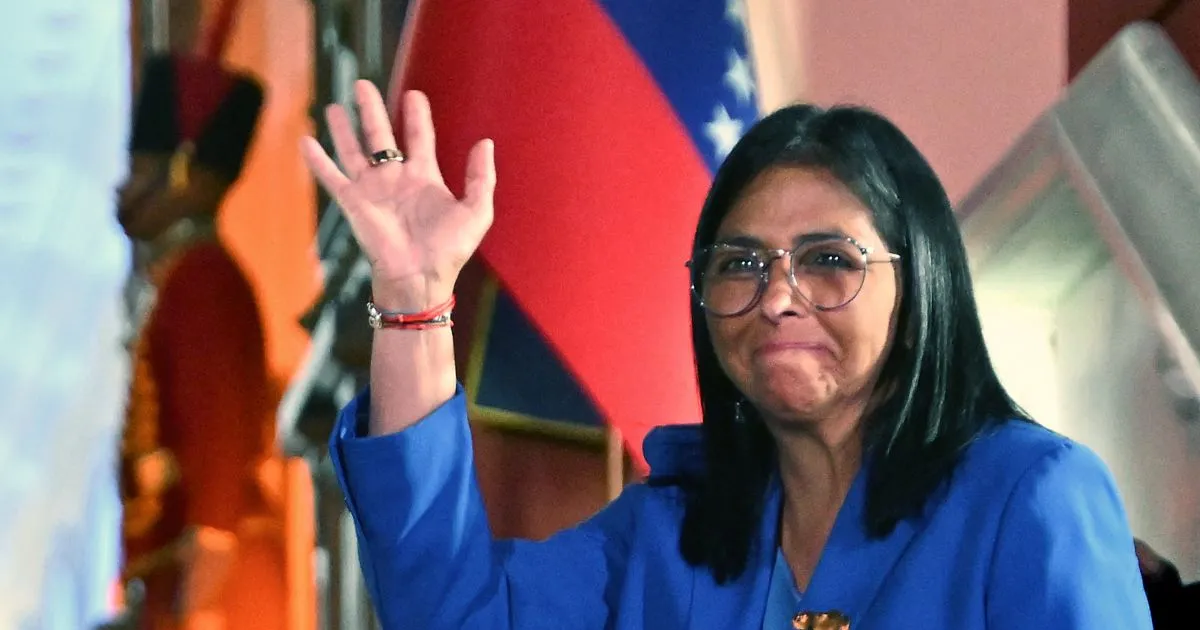
CARACAS. The president in charge of Venezuela, Delcy Rodríguez, described it as “unusual” that Guyana criticizes the official use of the map of Venezuela that includes the Essequibo territory, currently in litigation in the International Court of Justice.
Rodríguez made the statement in an event that took place in the state of Carabobo (central Venezuela) according to information broadcast by the Telesur network.
This adds more tension between Guyana and the Caribbean country that has a dispute over the Essequibo area.
He claimed the rights of Venezuelans over the area, which he considers “historical and irrefutable”; in addition to “based on the legality of the 1966 Geneva Agreement.”
The interim head in Venezuela with her words made reference to statements by the President of Guyana, Irfaan Ali, who criticized Rodríguez’s use of a brooch in which the map of Venezuela with the Essequibo region is visible, which occupies two-thirds of the Guyanese territory and is claimed by Caracas.
“Provocation”
Ali has noted that: “This is not just a symbolic issue” but rather “a calculated and provocative assertion of a claim that Guyana has consistently and legitimately rejected, and which is in the hands of the International Court of Justice for final resolution.”
Guyana considers that the territory was acquired by the United Kingdom through an agreement with the Netherlands in 1814 and that Venezuela has to accept the borders established in the Paris Arbitration Award of 1899.
In 2018, in the midst of one of these ups and downs that the dispute has had, Guyana asked the International Court of Justice (ICJ) in The Hague, the main judicial body of the United Nations, to mediate the conflict based on the Paris award, which is not recognized by Venezuela.
However, Venezuela does not accept ICJ mediation and only recognizes the 1966 Geneva Agreement as valid.
The ICJ, which declared that it had jurisdiction to settle the territorial dispute between the two South American countries, convened hearings between May 4 and 11 to determine the validity or not of the 1899 award that established the border between the then British Guiana and Venezuela.
The hearings scheduled for next month will focus on examining the merits of the litigation, a step towards a future final decision by the court on one of the longest territorial conflicts in South America.
