
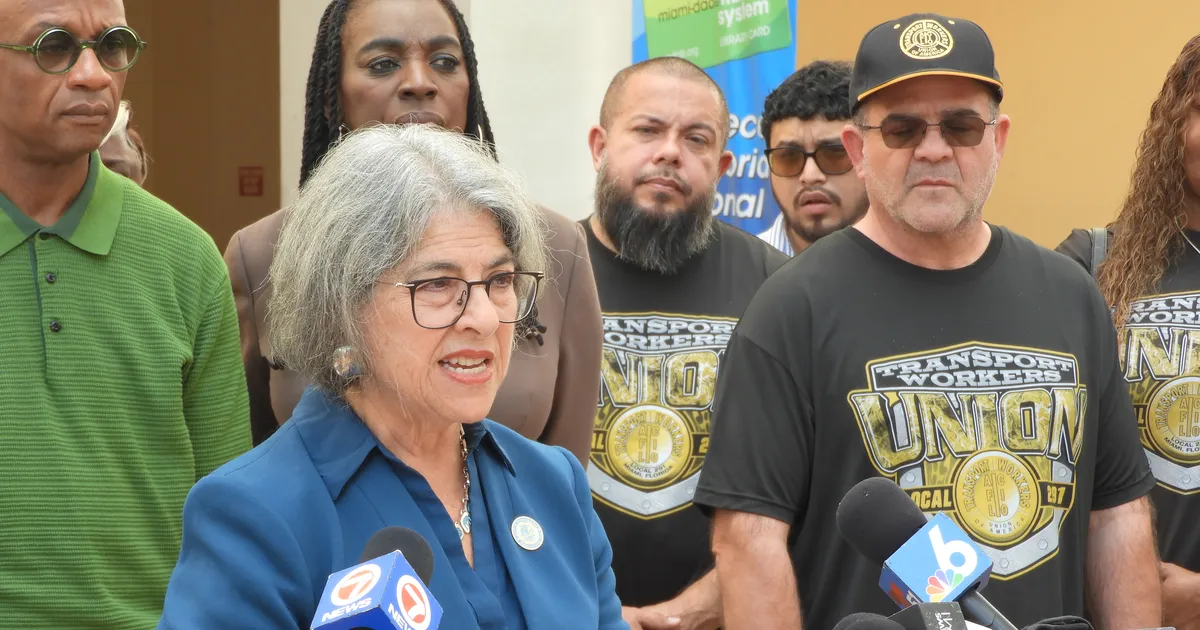
The press conference took place in the plaza of the Miami-Dade Main Library, located at 101 W Flagler St., in downtown Miami. Levine Cava was accompanied by elected officials from Miami-Dade and Broward, as well as representatives of labor, business and community organizations.
“We are united for the future of our community,” said the mayor, who acknowledged that the cost of housing, insurance and food is suffocating many families, but maintained that Amendment 3 is not the appropriate solution.
“It is being presented as a simple tax cut, but it does not eliminate the cost of providing the services our communities depend on. It simply changes who pays for them,” he said.
Why Levine Cava rejects the proposed reduction
Levine Cava clarified that he is not opposed to providing tax relief to homeowners. Their objection focuses on the breadth of the proposal and that it does not establish a permanent source of income to replace the resources that counties and municipalities would lose.
The amendment would increase the principal residence exemption, known as homestead exemptionfor taxes not allocated to schools. It would go from the current $50,000 to $150,000 in 2027 and to $250,000 in 2028.
The mayor argued that property taxes finance a good part of the daily services that Miami-Dade provides. The demand for these services, he said, will not decrease when revenue drops.
“Properties with a principal residence exemption would pay less, but the cost of providing essential services does not go down with the tax bill,” he explained.
According to Levine Cava, the loss would represent approximately 10% of the county’s general fund revenue in the first year and about 20% in the second. An estimate cited during the debate puts the initial reduction in revenue for Miami-Dade at about $359 million.
The mayor warned that the county would have to reduce services, eliminate jobs, find other revenue or combine those alternatives.
Police, transport, parks and libraries under pressure
Levine Cava listed police, firefighters, 911 response, hurricane preparedness, roads, bridges, storm drainage and flood protection among potentially affected areas.
He also mentioned public transportation, parks, libraries, after-school programs, community centers, food assistance for seniors and investments in affordable housing.
“These are not luxuries. They are basic and essential services that protect our lives, our families and our neighborhoods,” he said.
The mayor pointed out that an emergency cannot wait for the Government to find a new source of financing. Residents, he stressed, expect police or an ambulance to respond quickly when they call 911 and that the county can open shelters, remove debris and recover infrastructure after a hurricane.
In addition, he assured that a reduction in public personnel would have broader economic repercussions because many government employees live and spend their salaries in Miami-Dade.
“We can and must do things better,” he expressed before exhorting. “Protect our families, our safety and the future of South Florida. Vote no on Amendment 3.”
Oliver Gilbert asks to address the cost of insurance
Miami-Dade Commissioner Oliver G. Gilbert III said the proposal would especially impact those who rely on subsidized services.
“If you are an older person who uses the buses for free, this matters to you. If you are going to call the police and want them to arrive in a reasonable time, this matters to you. If you have a child in one of our after-school programs in the parks because you have to work, this matters to you,” he said.
Gilbert said Tallahassee should focus on reducing homeowner’s insurance premiums, one of the expenses that most concern homeowners and renters.
“Fix the insurance. Do something,” insisted the commissioner, who questioned why the Legislature chose to reduce the resources of local governments without first solving the cost of insuring homes.
Gilbert recalled that Miami-Dade subsidizes 89 cents of every dollar it costs to provide bus service with public funds. A loss of revenue could translate into fewer routes, higher fares or the elimination of some benefits.
Palmetto Bay allocates 51% of its income to the Police
The outgoing mayor of Palmetto Bay, Karyn Cunningham, indicated that approximately 92% of that municipality is residential and more than 60% of its income comes from taxes ad valorem.
Of that money, he explained, 51% is used to pay for police services.
Cunningham linked that investment to the fact that Palmetto Bay maintains one of the lowest crime rates in Miami-Dade. In his opinion, reducing revenue would force the city to look at how to close the fiscal gap.
The official also considered that the main problem for many families is not the housing exemption, but the cost of insurance against floods, winds and other damages.
Although he clarified that he was speaking as a resident and did not present an official position of the town, he asked voters to “know the numbers, know the facts and do their homework before voting.”
Pinecrest estimates $15 million loss
The elected mayor of Pinecrest, Shannon del Prado, stated that the municipality could lose about 15 million dollars during the first five years of the amendment.
“If we have a pothole, will we have to call Tallahassee to fix it? If a stop sign goes down, will Tallahassee have to come fix it?” he asked.
Del Prado maintained that Pinecrest was incorporated precisely to respond quickly to local needs, especially in matters of public safety. A reduction in revenue, he said, would compromise that ability.
“It’s not that cities don’t have to be responsible, absolutely. But it is intuitive that, if you reduce your income, you will have to reduce your expenses,” he said.
Possible rate increases in Miami
Miami Commissioner Damian Pardo compared the proposal to a payday loan due, he said, to its inconspicuous costs and consequences.
“It has a lot of unforeseen consequences. It looks like a payday loan: You don’t know what the interest is, what the costs are, what the fees are,” he said.
Pardo cited as an example Miami’s garbage collection fee, which is heavily subsidized by the city’s general fund. If revenue declines, he warned, residents could face an increase of several hundred dollars in that rate or a reduction in the frequency of service.
Broward anticipates million-dollar cuts
Broward County Commissioner Alexandra P. Davis explained that about $1.7 billion currently comes in through property taxes in that county.
According to Davis, Broward could lose close to $200 million in the first year and more than $340 million in the second.
The commissioner noted that these resources finance the Broward Sheriff’s Office, courts, parks, libraries, animal services, social programs, public works and the Medical Examiner’s Office.
“There will be cuts and livelihoods will be affected,” he warned.
Possible impact on rentals and small businesses
Levine Cava maintained that the extension of the exemption would directly benefit main residences, but would not grant the same discount to rented properties or commercial premises. However, the proposal would reduce the annual limit on increases in the assessed value of properties without the main residence exemption from 10% to 5%.
However, if local governments decide to offset the loss by raising tax rates or creating new fees, rental property owners and merchants could face higher expenses.
In that scenario, landlords could pass on additional costs to their tenants through rent increases, while small businesses could raise prices, reduce staff or absorb the expense.
This effect would not be automatic, it would depend on the budgetary decisions adopted by each local government after eventual approval.
Advocates for maintaining the employee workforce
When speaking with the press, Levine Cava also defended maintaining the county’s workforce by pointing out that it is public employees who make the provision of essential services possible. He warned that reducing revenue would force job cuts or pay cuts, resulting in the loss of qualified staff and impacting Miami-Dade’s ability to serve nearly three million residents and their visitors. “People provide the services. If we reduce the pay of government workers, we will lose workers and we will not be able to provide those services,” he said. In addition, he recalled that these employees live in one of the most expensive areas of the country and need sufficient compensation to remain in the community they serve.
What does Amendment 3 briefly state?
Amendment 3 will appear in the November 3, 2026 general election and will need at least 60% of the vote to be incorporated into the Florida Constitution.
The proposal would raise the primary residence exemption for non-school taxes to $150,000 in 2027 and to $250,000 in 2028, with subsequent adjustments for inflation. Taxes allocated to schools would not be included. That is, homeowners would not pay tax on the first $250,000 of their primary home, except for school taxes. It would also reduce the annual limit on non-residential property assessment increases from 10% to 5% and would take effect on January 1, 2027.
Its proponents, including Gov. Ron DeSantis, argue it would offer considerable relief from rising housing costs. Officials meeting in Miami responded that this benefit could lead to service cuts or new charges if they do not determine how to replace the lost revenue.
(email protected)
