
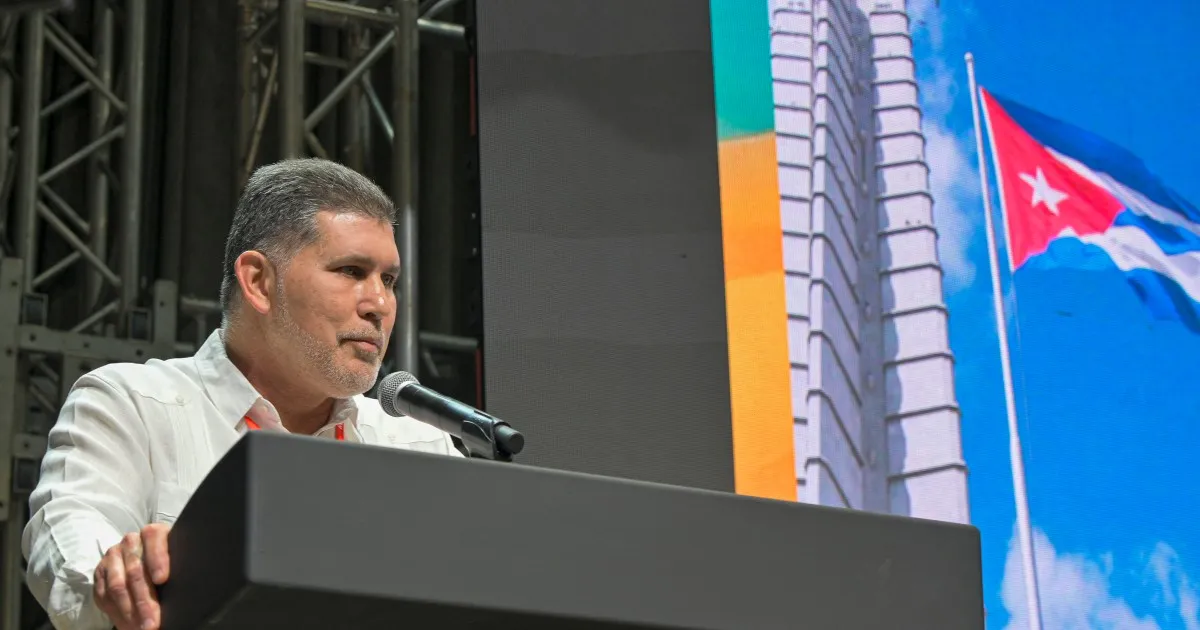
MIAMI.- As we had announced before, Oscar Pérez-Oliva Fraga, Minister of Foreign Investment of Cuba, made this Monday, March 16, a call to the Cuban diaspora to invest in the island. The information was offered at a press conference to foreign media accredited on the island, although Cubadebate has not yet reported it.
The information was obtained by DIARIO LAS AMÉRICAS from a source on the island who asked not to be identified and which demonstrates the desperate race in which the regime’s officials find themselves in the face of the imminent decision by the US that although they publicly deny, they are aware that it is a fact that cannot be postponed.
The public appearance of Miguel Díaz-Canel was the recognition of the contacts that have been taking place between Washington and Havana, about which information had been leaked from various sources and the US president had also referred to repeatedly, although Cuba, through its president and Foreign Minister Bruno Rodríguez himself, denied it until a few days before admitting it.
The possibility of Cuban exiles investing capital in Cuba is an alternative that Cuban rulers have appealed to on other occasions. In fact, some investors have tried it and there is a long history of testimonies that refer in the first instance to an inefficient legal framework that offers guarantees for investment, as well as a great divorce between the nature of the economy controlled by the State and the free market system from which private investments are nourished for their development.
An irreconcilable bond
The entrepreneurial and small business practice in Cuba has constituted a true chimera for those who have taken the initiative and have joined different moments in which the dictatorship has made threats to allow it.
Those who follow the course of Cuban reality will remember the stage of approval of self-employment in the 90s, after the fall of socialism in Eastern Europe and with the beginning of the so-called special period in Cuba, with which free peasant markets and the emergence of small private restaurants (paladares) were admitted. These initiatives, which at the time constituted a real alternative for food options, ended up being the pretext for a crusade of confiscations and judicial proceedings against their executors.
There have been other moments of approval for private initiative, generally coinciding with the worsening of the systemic economic crisis in Cuba that have barely served to alleviate popular discontent.
One of those moments was seen with the reforms adopted in 2010, when self-employment was accepted and expanded, with the authorization of more than 200 private activities.
Another, occurred in 2021 when the so-called MYPIMES (micro, small and medium-sized enterprises) were recognized.
However, in the Cuban State’s attempts to admit the private sector, three essential characteristics have prevailed: strategic sectors continue to be reserved solely for state control, strong regulation, and limitations on financing and foreign trade.
Drowned kicks
Returning to the words spoken by Díaz-Canel about the talks with the United States, the president referred to the fact that the dialogue sought a solution to the differences between both states and solutions to the problems of both peoples (Cuban and American).
Díaz-Canel knows, although he refuses to admit it, that, at this point, the only probable dialogue would be focusing on the analysis of an exit of the entire ruling leadership of the power apparatus in Cuba. If the deadline given by Trump does not end before then and the exit is carried out in a forced manner. Maduro in Venezuela is an illustrative example.
They look for time and repress
The repressive acts committed by police and special troops against the civilian population in the midst of the citizen protests that are taking place these days due to the energy collapse, demonstrate why the regime is seeking to buy time.
While Díaz-Canel from a platform urges the United States to dialogue and find solutions, the Cuban population, in addition to suffering all kinds of hardships, is also the target of the most brutal repression: religious leaders are arrested, independent journalists are prevented from leaving their homes, police summonses are sent to those who demonstrate against arbitrariness and they use physical force and shoot weapons in demonstrations and make arrests.
The lure of emigrants
This Sunday, President Trump resumed his promise to find a solution for Cuba and, in parallel, the Havana dictatorship, which is debating between all possible options to postpone its permanence in control of the country, prepares its Minister of Foreign Investment with a proposal that would urge free Cubans to invest dollars in a collapsed country.
The capital investment, to which many Cuban businessmen and entrepreneurs would be willing in their country of birth, will surely be made and in an unimaginable way once the recovery of Cuba, for all Cubans without distinction, becomes a tangible reality.
@IlianaLavastida
