
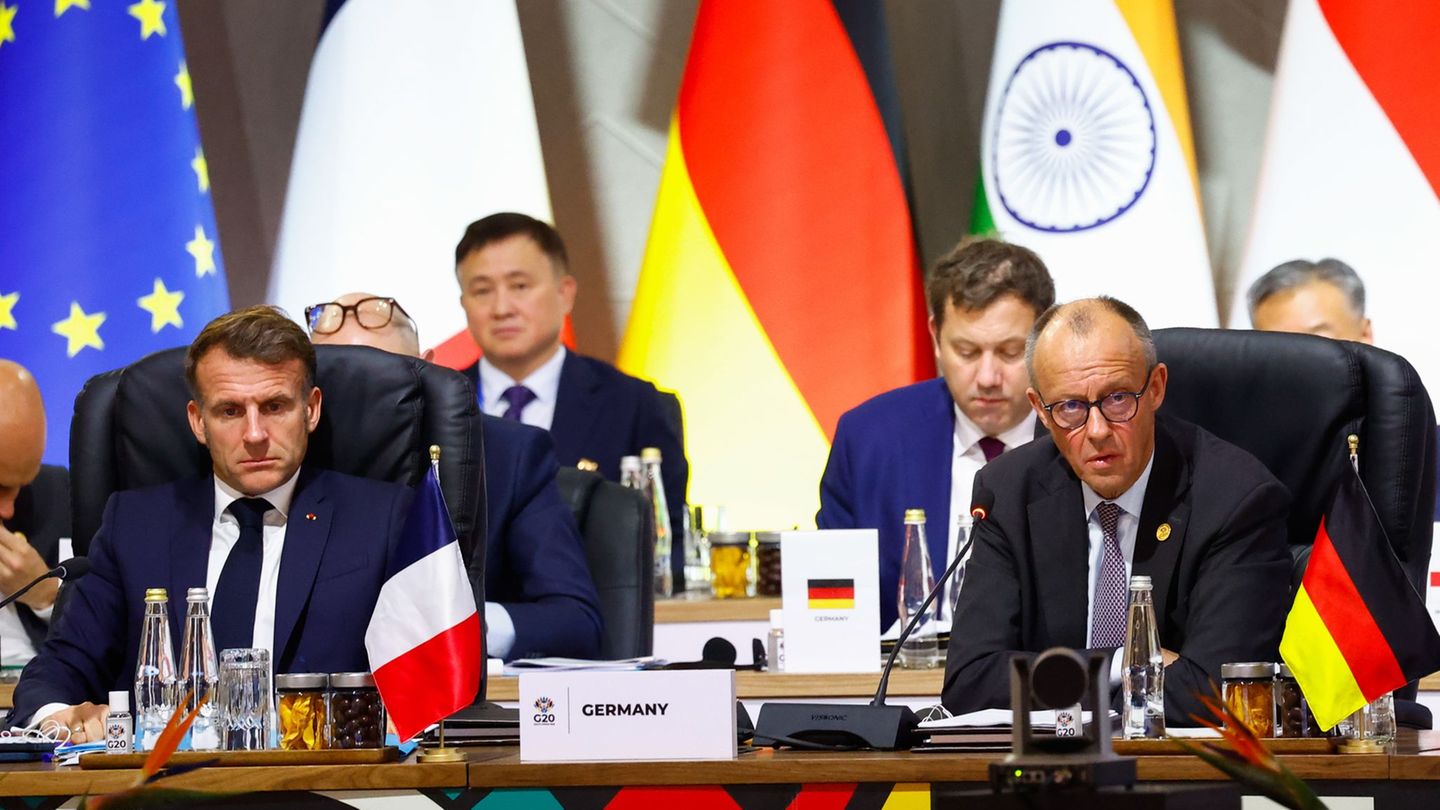
The seriousness of the situation can be heard when Chancellor Friedrich Merz (CDU) appears in front of the cameras at the G20 summit in Johannesburg. Shortly beforehand, he discussed US President Donald Trump’s peace initiative with European heads of state and government. About the plan that shocked not only Ukrainian President Volodymyr Zelensky, but also his European allies. Japan and Canada join in. Basically everyone who doesn’t want to let Ukraine down in the crucial phase of the defensive battle against Russia has come together.
It’s about perhaps getting the peace plan, which is simply unacceptable for Ukraine, on the right track. And all this under massive time pressure. Trump wants a result by Thursday. His proposal, for example, stipulates that Ukraine cede previously defended areas to Russia, limit its military capabilities and that NATO declare a renunciation of any expansion. That would be tantamount to surrender.
Forced surrender, dictated peace?
For the Europeans, dealing with the American plan is a high-risk balancing act. They see the great risk that the security situation could become even worse for them if far-reaching concessions are made to the aggressor Russia.
At the same time, many heads of state and government are confronted with war-weary voters at home who are increasingly questioning the costly support for Ukraine. The European Union and the member states have now mobilized almost 190 billion euros.
It is also viewed critically that since travel restrictions were relaxed, numerous young Ukrainian men have left their homeland for the EU in order to avoid being drafted into military service. The question is why should we continue to support the country if not even young Ukrainians want to fight for the future of their country?
Hardly any leverage against Trump
The problem for the Europeans is that they have little leverage against US President Trump. A number of top politicians have openly admitted in the past that attempting to support Ukraine without the United States would probably be futile. Quite simply because the necessary military capabilities were lacking. For example, American Patriot air defense systems are considered indispensable for the foreseeable future in defending Ukrainian airspace against Russian drones and missile attacks. The same applies to US intelligence information and long-range rocket launchers.
In addition, the costly and risky nature of attempting it would probably be very difficult to convey to the population in many countries. Within the EU, far-reaching plans for more support for Ukraine can no longer be implemented because they require unanimous approval and block countries like Hungary and Slovakia.
Europeans want to make Trump change his mind
The Europeans now want to try to convince Trump that implementing this plan would also be extremely dangerous for America. They can argue, for example, that it could motivate China to forcibly annex Taiwan.
There is hope that things could go like they did in the summer. Even then, after the personal meeting between Trump and Russian President Vladimir Putin in Alaska, there was already great fear that Ukraine would be forced to agree to a peace treaty. But the Europeans then managed to get Trump to change his mind. A planned second meeting in Budapest has not yet taken place. Instead, Trump even imposed new sanctions on Russian energy companies.
Contradictions in the authorship of the plan
The night saw an unusual public disagreement over the authorship of the plan. Two US senators said that Secretary of State Marco Rubio informed them in a phone call that the plan did not originate in Washington. Republican Senator Mike Rounds said the plan was brought to the US government by a Russian representative. Nonpartisan Senator Angus King, citing the conversation with Rubio, said the plan was “essentially the Russians’ wish list.”
A short time later, the minister contradicted them on Platform X and emphasized that the USA was the originator of the plan. This serves “as a solid framework for the ongoing negotiations”. It was created by the USA and was based on “suggestions from the Russian side, but also on previous and current contributions from Ukraine,” wrote Rubio.
First contact on Sunday
But what exactly happens next? Today marks the first direct contact between the US and Ukraine and their key European allies at the level of foreign policy advisors to the heads of state and government. Merz’s top diplomat Günter Sautter is traveling to Geneva for Germany. The National Security Council had previously met in the evening under the chairmanship of the Federal Chancellor on the subject of Ukraine, as government spokesman Stefan Kornelius announced. Great Britain and France are also there in Geneva, as are the EU Commission and probably Italy too.
After this meeting it will be clearer whether there are chances to put the US peace initiative on a broader foundation that the Europeans can also support. They go into the meeting prepared and sent proposed changes to Washington on Saturday.
So there are two documents on the table when negotiations begin in Geneva on Sunday. Then there are only four days left until the deadline set by Trump. There was a glimmer of hope on Saturday evening. In Washington, Trump said no to a reporter’s question as to whether his peace plan was the last offer. “We’re trying to end this one way or another,” he added.
