
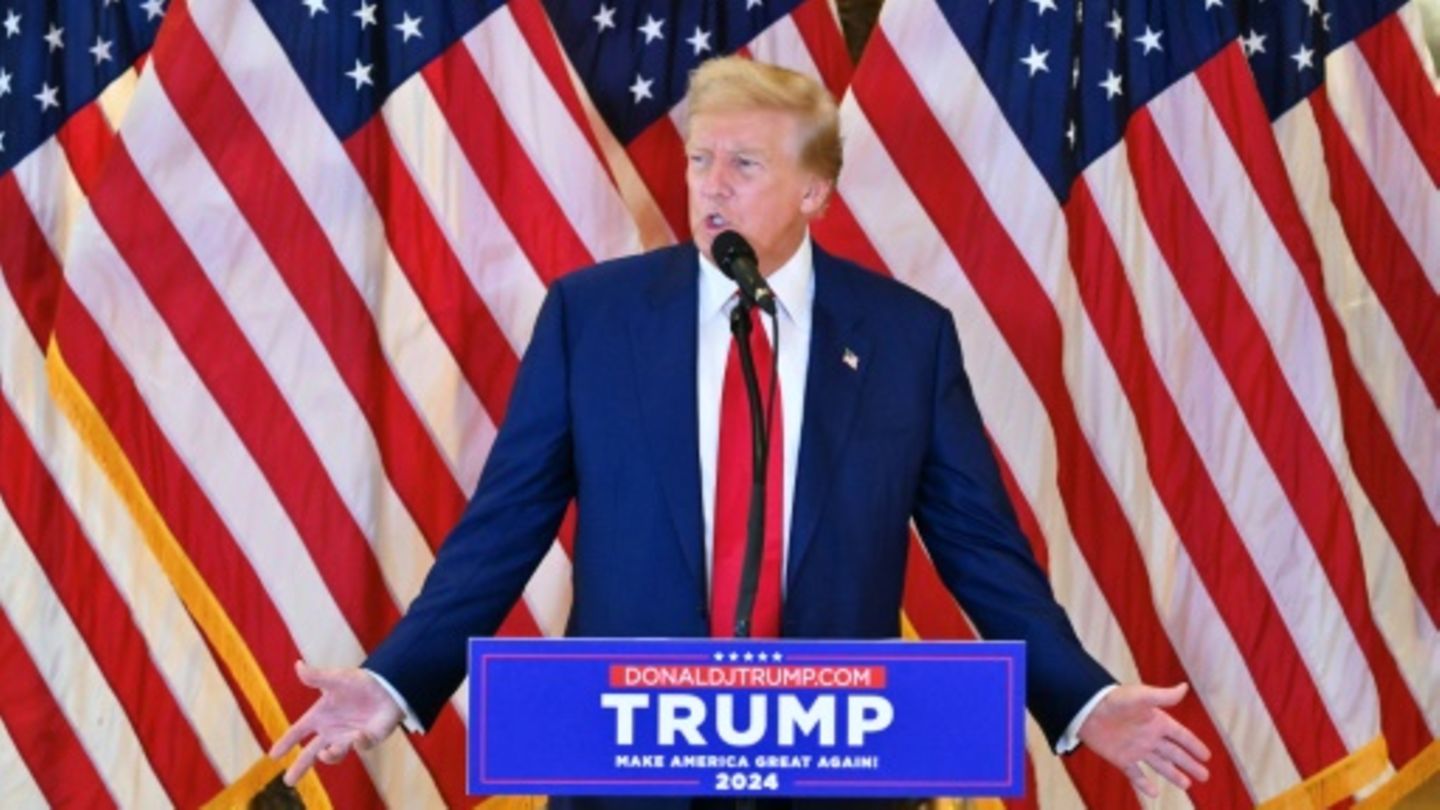
The decision of the US Supreme Court in favor of partial immunity for presidents has had its first consequences for the legal disputes of former head of state Donald Trump: In the New York hush money trial against the right-wing populist, the judiciary postponed the announcement of the sentence from July 11 to September 18 – “if this is still necessary,” as Judge Juan Merchan wrote on Tuesday. The postponement is intended to give the court time to take into account the Supreme Court’s ruling on Monday.
In the hush money trial on May 30, the jury found Trump guilty on all 34 counts of concealing a hush money payment to former porn actress Stormy Daniels by falsifying business documents. Trump is thus the first former US president in history to be convicted of a criminal offense.
However, in a decision announced on Monday, the Supreme Court granted Trump, who is embroiled in various legal disputes, partial immunity. It ruled that official acts by US presidents are protected against subsequent prosecution, but “unofficial” acts are not.
Shortly afterwards, Trump’s lawyer Todd Blanche wrote to the judge asking for permission to challenge the guilty verdict and to postpone the sentencing hearing. Senior prosecutor Alvin Bragg said he would not oppose a postponement of the hearing – but he considered Trump’s arguments to be “unfounded.”
A prison sentence for the 78-year-old, who wants to run against incumbent Joe Biden in the presidential election in November in a repeat of the 2020 duel, is considered unlikely. Since Trump is being convicted of a criminal offense for the first time and it is not a violent offense, experts expect a suspended sentence or a fine.
Trump’s lawyers, however, want to achieve a complete annulment of the guilty verdict. In a post on his online network Truth Social, Trump wrote on Tuesday that the effects of the immunity ruling were “a loud and clear signal for justice” in the USA.
However, the Supreme Court did not grant Trump complete immunity for all of his actions during his time as president. The court expressly excluded from protection against prosecution those actions that are of an “unofficial” – i.e. private – nature.
The hush money of $130,000 (around €122,000 today) was paid to Stormy Daniels before Trump took office in the White House. However, it was paid by Trump’s then-lawyer Michael Cohen, who, according to the indictment, was later reimbursed by Trump when he was already president.
Law professor Asha Rangappa of the elite Yale University expressed the view that the conduct for which Trump was convicted appears to be “far removed from his official duties.” However, the Supreme Court provided only very limited guidance in its decision, so it is “difficult to know what counts and what doesn’t.”
Specifically, the Supreme Court’s decision also related to another case, namely the indictment of Trump in federal court for his attempts to retroactively overturn his 2020 election defeat to Biden.
Following this decision, Rangappa said, not only is it impossible to prosecute a president for his official actions while in office, but “if a conduct is official, you cannot even use it as evidence, motive or intent for another crime,” Rangappa said.
This aspect of the ruling will have an impact on the trial on the allegations of election manipulation, said law professor Steven Schwinn of the University of Illinois at Chicago: It will “significantly hinder the prosecution from proving that Trump’s unofficial conduct was illegal.”
The lawsuit against Trump concerns, among other things, his role in the storming of the Capitol in Washington in January 2021. Special Counsel Jack White, who brought the charges against the US President, had already taken the view before the Supreme Court decision that at least part of the charges concerned “private” and unofficial actions.
The trial was supposed to begin in early March, but was suspended due to the unresolved immunity issue. Now everything suggests that the trial will not begin before the presidential election in November.
