
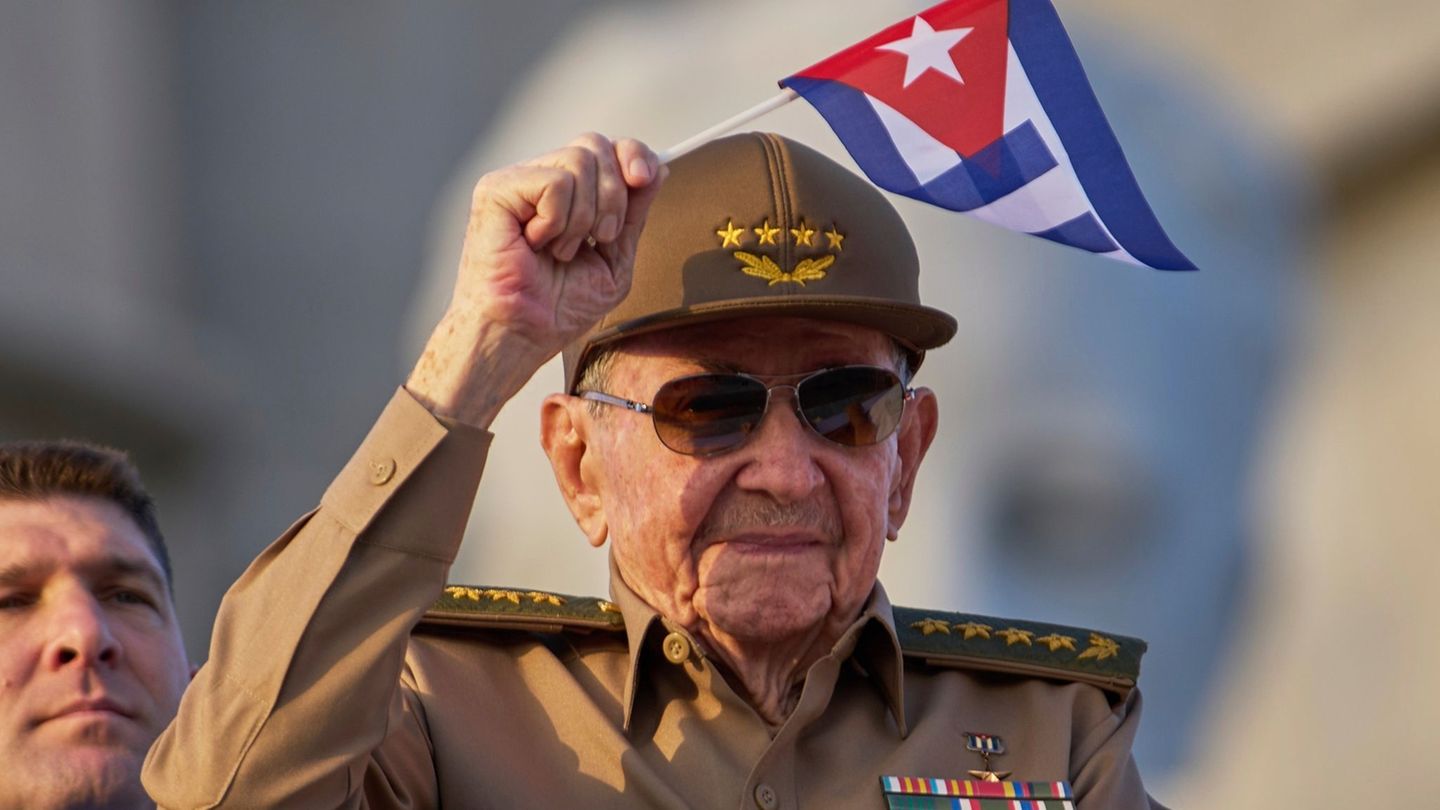
The US government has announced a lawsuit against Cuba’s former head of state Raúl Castro. According to acting Attorney General Todd Blanche, the 94-year-old is accused of involvement in the shooting down of planes by Cuba’s air force in 1996, in which Americans died.
Raúl Castro and others are accused of, among other things, destroying one or more aircraft and four murders. According to the information, Raúl Castro, as defense minister at the time, is said to have overseen a chain of command that led to Cuban warplanes firing on civilian aircraft over international waters.
As Blanche said, a grand jury approved the indictment in April. Today the responsible federal court in Florida published the document. He emphasized that Raúl Castro should come to the USA for his trial – no matter how. “We expect that he will come here either voluntarily or through some other means,” Blanche said in Miami. He did not provide any further information.
Tensions between Washington and Havana are likely to worsen significantly as a result of the move – at a time when the USA is already putting the island state under heavy pressure with takeover threats and sanctions.
The communist government in Havana also immediately rejected the lawsuit: “It is a political action without any legal basis, which only aims to create a pretext to justify the madness of military aggression against Cuba,” wrote Cuban President Miguel Díaz-Canel on Platform X.
The role of Raúl Castro in Cuba
After the victory of the revolution in 1959, Raúl Castro was defense minister for almost 50 years before replacing his ailing brother Fidel Castro at the head of state. He initially took over the office of president provisionally in 2006, then officially from 2008 to 2018. After leaving his post, he remained at the head of the Cuban Communist Party until 2021.
As the younger brother of the historic revolutionary leader Fidel Castro and one of the last representatives of the generation of revolutionaries, he is still influential. He is considered a key figure working behind the scenes in President Díaz-Canel’s government and, as a former defense minister, is well connected in the powerful military. In Cuba, the army controls much of the economy.
When the Cuban Air Force shot down two planes belonging to the then active Miami-based Cuban exile organization “Hermanos al Rescate” (Brothers to the Rescue) on a flight off the Cuban coast in 1996, Raúl Castro was defense minister. According to the government in Havana, the planes had entered Cuban airspace at the time. The International Civil Aviation Organization, however, concluded that they were over international waters. Three of the four fatalities were US citizens – relations between the US and Cuba deteriorated significantly because of the incident.
A few months ago, several US members of Congress wrote a letter to the US government calling for charges against Raúl Castro. Your accusation: He ordered the shooting down as the defense minister at the time.
The parallel with Venezuela
The fact that the USA is now actually taking steps to prosecute Raúl Castro brings back memories of its actions against Venezuela’s ousted head of state Nicolás Maduro. President Donald Trump’s government justified Maduro’s capture by US special forces in Venezuela earlier this year, among other things, by indicting the autocrat. He is to be tried in New York for alleged involvement in drug trafficking.
Is there a threat of a US military attack in Cuba similar to that in Venezuela? In the US media, various experts have their say who consider this to be rather unlikely.
The accusation as a means of pressure and symbol
Frank Mora, a former high-ranking defense official who now teaches on Cuba at Florida International University, among other things, described the indictment to the New York Times as a “psychological operation.” It’s more about stirring up fear in the Cuban power apparatus in order to intimidate the leadership in Havana. The charges were not yet officially known at the time of Mora’s statements, but various US media already had information about them.
Brian Fonseca, a national security and foreign policy expert at Florida International University, also sees the charges as part of a campaign of systematic pressure on the Cuban leadership, as the Miami Herald newspaper reports. “The indictment is symbolic; it stands to indict one of the archenemies of the Cuban-American community and the architect of the failed Cuban revolution,” the newspaper quoted him as saying last week.
Cuba policy under Trump and Rubio
Relations between the two countries have been tense since the 1959 revolution. With the start of US President Donald Trump’s second term in office, the situation has worsened again: The US government put the island state ruled by the Communist Party back on a US terror list – and has been increasing pressure for months to force economic and political change there in the interests of the US.
Trump also brought up a takeover of Cuba several times. He described the socialist Caribbean island as a failed state and, after the military operations in Venezuela and Iran, threatened: “Cuba is next.”
His Foreign Minister Marco Rubio – the son of Cuban immigrants – has also long been hoping for a change of power in Cuba. He is considered the mastermind behind Trump’s Cuba policy.
Discussions have been underway between Washington and Havana for several months, the content of which has not yet been made public. According to media reports, a grandson of Raúl Castro is said to play a central role. Raúl Guillermo Rodríguez Castro, also known as “Raulito” or “the Crab”, is considered his grandfather’s closest confidant.
The situation in Cuba
Cuba is suffering from the worst economic crisis in decades. The situation is made worse by a massive energy shortage because the US government has imposed an oil blockade on the island nation since January. The power goes out there again and again for hours, sometimes nationwide, and there is a shortage of fuel, food and many other daily necessities.
At the same time as the announcement of the indictment in the USA, commemorative events for Raúl Castro’s 95th birthday on June 3 were announced in Cuba. Numerous government posts on Platform
