
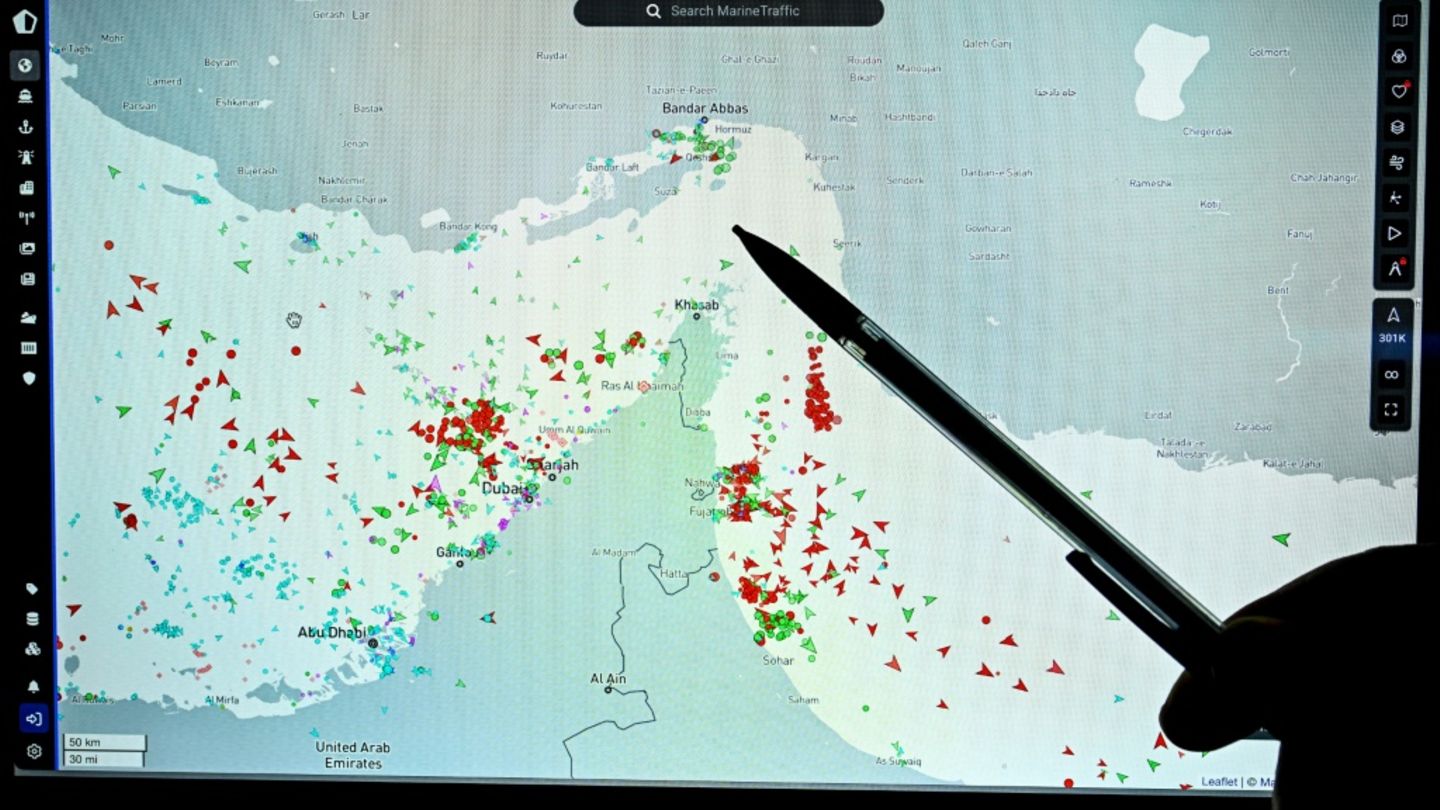
US President Trump had called for an international naval operation to secure the strategically important Strait of Hormuz, which is currently de facto closed due to the risk of Iranian attacks on merchant ships. Trump also called for NATO to participate and threatened the alliance with unspecified consequences if it did not provide support.
However, the federal government categorically rules out the participation of the German Navy in such a mission. “We are not taking part in this war, we have said that from day one,” said Chancellor Friedrich Merz (CDU) in Berlin on Monday. This no also applies to military security of the Strait of Hormuz.
The general manager of the Association of German Shipowners (VDR), Martin Kröger, told the “Rheinische Post” that, from his industry’s point of view, it was “not about German participation in the war, but about supporting international efforts to protect merchant shipping, at least politically and diplomatically.”
As a large trading nation, Germany has a fundamental interest in safe sea routes. “Anyone who wants a reliable supply for the economy and the population must not leave alone those who make trade by sea possible, sometimes at great risk,” warned Kröger.
CDU defense politician Bastian Ernst called it “wrong” that the federal government is ruling out the possibility of a Bundeswehr deployment. In the “Zeit” he made it clear: “We will not take part in the war.” However, the Federal Republic, for which international maritime trade is so important, should “make its own contribution to clarifying the situation in the Strait of Hormuz.”
In this context, Ernst spoke out in favor of expanding the EU naval mission Aspides in the Red Sea. In this context, “we could rely on Bundeswehr reconnaissance forces that are already in the region,” he argued. However, the EU foreign ministers ruled out expanding the naval mission at their meeting in Brussels on Monday.
Union Parliament Secretary Steffen Bilger (CDU) viewed statements like those by defense politician Ernst as individual opinions. The federal government’s line has “very broad support” in the Union parliamentary group, said Bilger in Berlin. He expects “no controversial debate” among the CDU and CSU on this issue.
The CDU foreign politician Roderich Kiesewetter also defended the position of Germany and other EU states not to take part in the Iran war. On Bayerischer Rundfunk, Kiesewetter said that Europeans should not allow themselves to be intimidated, but rather “act even more confidently.” For Europe, protecting Ukraine must be a priority.
The SPD foreign policy expert Adis Ahmetovic said in a podcast on the Politico portal that Germany “will not take part” in this war. This also applies – “as long as it’s running” – to a security mission in the Strait of Hormuz.
Green parliamentary group leader Katharina Dröge said in Berlin that her party supports the federal government’s stance. German military involvement in the Iran conflict “does not make sense.”
