
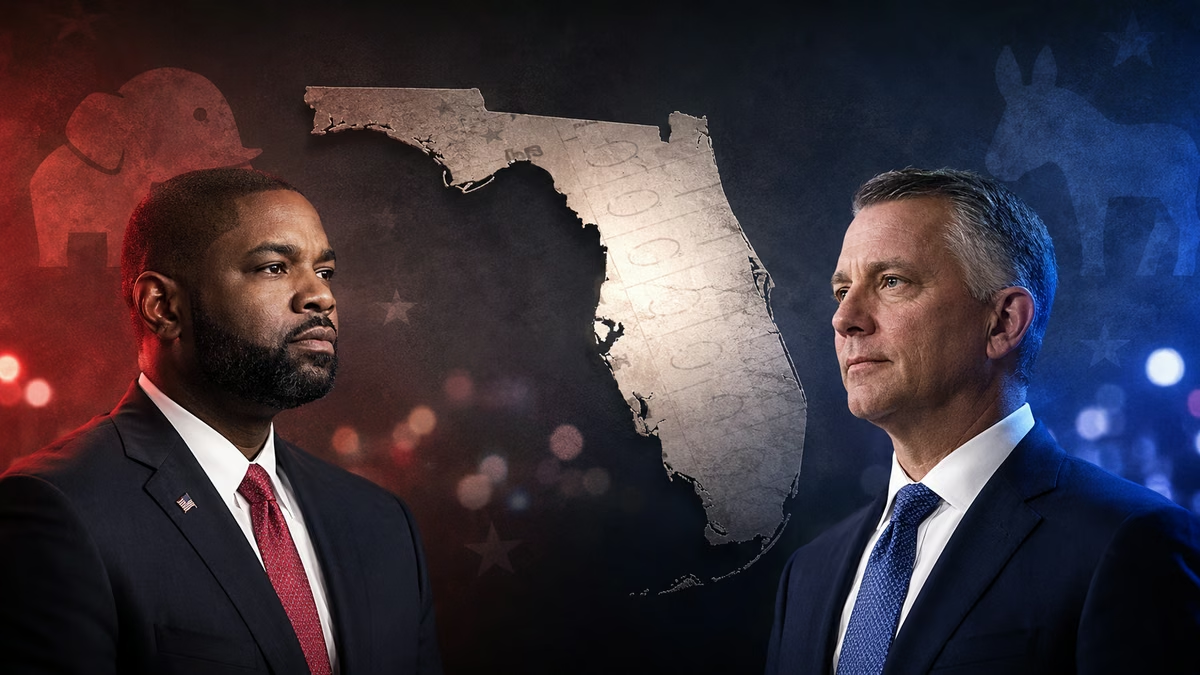
MIAMI.— Republican Byron Donalds would maintain an advantage of eight percentage points over Democrat David Jolly in the race for governor of Florida, but the panorama changes among Latino voters, who would favor the opposing candidate two weeks before the elections.
A survey by YouGov and N+ Univision places Donalds with 50% voting intention among the state’s registered voters, compared to 42% for Jolly. Another 8% remain undecided, a proportion enough to change the margin, although not necessarily to change who occupies the first position.
The Nov. 3 election will determine the successor to Gov. Ron DeSantis, who is constitutionally barred from seeking a third consecutive term. Donalds is trying to prolong Republican dominance over the state executive, while Jolly is trying to become the first Democrat elected governor of Florida since 1994.
Jolly advances among Hispanics
Among the Hispanic electorate, Jolly obtains 48% and Donalds 43%, while 9% still do not define their preference. The difference is close to the margin of error of the sample, although it exposes a much closer competition than that observed in the state as a whole.
The Hispanic vote does not constitute a uniform bloc either. For example, Cubans favor Donalds by 51% compared to 42% for Jolly. Among Puerto Ricans, the relationship changes considerably: 51% support the Democrat and 35% the Republican.
Likewise, voters of South American origin present the most balanced race, with 47% for Jolly and 44% for Donalds. Additionally, 84% of Latinos who voted for Donald Trump in 2024 continue to support the Republican candidate for governor.
These figures suggest that Jolly’s advantage among Hispanics comes mainly from Democratic voters, independents and some voters who have distanced themselves from the current Administration, not from a general break among Latinos who supported Trump.
Immigration and cost of living
The survey shows that 55% of Latinos consider that the application of immigration policies has gone too far. The proportion includes people who support a safer border, but question the way arrests and operations are carried out.
Concern crosses communities: this opinion is shared by 54% of Cubans and 56% of Puerto Ricans and South Americans consulted. Additionally, 41% fear that they, a family member or someone close to them could be detained or directly affected.
However, the economy retains greater electoral weight. 59% identify employment and the cost of living among Florida’s main problems; 57% mention the price of housing and 33% select immigration and immigration law enforcement.
The survey was conducted online between October 2 and 15. YouGov interviewed 825 registered voters for the state sample and used another sample of 937 Latino voters. The margins of error are approximately four percentage points.
Because they are registered voters, not exclusively probable voters, the figures measure current preferences, but do not predict participation. The ability of each campaign to mobilize its supporters during early voting and on November 3 will be decisive.
