
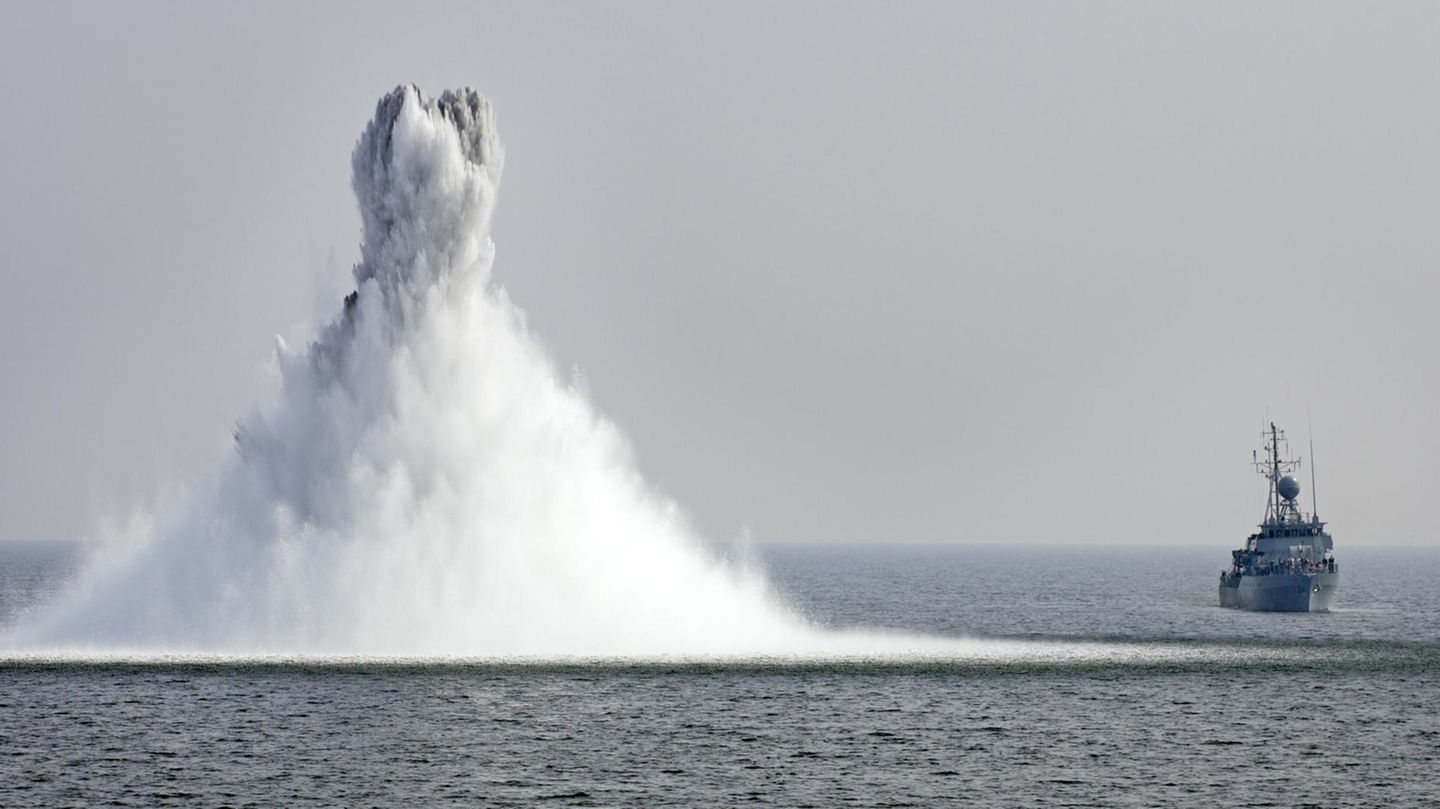
The Iranian military’s blockade of the Strait of Hormuz is driving up global oil prices. As a result, fuel prices are rising at the gas station, but other consumer prices could also rise massively – a huge problem for governments worldwide. The USA and its President Donald Trump in particular are coming under pressure because criticism and doubts about the Iran war are increasing and it is becoming increasingly obvious that the US government has made major strategic errors in its assessment of the war.
The problem is compounded by the fact that the Strait of Hormuz was (probably) mined by Iran. The fact that, according to Trump, the US Air Force destroyed 16 minelayers sounds almost ridiculous given the effectiveness of this asymmetrical weapon and the capabilities that the Iranian military has. But what makes sea mines so dangerous and how do they work? An overview.
The strategic and tactical importance
The big advantage of sea mines is that they are easy to lay and require great effort to remove. They are a perfect weapon to challenge US and Israeli military superiority by driving up the cost of war.
You don’t need highly specialized boats or ships to lay sea mines. The Iranian Revolutionary Guards are used to operating in the Strait of Hormuz with small, fast boats from the Ashura Fleet.
You probably have hundreds, if not thousands, of them. In addition, Iran was probably prepared for the attack. Since the first armed conflict in the summer of 2025 at the latest, the mullahs’ regime is said to have massively armed itself again. Iran has a plan.
What types of mines does Iran have?
According to media reports, the Sadaf-02 sea mine makes up the largest part of the arsenal. This is one anchored to the ground Contact mine (also anchor mine; see graphic below), which floats just below the surface of the water. If a ship hits it, it explodes. It is estimated that Iran has between 2,000 and 6,000 Sadaf-02 mines.
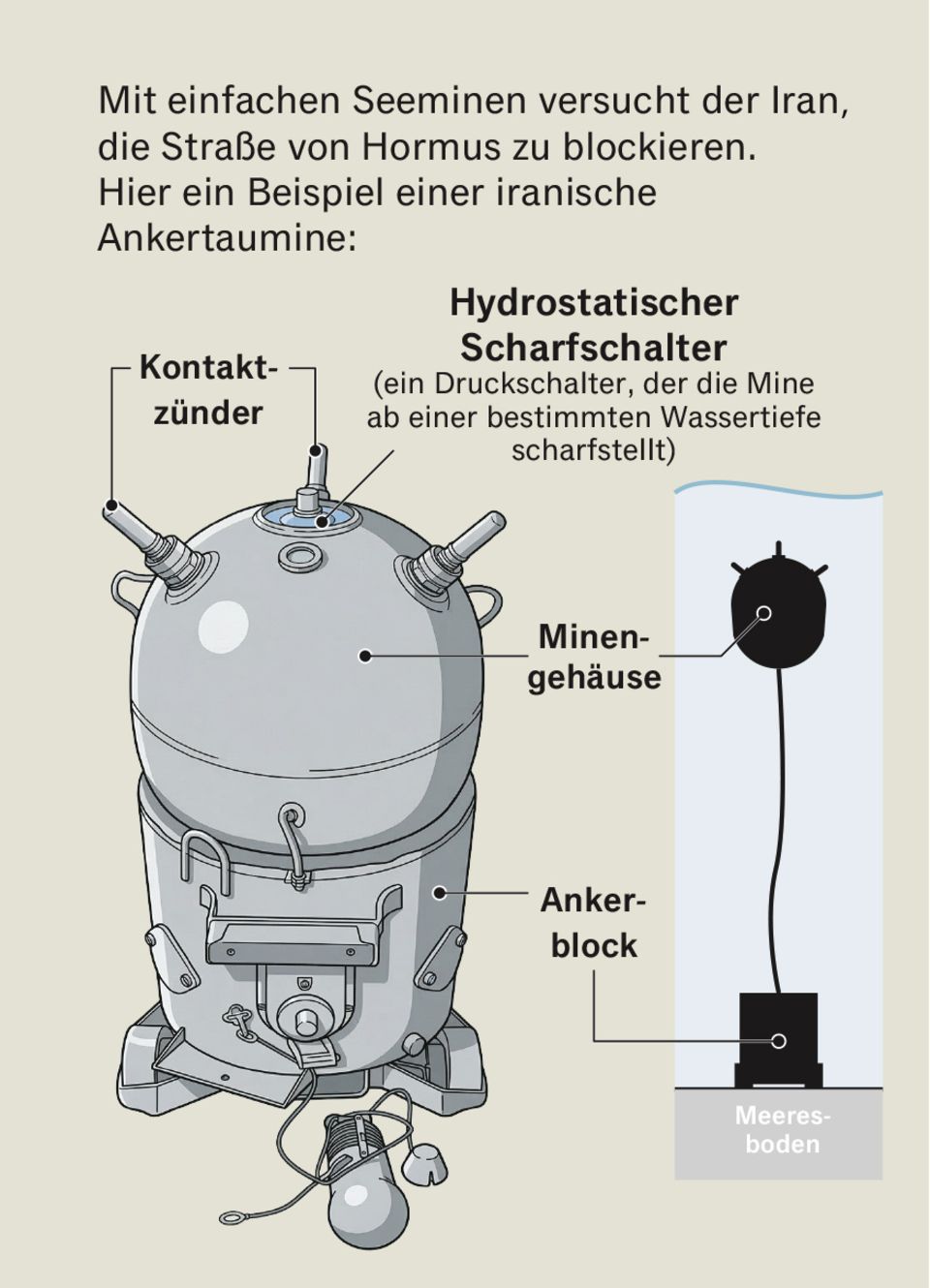
The smaller variant Sadaf-01 and the Maham-2 are also available. The latter is one Base mine. This type is usually larger and has the shape of a cylinder. Bottom mines are simply sunk on the seabed and detonated using acoustic or magnetic sensors. They are primarily intended for use in shallow waters. The explosion lifts the ship through the resulting gas bubble, then it falls down and is damaged or destroyed. Base mines can be equipped with rockets that rise. However, they are technically more complex. It is possible that Iran has the EM-52 from China.
A third type of mine is the drift mine. It floats in the water without anchoring and explodes on contact. It is unlikely to play a role in the Iran war because its use is difficult to control. Drift mines can pose a danger to your own shipping.
How can mines be cleared?
As already suggested, this is the great weakness of the US Army. Mines are detected by divers, ships or from the air. However, divers only find individual mines and cannot neutralize them across the board. The use is complex, lengthy and highly risky. In addition, the US Navy has withdrawn the old Avenger-class minesweepers from the region. They should be scrapped at home. The successor models, the Littoral Combat Ships (LCS), are considered a faulty design because they have little combat capability and, according to media reports, mine clearance technology is not installed or is missing in many ships.
Who could help?
Actually the German Navy. At least in theory. With the Frankenthal class boats, the German Navy is the world leader in mine hunting. Although they are old, they are equipped with the latest sonar technology. The only problem is that the 3rd Minesweeper Squadron is stationed in Kiel. The route to the Strait of Hormuz would take two to three weeks. In addition, deployment would be a political decision. So far, the federal government has stayed out of the war.
How could the US misjudge the situation so badly?
That’s the big question. It is likely that the president’s advisors have considered the various scenarios. Donald Trump and Secretary of War Pete Hegseth may have brushed aside concerns. One criticism of the US government is that it plunged into the war adventure haphazardly and misjudged the risk (or the enemy’s capabilities). There’s a lot to be said for that.
The fact is that by blocking the Strait of Hormuz and using mines, Iran has a means that can ultimately force the USA and Israel to give in.
Sources: “Handelsblatt”, MS Now, “Focus”, “Wirtschaftswoche”, DPA news agency
