
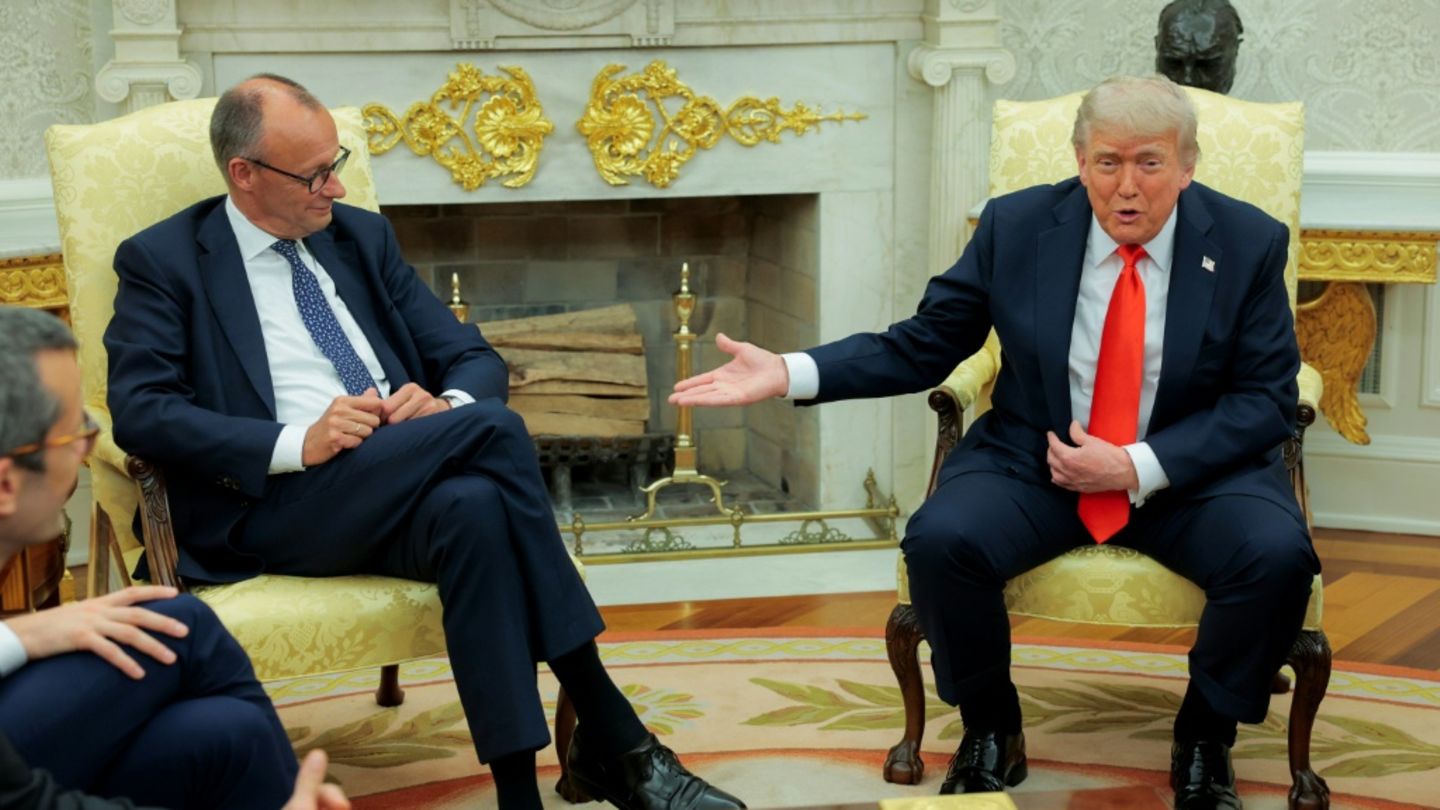
The Chancellor is flying to the USA on Monday. He will meet US President Donald Trump for a meeting in the White House on Tuesday morning (local time). Afterwards a lunch together is planned.
A week ago, the US Supreme Court invalidated most of Trump’s tariffs. The US President then replaced this with a new 10 percent special tariff on the basis of a different legal basis – and declared that he wants to increase this to 15 percent. The decision caused great uncertainty around the world about the future customs policy of the USA.
The federal government is committed to ensuring that the new surcharges “do not go beyond the 15 percent tariff cap agreed in the summer,” said deputy government spokesman Sebastian Hille, referring to the previous agreement between Washington and Brussels. After Trump’s latest tariff announcements, the EU Parliament put the implementation of previous European commitments with Washington on hold for the time being.
The federal government welcomes “the signals from the US government that it wants to comply with the agreements reached with the EU,” Hille continued. Germany wants “stability and predictability in trade relations.” Because “companies need planning security – and that applies on both sides of the Atlantic (…) Customs disputes and trade conflicts harm everyone.”
The Federal Association of Wholesale, Foreign Trade and Services (BGA) also pointed this out: “Our companies can deal with clear rules – but not with permanent uncertainty,” explained association president Dirk Jandura. The Chancellor must make it clear in the talks with Trump that Germany and the EU are prepared to “set limits” to Trump’s “erratic customs policy” and will “react decisively and together.”
The EU had already prepared counter-tariffs worth billions last year if the trade dispute with Washington escalated. They could be put into effect quickly.
Hille emphasized that a united stance in the European Union is “important.” Merz will hold talks with EU partners before the trip and “will be in Washington on Tuesday with an agreed position.”
The federal government mentioned the Russian war of aggression against Ukraine as another topic in Merz’s talks with Trump. This is likely to be about the ongoing peace talks in Geneva and Washington’s continued support for Ukraine.
The situation in the Middle East will also be a topic. Observers expected that, in addition to the situation in the Gaza Strip, it would also be about negotiations over the Iranian nuclear program, against which Washington has threatened a military strike if necessary.
Together with other bilateral, economic and security policy issues, there is “a lot to discuss,” said Hille. Merz wants to continue his “close, good contact” with Trump.
Unlike his recently completed trip to China, the Chancellor will not be accompanied to Washington by a business delegation. Hille could not yet say whether Merz will also meet US congressmen. The travel planning is still “in flux”.
It is Merz’s third visit to Washington as Chancellor. He initially traveled to Trump for his inaugural visit at the beginning of June. In mid-August, he took part in a summit on Ukraine with other European heads of state and government in the US capital.
