
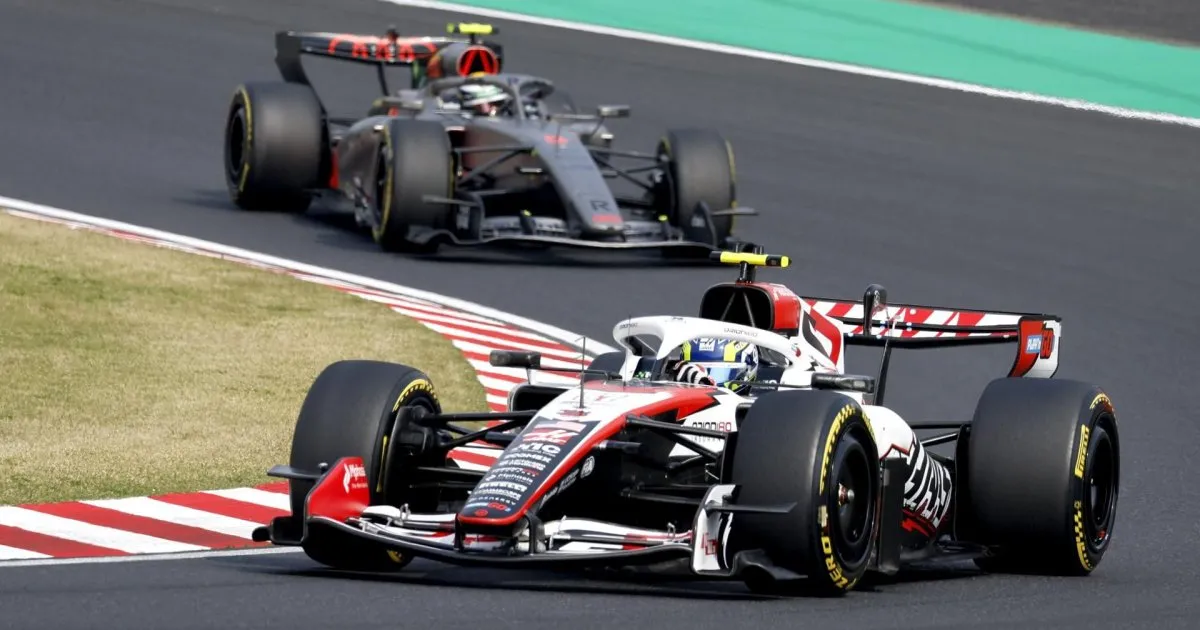
The young British man haasbarely 20 years old, suffered a bruise on his knee after a violent accident at more than 300 km/h, after encountering Franco Colapinto’s Alpine on the track, which was traveling at a considerably lower speed. The difference, according to the protagonists, was around 50 km/h.
Although Bearman avoided direct contact with the Argentine driver, he ended up losing control and crashing his car into a safety barrier. The event revived the warnings that several drivers had already made about the new technical regulations that will debut in Formula 1.
Carlos Sainz Jr warned about the danger: “We already knew this was going to happen”
One of the first to react was Carlos Sainz Jr, current Williams driver and one of the most influential voices among the championship’s riders. The Spaniard was blunt in pointing out that this type of situation had already been anticipated within the paddock.
“We had warned that these types of accidents were going to come, one day or another,” Sainz said after the race.
The Madrid native also left a reflection that increased concern within the category:
“Fortunately, there was an escape route, but imagine an accident like this against a wall in Baku, Singapore or Las Vegas.”
His comment focused on the urban Formula 1 circuits, where escapes are minimal and the margin for error is practically non-existent.
Oliver Bearman pointed to the new rules for hybrid engines
After the accident, Oliver Bearman confirmed that he was “perfectly fine”, although he acknowledged that the situation in Suzuka was directly influenced by the new technical characteristics of the cars.
The Haas driver explained that the large speed difference between his car and Colapinto’s was due, at least in part, to the new rules that regulate the distribution of power between the thermal engine and the electrical system.
“You have to get used to it, but I have the feeling that I didn’t have enough space on the track taking into account the enormous difference in speed,” said the Briton.
The statement fueled a debate that had already been growing since the preseason: whether the new power unit concept could compromise safety in full competition.
Why 2026 hybrid engines generate so much controversy in Formula 1
The new FIA regulations for 2026 establish an engine configuration much more dependent on hybrid energy. In general terms, the power will be divided in a more balanced scheme between the internal combustion engine and the electrical system, with a much greater role for the battery.
The intention of the International Automobile Federation (FIA) is to promote a more efficient, modern Formula 1 and aligned with the future of the automotive industry. However, several teams and drivers consider that the system can generate dangerous situations on the track.
The main problem lies in the management of electrical energy. The cars will have special modes for overtaking, such as the boost system or overpower mode, but using it excessively can empty the battery and cause an abrupt loss of speed on a straight line.
That scenario, precisely, was one of the most criticized points after the Bearman accident: a car can go from being competitive to being extremely vulnerable in a matter of seconds.
The risk in the race: suddenly slower cars and more dangerous overtaking
The big concern within the paddock is that these new cars can generate very marked speed differences between cars that share the same track at the same time.
In a race, a driver could activate all his electrical power to attack or defend position, but then be forced to reduce the pace to recover energy. That would open the door to delicate situations in fast areas, especially in circuits such as:
Suzuki
Baku
Singapore
vegas
Monaco
On all of these routes, a car with a lower top speed can become an extremely difficult obstacle to anticipate for whoever is following at maximum speed.
The FIA has already made adjustments, but the debate is still open
Before the Japanese Grand Prix, the FIA had already communicated some adjustments in the management of electrical power during the qualifying sessions, trying to correct certain imbalances detected in the first dates.
However, the entity itself recognized that making career changes requires a much deeper analysis.
As expressed by the organization, any additional modification on the use of electrical energy in competition requires:
- detailed technical simulations
- engineering evaluation
- security analysis
- and consensus between the parties involved
This makes it clear that the problem is not minor and that Formula 1 could be facing one of the most important technical debates in recent years.
Formula 1 could use April to review the regulations
According to versions circulating within the category, the FIA, Formula 1, the teams and the drivers would take advantage of the month of April to hold key meetings on this topic.
The window would open due to the cancellation of several scheduled appointments in the Gulf region, freeing up time on the calendar to discuss possible solutions.
Among the points that could be put on the table are:
a new distribution of electrical energy in the race,
adjustments to the recharging system,
changes in the use of overtaking mode,
and measures to reduce speed differences between cars.
Franco Colapinto, involuntarily at the center of the action
Although he was not directly responsible for the accident, Franco Colapinto was involved in one of the most talked about images of the weekend in Japan.
The Argentine from Alpine was traveling at a slower speed when Bearman came thrown from behind, which generated a extreme maneuver that ended with the Haas against the protections. The scene was a clear example of the problem that many fear for the immediate future of the category.
For Colapinto, the episode also represents a warning sign about the type of situations that could be repeated if corrections are not introduced in the regulations.
Safety returns to the center of the debate in F1
Formula 1 has invested for decades in improving driver safety, with huge advances in impact structures, barriers, helmets, halo and medical protocols. However, the Suzuka accident reminded us that not all risks come from the design of the car or the circuit: they can also arise from the regulations themselves.
The Oliver Bearman case in Japan left an open question that is now shaking the paddock:
Is F1 really prepared to compete with this new hybrid concept without increasing the risk on the track?
For now, the FIA will have to listen to drivers, teams and engineers to decide whether to maintain the current course or make changes before an even more serious incident occurs.
