
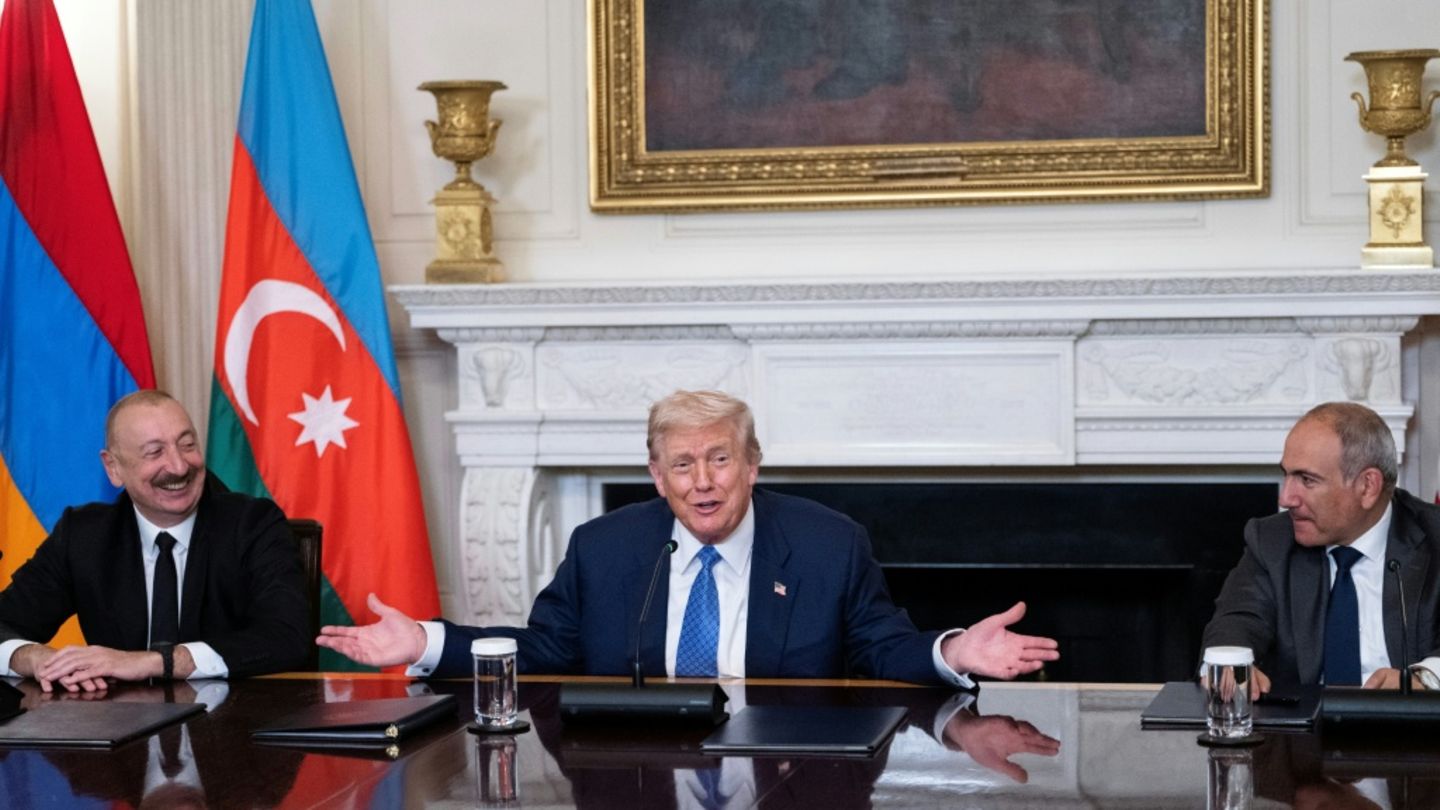
Armenia’s Prime Minister Nikol Paschinjan and Azerbaijani head of state Ilham Alijew had signed a declaration of peace in the White House on Friday and at the same time brought Trump into play for the Nobel Peace Prize. “Armenia and Azerbaijan undertake to hire all fights forever, to resume trade, travel and diplomatic relationships and to respect the sovereignty and territorial integrity of each other,” said Trump.
Paschinjan spoke of a “historical” agreement of the states that were hostile for decades. “Today we create peace in the Caucasus,” added Alijew. He also offered to propose the US President for the Nobel Peace Prize together with Paschinjan. “Who, if not President Trump, deserves the Nobel Peace Prize?” said Alijew. Paschinjan agreed with: The “breakthrough” would not have been possible without Trump.
Alijew and Paschinjan would now have a “great relationship”, said Trump. “If there is a conflict, you will call me and we will clarify that.” Alijew and Paschinjan shook their hands under the benevolent looks of the US President.
All three politicians then signed the document, which the White House described as a “common explanation”. It was initially unclear how binding under international law – and to what extent the document coincides with a peace agreement that the two states had already agreed on in March.
It is apparently planned, among other things, that Azerbaijan can create a corridor through the Armenian area to his exclave Nachitschewan. In the run-up to the ceremony in the White House, Trump’s vice spokeswoman Anna Kelly had said that the transit strip should bear the name “Trump-Straße for international peace and prosperity”. The United States would have economic development rights for the corridor in the strategically important and raw -rich region.
Baku has long been striving to connect its territory to Armenia, Turkey and the Iran -bordering exclave afternitchewan. However, the connection would cut the access of Iran to Armenia – accordingly there is a lot of harsh reaction in Tehran.
Iran will not allow the creation of such a corridor, explained a consultant of the spiritual head of Ayatollah Ali Chamenei. It was “an impossible idea and this will not happen,” said Ali Akbar Welajati. “With the implementation of this plan, the safety of the South Caucasus is at risk.”
On the other hand, moscow, which still has great influence in the region and is a close ally of Iran, was careful about the unification of the two earlier Soviet republics. The meeting in Washington “deserves a positive assessment,” said foreign office spokeswoman Maria Sacharova. “We hope that this step will help to promote the peace agenda.”
In particular, the agreement on the transit corridor must be “analyzed more precisely”, added Sacharova. She also pointed out that Russian troops were on site in the region.
Meanwhile, there was praise from NATO, the EU, Germany and Great Britain. A NATO spokeswoman also praised Trump’s role. Federal Foreign Minister Johann WadePhul (CDU) welcomed the agreement between Armenia and Azerbaijan as “a new chapter” in history between the two countries. The British Foreign Minister David Lammy said that the United Kingdom was ready to “support peace in South Caucasus, provided both sides adhere to their obligations”.
Turkey called the agreement “an extremely important development for the promotion of peace and stability in the region”. Ankara is a traditional ally of the Turk -Language Azerbaijan – and Rival of Iran in the fight for influence in the region. Azerbaijan also maintains good relationships with Iran’s archenemy Israel.
Armenia and Azerbaijan had waged two wars against each other in the past decades, dealing with the Bergkarabach region. In 2023, Azerbaijan brought the region under his control in a large -scale military offensive. The military operation triggered the escape of more than 100,000 people to Armenia.
