
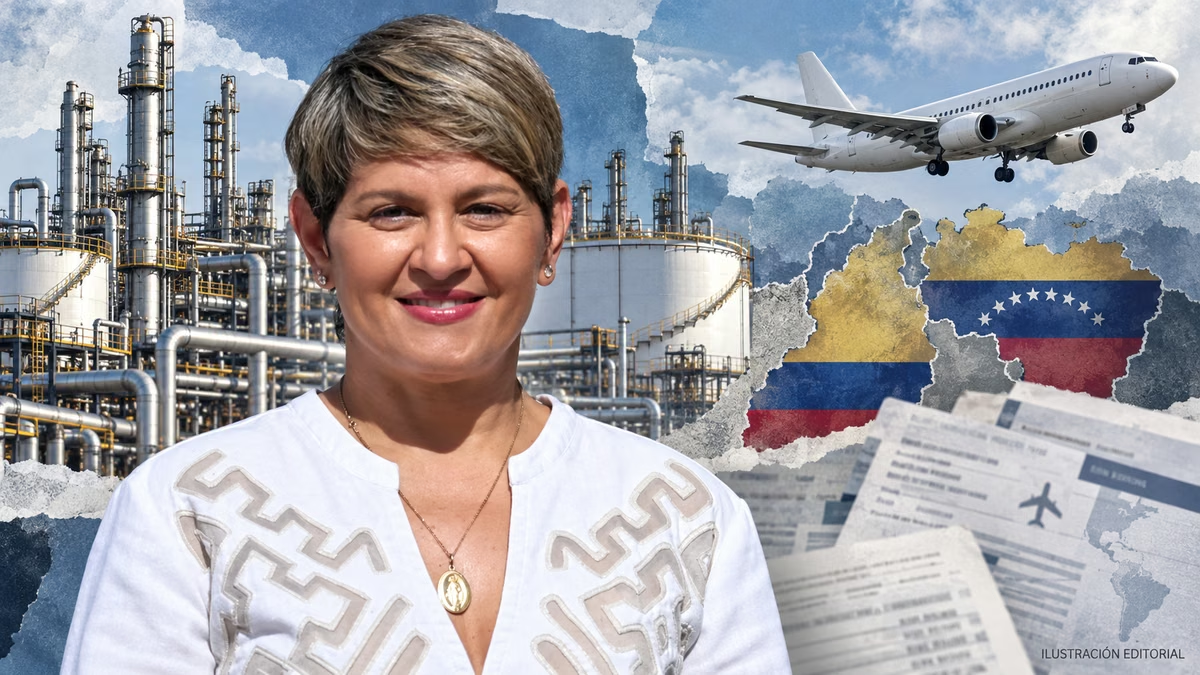
MIAMI.– The complaints about alleged interventions in Ecopetrol, the Colombian oil company with a state majority, and the accusations of a former advisor about alleged movements of drugs and money between Colombia and Venezuela have put the environment of Verónica Alcocer, wife of former Colombian president Gustavo Petro, under scrutiny. The episodes raise questions about the influence of those close to him in public decisions and the financing of his private expenses, although responsibilities and the veracity of the accusations remain to be established.
One of the questions is whether Alcocer is the person identified as “The Dancer” in information examined by the Ecopetrol audit. Consulted by Noticias Caracol on September 16, 2026, Luis Felipe Henao responded: “That is what is suspected,” and noted that it was up to the auditors and judicial authorities to establish his identity.
Separately, Eva Ferrer, a former advisor and friend of Alcocer, made accusations about alleged interventions in public entities, management of private expenses and alleged movements of drugs and money between both countries. He also spoke of possible links between people from that environment and arms trafficking. They are different signs, with scope and supports that must be examined separately.
The interview he gave to Vicky Dávila, published by the Colombian magazine Semana on October 10, put under scrutiny people who were close to Alcocer during the Government: the Catalan businessman Manel Grau; Danilo Romero, Petro’s friend; his wife, Ingrid Carolina Plata Navas; and Mario Fernández Alcocer, cousin of the former first lady.
Ferrer worked with Alcocer during the presidential campaign and later was a government advisor. He knew that environment from the inside. His testimony is relevant due to that closeness, although some of his accusations come from conversations that he attributes to third parties and require corroboration.
Questions about Ecopetrol
At Ecopetrol, the questions point to appointments, contracts and possible interventions by people outside the company. Henao reported in September that the audit had identified more than 32 cases of alleged irregularities. He mentioned possible payments for positions, maintenance contracts, gas and solar panel deals, and the Termorichal 1 and 2 projects.
He also assured that digital information and institutional chats had been preserved. This figure corresponds to the entire audit, not to cases attributed entirely to Alcocer.
A report from the Colombian newspaper El Colombiano, published on September 27, added information about “La Bailarina.” A vice president of Ecopetrol claimed to have provided data on a case related to the Vice Presidency of Supply, a Catalan businessman and the person mentioned by that nickname.
The publication also described a 43-minute recording, subjected to voice matching, in which a voice attributed to Grau boasted of his ability to intervene in appointments. Juan Carlos Hurtado Parra, who later assumed the presidency of Ecopetrol during the absence of Ricardo Roa, and an intermediary identified as “Víctor” would have participated in the meeting.
Who did Grau represent? What appointments would you have promoted and who approved them? What relationship did “La Bailarina” have with the aforementioned efforts? The audit must establish whether these conversations had consequences on specific decisions of the oil company.
Background and warnings
The warnings about some of these names have history in my columns. On October 26, 2025, in “Danilo Romero, Petro’s friend behind the power”, published in Semana, I asked to investigate Romero and Carolina Plata, and I examined their closeness to Petro and Alcocer and the questions about their relationships with the Government.
On July 26, 2026, in “To the new board of Ecopetrol: watch out for Danilo Romero, Petro’s compadre,” I insisted that his name should be considered in the review of the alleged irregularities of the oil company and its subsidiaries.
I collected the episode of Cenit, a subsidiary of Ecopetrol dedicated to the transportation and logistics of oil and fuels, and the reports on Colven Business & Corp., a company that, according to those publications, had oil businesses in Venezuela. Romero claimed to have retired from that company in 2024.
On September 20, 2026, in “Corruption at Ecopetrol: who pulled the strings?”, I addressed testimonies about possible external interventions in company decisions. There I mentioned “The Dancer” and pointed out that her identity had to be clarified.
One of the episodes collected in that column was the story of Luis Enrique Rojas, former president of Hocol, a subsidiary of the Ecopetrol Group dedicated to the exploration and production of oil and gas. According to Rojas, Grau offered to intercede with Roa to prevent his departure from the company. The businessman would have invoked his closeness to Alcocer and mentioned that he could eventually ask for one or two resumes.
Rojas also reported that Roa later asked him why he had sought out Grau and linked that approach to the support of the then first lady. Why was the permanence of the president of a subsidiary discussed with an external businessman? What capacity did Grau have to influence that decision?
In the case of Cenit, a recording released in November 2024 recorded a meeting in which a manager received a proposal to participate in an alleged scheme for directing contracts and positions. During the conversation, third parties mentioned Romero and Alexander Cadena, then president of the subsidiary, and talked about paying campaign commitments.
The manager reported what happened in the ethical line. Romero and Cadena were not at that meeting and stated that their names had been used improperly. Cadena maintained that he had been exonerated in the internal investigation. Petro denied that Romero had any interference in Cenit or that electoral commitments were paid with Ecopetrol resources.
Who paid the private expenses?
Ferrer’s statements extend the questions to the management of Alcocer’s expenses. According to her version, Carolina Plata would have participated in purchases, accounts and trips of the then first lady.
Ferrer stated that some purchases in Europe were paid with Silver cards and that Romero would have gone to the Casa de Nariño, headquarters of the Colombian Presidency, in 2024 to present accounts to Alcocer.
The former advisor pointed them out as alleged front men. He also mentioned Fabio Mascialino and Enrico Romagnoli as alleged financiers of private expenses and possible front men. These accusations must be contrasted with bank records, payment documents and property documents.
Who covered Alcocer’s private expenses? What accounts did the resources come from? If there were payments from third parties, what relationship did those people have with business or dealings with public entities?
The accusations about Venezuela
The trip to Venezuela front contains the most serious points of the interview. Ferrer maintained that official aircraft would have been used to transport drugs to that country and transfer money to Colombia. He attributed the information about the income of 2.5 million dollars after a displacement in January 2023 to a conversation with Grau.
According to Ferrer, Grau would have told him that part of those resources was destined for Mario Fernández Alcocer’s campaign for the Governor of Sucre, a department in northern Colombia. He also attributed information about the presence of drugs on those trips. The existence of that conversation and the veracity of its content remain to be verified.
Were there movements of money that were not declared? What controls were applied to passengers and luggage? Are there financial records that allow the resources mentioned by Ferrer to be followed? Logbooks can establish displacements; To prove the content of a cargo or the origin of money, other elements are needed.
Ferrer also claimed to have received warnings from third parties about alleged links between people in his environment and arms and drug trafficking. In what was published, it did not identify a specific load of weapons, a specific flight that transported them, or documents that would allow this accusation to be verified.
Therefore, it is not appropriate to present the alleged transfer of drugs, the movement of dollars and the accusations about weapons as a single fact.
The log review published by Semana records, according to the magazine, 149 Alcocer trips between August 2022 and July 2026, of which 137 would have used state aircraft. Carolina Plata appears in 110 records, Romero in four and Grau in eight.
The data show the frequency with which some close friends accompanied Alcocer, but do not prove what they were carrying.
The responses of those indicated
Grau rejected Ferrer’s accusations on October 14, calling them false and announcing criminal and civil actions. Mario Fernández Alcocer denied having received illicit money for his campaign and maintained that the sources of his financing were registered in Clear Accounts, the accountability platform for electoral campaigns in Colombia.
Alcocer responded that same day. According to RCN News, he filed a petition with the Prosecutor’s Office and denied having participated in the reported conduct. He assured that he only traveled to Venezuela on two occasions, both official: on January 31 and November 18, 2023.
Ferrer did not appear at the Prosecutor’s Office summons scheduled for October 14. His lawyer, Jhony Batalla, reported that he agreed with the prosecutor in the case on a methodology to provide the evidence that, according to the defense, supports his complaints.
He also requested a risk study and protection guarantees for the former counselor, who is out of the country after reporting threats.
The fronts are several and each one requires verification: the alleged interventions in Ecopetrol, the management of private expenses, the alleged movements of drugs and money and the allegations of arms trafficking. The closeness between the aforementioned people allows their relationships to be examined, but responsibilities must be established based on concrete actions and evidence.
Who requested the charges and who gave the instructions at Ecopetrol? Is Verónica Alcocer “The Dancer”? Added to these questions are the complaints collected by Semana about alleged movements of drugs and money and possible links to arms trafficking. Ferrer’s defense reported that it agreed with the Prosecutor’s Office how to provide the evidence. Now it is necessary to establish which of these statements find support and what responsibilities derive from them.
