
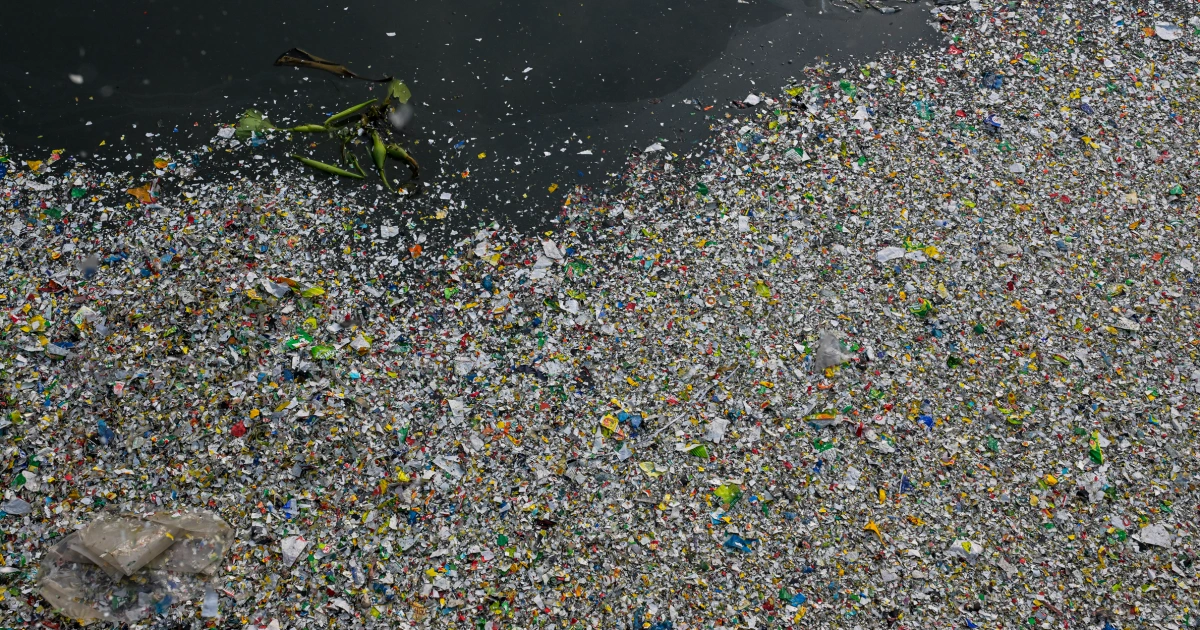
Over the past decade, scientists have found microplastics in almost every part of the human body: in the lungs, the bloodstream, and even in the placenta.
The health consequences of these tiny polymer particles remain unclear, but researchers have linked them to an increased risk of heart attacks, strokes, and inflammatory bowel disease, among other problems.
Now, scientists believe they have identified, for the first time, a mechanism that could explain how microplastics increase the risk of suffering from some of these diseases. This finding calls into question a long-held assumption about plastics.
In a study published this Wednesday in the journal Nature, scientists describe how tiny plastic particles cause chemical reactions with water that generate chemically unstable molecules called free radicals. According to research, in the body, these free radicals can cause oxidative stress and inflammation.
In essence, the findings suggest that microplastics could be chemically active in water, even in cells with high water content or in the bloodstream.
(Researchers explain how easily microplastics leach into the food we eat)
Microplastics are “like a small permanent factory” that generates these free radicals, said Wei Min, a professor of chemistry at Columbia University and one of the authors of the study. “Our cells are made up of 60% to 70% water, so this effect could be ubiquitous.”
For their research, Min and his co-authors used various microscopy techniques to observe how water reacts to microplastics and saw free radicals form. They indicated that it is the first time that this process has been observed in detail. The scientists then mixed the microplastics with mouse blood in the lab and watched what happened.
“We take red blood cells from mice, mix them with microplastics, and then the red blood cells rupture,” Min said. “We demonstrate immediate biological consequences. Proteins are damaged. Cells are damaged.”
(California passes strictest law in the country to eliminate single-use plastics and packaging waste)
Graham Cooks, a professor of chemistry at Purdue University who was not involved in the study, said the work is important and links observations based on chemistry and biology with an avalanche of research that has linked microplastics to health problems.
“It is direct evidence that microplastics play a significant role in biological processes – and an undesirable role,” Cooks said. “I think it will have strong repercussions in a practical sense.”
Scientists have long considered most plastics to be chemically inert, meaning they are stable and do not react easily with other chemicals. This material is supposed to not degrade easily, which makes it useful for items such as food storage containers and is the reason it can persist for hundreds or thousands of years. But the study refutes this idea and reveals, on the contrary, that plastic it does cause a chemical reaction in the water.
(One study found microplastics in dog testicles. In humans, it found three times more)
“Once something becomes so deeply ingrained in the minds of scientists and everyone, there’s no reason to take some plastic and sit down and do painstaking experiments,” Cooks said. “Everyone knows nothing is going to happen, except it isn’t.”
The plastic is hydrophobic, meaning it repels water. However, the new study shows that when both substances are next to each other, the plastic can create an electric field that strips electrons from water molecules and releases free radicals. This effect is not of much concern with large pieces of plastic, but smaller particles generate stronger electric fields.
Microplastics offer a much larger surface area for reactions to occur compared to bulk consolidated plastic.
“It’s the magic of the size of the plastic. Nothing more. It’s not the plastic that reacts. It’s the water that reacts,” Cooks said.
To illustrate these concepts, Min described a plastic credit card: “If you break the entire plastic credit card into micron-sized microplastics, the interface area that can be exposed to water increases more than 1,000 times,” he explained.
Researchers believe this mechanism has been overlooked and could be contributing to the health risks associated with microplastics. However, more research is needed.
“We can’t conclude by saying, ‘Well, this is exactly how plastic exerts its toxicity,'” Min said. “But we can say with certainty that this could be a contributing factor. It’s just that more studies are required to determine how important this factor is.”
Microplastics have become ubiquitous. Scientists have found microplastic pollution in snow near the summit of Mount Everest and in deeper parts of the ocean, such as the Mariana Trench. People routinely inhale or consume microplastics through food and drink.
Cooks noted that microplastics must be recognized as a source of pollution and a social problem that requires collective action and government cleanup efforts.
“We are all already full of microplastics (…) This chemical process is already happening,” he stated. “How do we remove them from the environment or stop people from ingesting them, and how do we prevent microplastics from forming?”
