
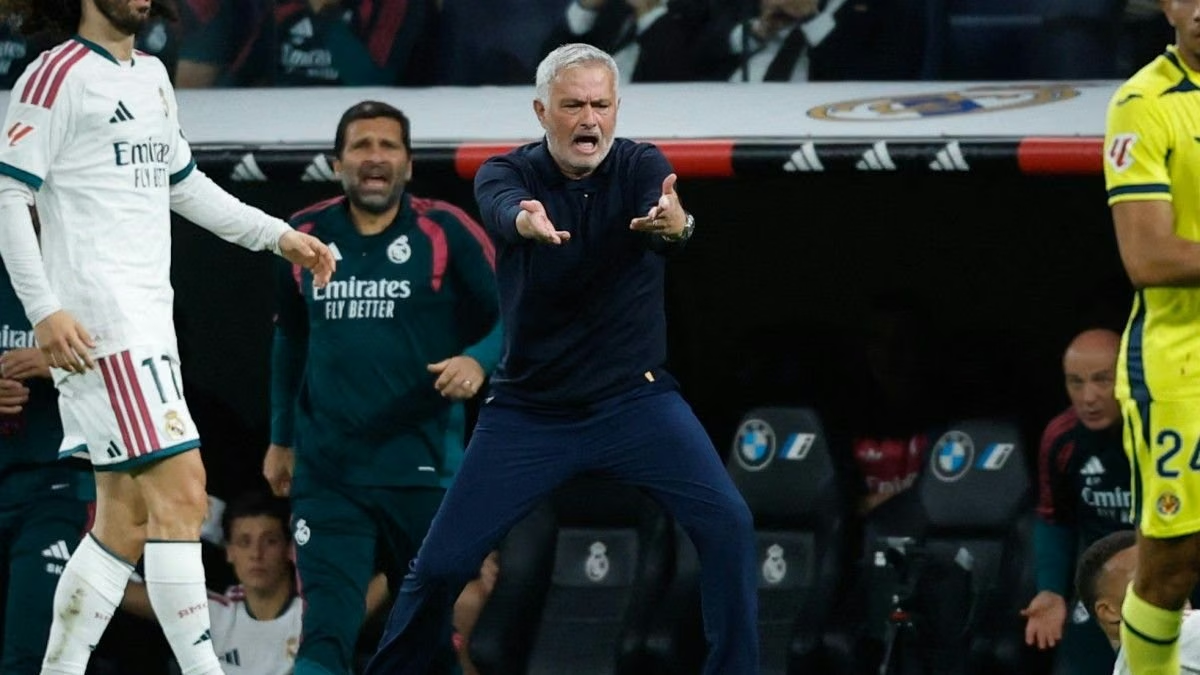
José Mourinho was once again the protagonist without saying a word. The Portuguese coach did not appear before the media after Real Madrid’s 1-0 victory against Villarreal, in a match marked by the refereeing controversy and the expulsion of Vinícius Júnior. A decision that revived a habit present at different times in his career: using silence as a response to uncomfortable situations.
The possibility of receiving a sanction for his statements would have led the coach to avoid the post-match press conference. However, this is not a new behavior for the Portuguese, who for years has alternated his usual appearances with absences, conferences delegated to his assistants and early departures from the room.
Karanka, Mourinho’s spokesperson
One of the most remembered episodes occurred on April 15, 2011, during his first stage at Real Madrid. On the eve of a classic against Barcelona, Mourinho went to the Valdebebas press room accompanied by Aitor Karanka, his assistant coach, but he let him answer the questions.
About thirty journalists, mainly Spanish, left the room in protest. Mourinho remained seated while his assistant attended to the informants who decided to stay.
The next day, after the 1-1 draw against Barcelona at the Santiago Bernabéu, the Portuguese appeared, but restricted his answers to the media who had not left the previous press conference. “If you don’t talk to my second, I only have to talk to the directors,” he explained then.
The formula was repeated numerous times during his three seasons on the Madrid bench. Karanka took on pre- and post-match appearances, a practice that Mourinho had already used during his first spell at Chelsea with his assistant Steve Clarke.
From Chelsea to the famous “Respect” in Manchester
On September 30, 2013, during his second spell at Chelsea, Mourinho decided to end a press conference early prior to a Champions League match against Steaua Bucharest. The manager was annoyed by questions regarding Kevin De Bruyne’s absence and felt there was too much attention being paid to players who were not available.
Five years later, on August 27, 2018, he starred in another scene that went around the world. After Manchester United’s 0-3 defeat against Tottenham at Old Trafford, Mourinho vindicated his career and recalled his three Premier League titles.
Before leaving, he raised three fingers and repeated three times a word that was associated with that episode: “Respect, respect, respect.”
Mourinho’s silences in Italy and Türkiye
His time at Roma also left several antecedents. Between December 2021 and April 2022, the Portuguese coach avoided appearing at press conferences prior to three matches against Inter Milan, the team with which he had won the treble in 2010.
On September 1, 2023, after Roma’s 1-2 defeat against Milan, he was again absent from appearances before the media after a match marked by referee decisions.
In Türkiye, on September 21, 2024, he also did not attend the press conference after the 1-3 defeat against Galatasaray. Four days later, he explained that he had waited about 70 minutes while his counterpart, Okan Buruk, appeared before deciding to leave. “In my 24 years of career I have never run away from a press conference, especially after a defeat,” he said.
A custom that also appeared in Benfica
Another recent episode took place during his time at Benfica. Before visiting Real Madrid in the second leg of a Champions League tie, Mourinho decided not to appear at the Santiago Bernabéu press conference. His assistant João Tralhão attended to the journalists in his place, in an image that was reminiscent of the appearances delegated to Karanka.
Now, with his absence after the victory against Villarreal, Mourinho once again resorts to a formula that has accompanied different stages of his career. This time there was no assistant to vouch for him, no fingers raised, no journalists leaving the room.
Just an empty chair. An image that summarizes another facet of a coach who has made words a tool to defend his teams, but who has also known how to turn silence into a message.
