
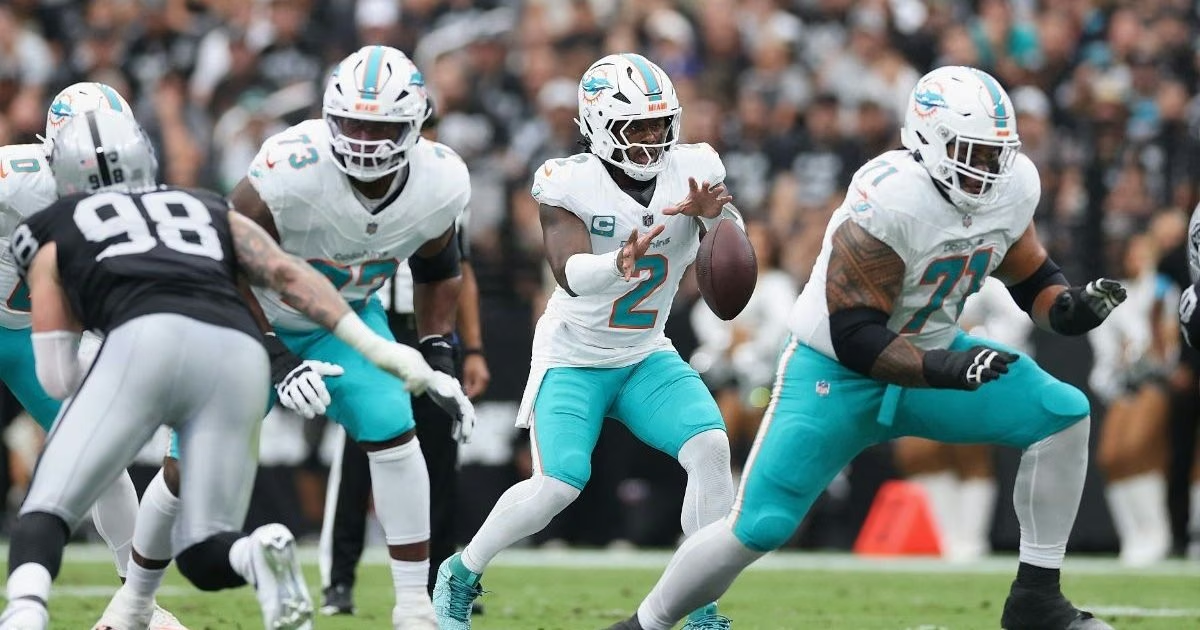
The Miami Dolphins began the 2026 season with a loss that left more questions than answers. The 27-13 defeat of the Las Vegas Raiders showed a young team, with some interesting pieces, but also with an evident lack of experience that translated into communication errors, coordination problems and situations that will have to be corrected quickly.
Youth was the protagonist from the beginning. Miami opened the game with three rookies on offense — Caleb Douglas, Will Kacmarek and Kadyn Proctor — and three more on defense: Jacob Rodriguez, Chris Johnson and Michael Taaffe. Douglas played 51 snaps, while Proctor participated in all 56 offensive actions. On defense, Rodriguez and Johnson were present on all 68 plays, while Taaffe participated on 51.
But the inexperience was not limited to the newcomers. Zayne Anderson played 53 snaps, more than 25% of all the snaps he had previously accumulated in his career. Malik Willis participated in 56, about 10% of his career total.
The data perfectly summarizes the situation: only eight of Miami’s 22 starters had surpassed 1,000 plays in the NFL before the game.
That lack of experience was noticeable. There were assignment and communication errors, while the offensive line had moments of confusion. Kadyn Proctor showed good actions as a blocker, but also suffered problems that ended up affecting some running plays. They are errors that can be corrected with work and experience, although Miami must demonstrate constant evolution.
Not everything was negative. Caleb Douglas offered one of the great news of his debut by finishing with five receptions for 94 yards on seven passes directed his way. His performance makes him one of the young players to watch in the coming weeks.
The secondary school also left encouraging signs. Taaffe had an interception and four tackles, while Dante Trader Jr. added another interception. Anderson finished with five tackles, one loss of yardage and one pass defensed. The group made mistakes, but also showed the talent to grow.
Defense with task
One of the main problems was in run defense. Las Vegas found too many spaces and managed to impose its running game. Kenneth Grant’s absence was noticeable on the interior of the defensive line, where Miami had difficulty stopping the Raiders’ running backs.
In attack, Malik Willis’ debut was irregular. The quarterback showed good condition and provided a running threat that Miami had not had consistently in recent years, but he was also sacked on several occasions and, at certain times, tried to solve the plays on his own.
The problem wasn’t just Willis. The offensive design seemed too extreme, with a constant combination of runs and long passes. There was a lack of short passes, quick plays and simple deliveries that would allow the quarterback to get into rhythm and keep the offense in favorable situations.
Malik Washington can be important in that regard. His speed and ability to gain yards after receiving the ball can make him a good alternative for short passes and plays designed to put him in open space.
But perhaps the biggest concern after the debut is with the coaching staff.
The Raiders understood their limitations and designed the game around them. Kirk Cousins completed 21 of 30 passes and threw three touchdowns, but only had 160 yards. Las Vegas avoided unnecessarily exposing its quarterback and relied on the running game. Miami, on the other hand, did not find a clear answer to stop that strategy.
The new coaching staff will have to find a way to protect Willis, take advantage of his characteristics and facilitate his development. He will also have to ensure that such a young defense can reduce errors without losing aggressiveness.
Special teams didn’t help either. Miami missed a 41-yard field goal and allowed 17.5 yards per punt return and 47.5 per kickoff return, numbers that made Las Vegas’ offensive work easier.
Therefore, 13-27 must be analyzed with perspective. The Dolphins have an extremely young roster and it is logical to expect mistakes during the first few weeks. The season, however, cannot become a succession of excuses.
The calendar will not be easy either. San Francisco, Kansas City, Minnesota and Cincinnati appear as demanding commitments. Therefore, rather than expecting immediate results, it will be important to observe the team’s evolution.
Miami needs to improve its communication, stop the run, protect Willis, diversify its offense and reduce mistakes on special teams. Above all, he must demonstrate that the new coaching staff has the ability to turn youth into an advantage and not a weakness.
The loss to Las Vegas was a bad start, but it is only the first chapter. If the young people respond and the team corrects its mistakes, this setback could remain a natural part of a reconstruction.
If the same problems are repeated in the coming months, doubts about the project will grow and the season could once again become the beginning of another process of changes for Miami.
