
NAGOYA.- For a time banned for their brutality, to the point of being described in the past as “human cockfights”, the Mixed Martial Arts (MMA) are trying to take advantage of their current popular momentum to try to integrate the Olympic program.
MMA debuts this week in the Asian Games that are celebrated in Japana milestone that fighters and organizers hope will one day become greater recognition.
Galastein Tangeneral director of the International Federation of Mixed Martial Artshe told AFP in Nagoya that being in the Asian Games is “a big step” towards greater recognition.
“Being included (in the Asian Games) means that you already have a good governance structure, enough members and athletes to be able to compete, your rules and officials are ready and therefore it is something significant,” he added.
In a gymnasium similar to a school’s sports hall, men and women compete in separate categories before a not very large, but enthusiastic audience.
Many of the competitors are from countries with a tradition in combat disciplines, such as Thailand, Kazakhstan, Philippines and the hostess Japan.
Inspire a generation
For fans of Ultimate Fighting Championship (UFC), the promoter of the main MMA competition, to the point that both acronyms have become almost synonymous, there is an immediate difference.
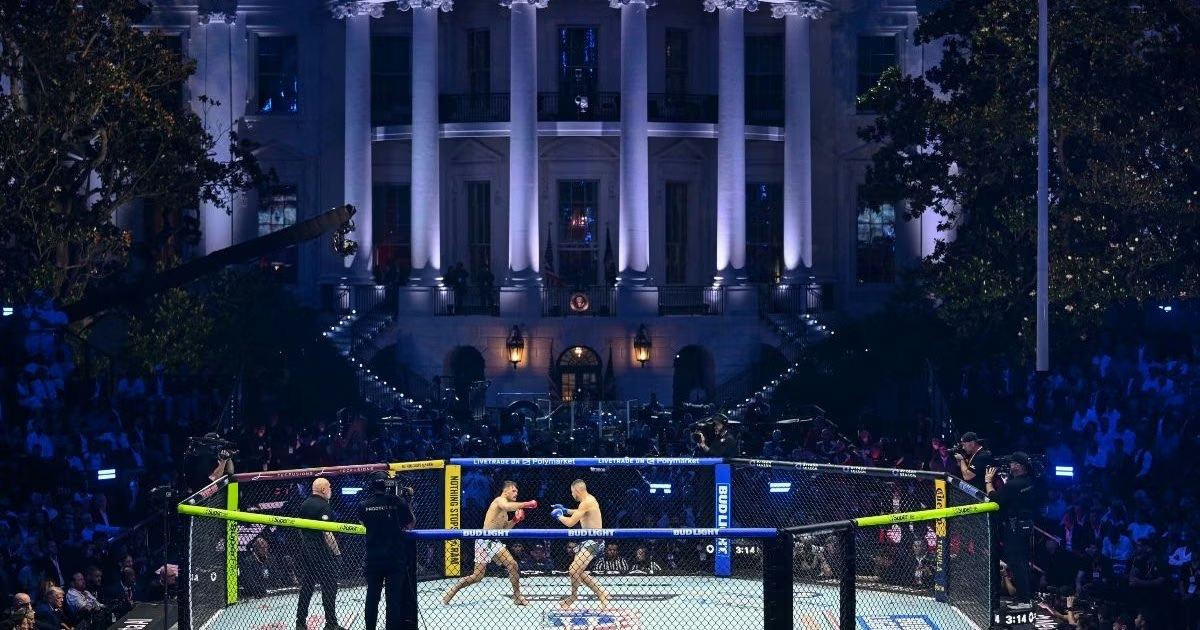
In the UFC, which held an event in the garden of the White Housethe fights are held inside an octagonal cage.
At the Asian Games, competitors fight their battles on a white and gray tatami, but they are not fenced.
For fighters accustomed to fighting in a cage, this requires some adaptation.
A cage “doesn’t really align with Olympic values,” Tan explained.
Getting everyone to agree on the rules of competition, including what moves are allowed, is one of the big obstacles to MMA reaching the mainstream. Olympics.
The Singaporean Teo Hui Hoon, who is assured of at least a silver medal, stated that recognition at the Asian Games will increase the number of practitioners, another aspect that will facilitate Olympic recognition.
“It will encourage more children and adolescents to practice sport and take it seriously” by aiming to “enter a national team and, as a next step, go to the Olympic Games,” he explained.
“We are ready”
This discipline is not the only one that debuts in Asia’s main sporting event and hopes to one day enter the Olympic Games.
He also does it teqball —a kind of hybrid between soccer and table tennis—, in addition to paddle tennis, a racket sport that is experiencing a moment of expansion in some parts of the world.
Taking into account other sports with Olympic aspirations, the competition to enter the Games program is going to be tough and MMA has a lot of work ahead of it.
“We have had conversations with the IOC and other relevant actors who have influence or decision-making power over recognition,” said an optimistic Tan.
This sport has Dana White on his side: the head of the UFC openly supports its inclusion in the Olympic Games.
However, many see this practice as too violent to be part of the Games, despite the fact that the success of the UFC has popularized this sport throughout the world and has improved an image described as “cockfighting” by the US senator. John McCain in the 1990s.
It is also essential to get the entire MMA world to cohere around a single governing body if it is to one day secure an Olympic berth.
Los Angeles 2028 It comes too soon and then comes Brisbane four years later.
“Nothing is impossible,” according to Tan. “We hope that MMA will be a sport that the Olympic Games consider relevant and capable of connecting with both adults and youth.”
“(It’s) a sport that has global appeal and is ready and able to fit into the schedule of a big Games. So if the IOC or LA28 come and say, ‘MMA, would you like to be an official sport or an exhibition sport?’, we’re ready.”
