
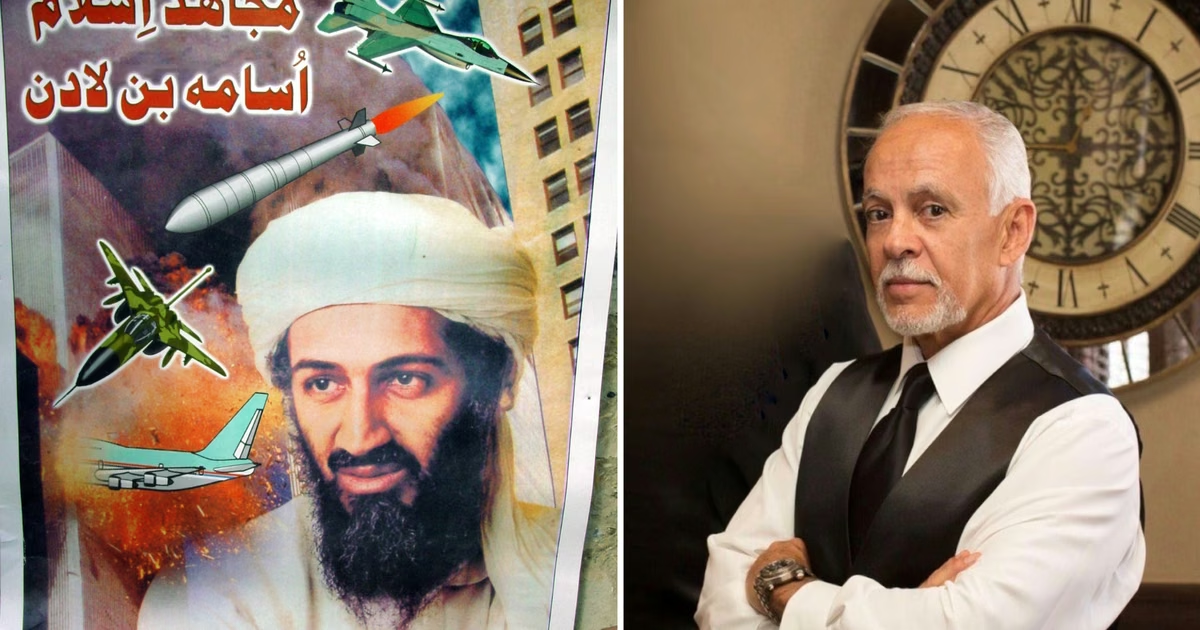
MIAMI.- The declassification of dozens of intelligence reports on Osama bin Laden puts the warnings received by the presidents’ administrations back under scrutiny Bill Clinton and George W. Bush before the terrorist attacks of September 11, 2001.
The documents, including reports in the President’s Daily Briefs (PDB), show that US intelligence knew for years about Bin Laden’s intentions to attack targets within the United States and had even contemplated scenarios involving airplanes and hijackings.
In statements offered to Diario Las Américas, Enrique “Ric” Pradoformer senior official of the Central Intelligence Agency (CIA), stated that the information made public confirms a reality that he learned from within the intelligence community: there were opportunities to act against Bin Laden before Al Qaeda carried out the attacks that left nearly 3,000 dead on September 11, 2001.
Prado was a founding member of the CIA’s first unit dedicated specifically to the Osama bin Laden threat and later served as Chief of Operations for the Agency’s Counterterrorism Center.
Warning about a plane with explosives
One of the declassified documents is a report from September 10, 1998 that indicated that the option that Bin Laden prioritized was to attack the United States in its own territory, especially Washington. The report also indicated that there was a possibility that Al Qaeda could use a plane loaded with explosives against an American city.
Another presidential report, dated December 4, 1998, indicated that members of Bin Laden’s network had received training to carry out aircraft hijackings. The document also revealed that conspirators had evaded security checks during a test at an unnamed New York airport.
The warnings remained in place during the George W. Bush administration. An August 6, 2001 PDB or presidential briefing informed the president of suspicious activities within the United States consistent with preparations for kidnappings or other attacks. In fact, weeks before September 11, the FBI He was carrying out some 70 investigations related to Bin Laden within the country.
The CIA released 71 presidential reports ranging from the beginning of 1998 to the day after the attacks. 69 of those documents had not previously been declassified.
Waiting for authorization
Prado provides a relevant perspective on that period because he was directly involved in the CIA’s initial efforts to confront the threat.
In January 1996, Prado and Michael Scheuer, along with a small team of officers, launched the CIA unit dedicated to studying Bin Laden’s movements. According to Prado, by the end of 1997 the Agency had gathered abundant intelligence on the terrorist’s activities.
The former officer maintains that, despite the information gathered, Bill Clinton’s administration did not allow progress with operational proposals aimed at neutralizing Bin Laden.
“In January 1996, Michael Scheuer and I, along with a small but committed team, launched the Bin Laden Task Force (also known as Alec Station) at the CIA. With the growing volume of intelligence information and first-hand data provided by Billy Waugh, by the end of 1997 we already had an enormous amount of intelligence about what Bin Laden was doing,” Prado said in a testimony that he expressly authorized to be made public.
Unfortunately, he added, “the administration at the time refused to act based on our intelligence information and also refused to authorize our operational plans to neutralize OBL.”
Prado’s experience provides him with a unique perspective on the evolving Al Qaeda threat. Born in Cuba, he left the island as a minor as part of Operation Pedro Pan and subsequently developed a 24-year career in the CIA.
He was an operations officer in six international assignments, and participated in paramilitary and anti-terrorist operations. In addition to being part of the first unit dedicated to the fight against Bin Laden, he was head of Operations at the Counterterrorism Center during the September 11 attacks. Upon retirement he had achieved the rank of Senior Intelligence Service-2 (SIS-2).
That September 11, 2001, Prado was in charge of the operations of the Counterterrorism Center. The war on terrorism that followed also took a personal toll on him: in his testimony he remembers three friends and colleagues he subsequently lost.
“It is a heavy burden of guilt that I and many of my colleagues carry. To make matters worse, I was Chief of Operations at the CIA’s Counterterrorism Center (CTC) on that infamous day. These are just three of the friends I lost in the Global War on Terrorism (GWOT): John O’Neil, Mike Spann and Jennifer Mathews.”
The documents
Although the new documentation does not directly establish that US authorities knew in advance of the specific plan that was finally executed on September 11, it does provide a detailed image of the volume and characteristics of the information that was handled at the highest levels of the Government: Bin Laden wanted to carry out attacks within the United States; Washington was among the possible targets; members of his network had received training related to air hijackings; and analysts even warned about the possibility of using a plane loaded with explosives against an American city.
Some of the material, which remains censored, describes different threats and scenarios considered by the intelligence services during those years.
For Prado, the matter goes beyond what the intelligence community knew. Question the political decisions that were adopted, and those that were not adopted, based on that information.
25 years after the terrorist attacks that forever changed the vision of United States security, these documents open one of the most painful wounds in the country’s recent history and call into question the actions of Presidents Clinton and Bush regarding the fight against terrorism.
