

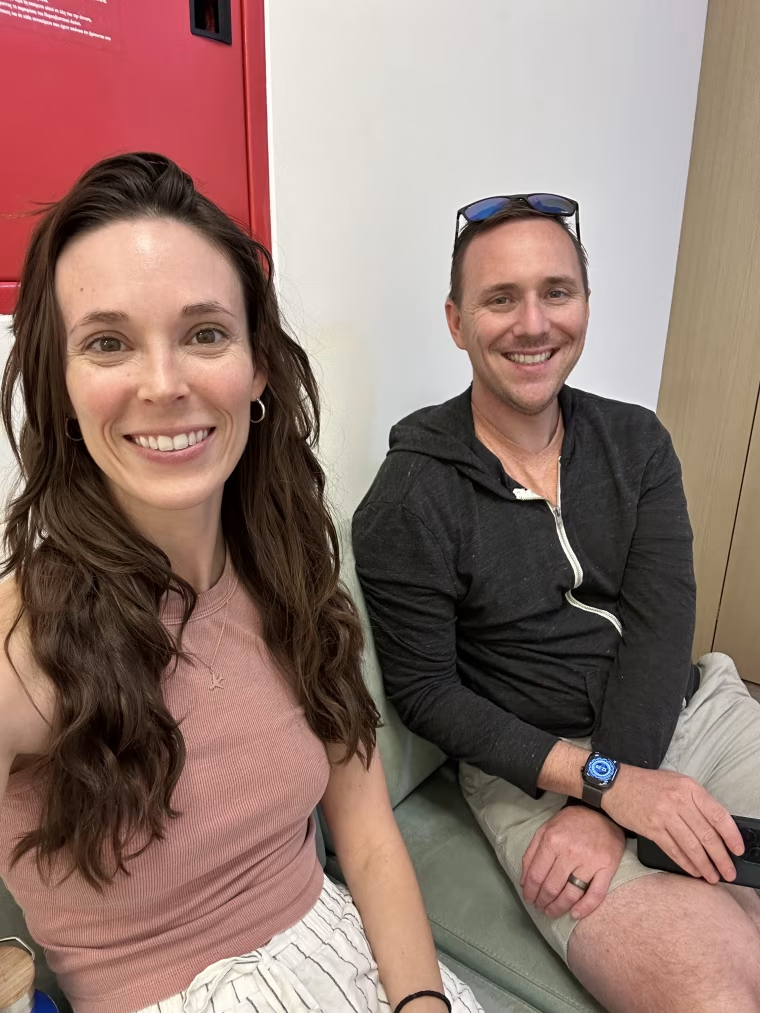
In the summer of 2024, Emilie and Justin Solomon embark on a top-secret mission to Greece.
Their family and friends thought that the couple, travelers and adventurers, were enjoying another vacation abroad. But in reality there was something else: they had disabled the location of their phones so that no one would know that they were visiting a Greek clinic where they were trying to have a child.
The Solomons are among a growing number of Americans looking abroad, particularly to Greece and Spain, to escape the high costs of fertility treatments in the United States, where these procedures are often not covered by health insurers.
Among them is in vitro fertilization (IVF), which consists of stimulating ovulation, extracting the eggs, fertilizing them in the laboratory and transferring the embryos to the uterus. But there are also other less complex medical treatments to try to resolve infertility.
President Donald Trump has made fertility, and in particular IVF, one of the topics on his Administration’s agenda, after promising full coverage for women during his 2024 campaign. In May, his government proposed a rule aimed at making it easier for employers to offer coverage for fertility treatments, although it has not yet been finalized.
So far, the most concrete result has been a reduction in the cost of some IVF medications through TrumpRx, a site where patients paying out of pocket can find discounted medications at participating pharmacies. The White House estimated that patients could save up to $2,200 per IVF cycle.
While significant, those savings come against a 90% increase in the cost of IVF drugs since 2014, according to GoodRx, a prescription drug discount service.
A study of insured Americans, published in July by Abene Health Partners and the Women’s Reproductive Health Foundation, found that the total cost of an IVF cycle was more than $29,000, equivalent to 35% of the median annual household income in the country.
According to this research, genetic testing, embryo banking, and care during pregnancy and birth can raise the total cost to more than $54,000 for each birth of a baby conceived through IVF.
On average, a patient needs between two and three cycles to have a child, so the costs can be even higher.
Infertility affects nearly 7 million people in the United States, but it is estimated that only 24% of treatment needs are met due to high costs and limited coverage, according to the American Society for Reproductive Medicine.
Infertility is believed to be increasing, partly because people are having children at older ages, as well as due to factors such as environmental pollution.
Still, more than 100,000 babies were born through IVF in the United States in 2024, a record number, according to the Society for Assisted Reproductive Technology.
A growing proportion of those hoping to become parents are seeking help in Europe: The number of Americans choosing European clinics rose more than 37% last year, according to Jakub Dejewski, president of the European Fertility Society, a group that collects data on fertility treatments in Europe.
The Solomons knew that IVF was their only chance to have biological children together, because Justin had had testicular cancer in his late teens. What these college sweethearts didn’t expect was the cost, and at the beginning of their IVF journey they learned that their insurance would not cover the treatment. Although some states have passed laws requiring insurers to pay for certain fertility treatments, coverage varies widely.

When the couple first explored the possibility of using IVF in Florida, where they live, they were quoted $40,000 for a single cycle of treatment. The price surprised them, and Emilie said she found the clinic’s offer of a spring discount for an embryo transfer “disturbing.”
“Somehow they take advantage of your hopes and dreams of becoming a father or mother,” Emilie said.
Treatment and island tours
The price of IVF and uncertainty surrounding a legislative proposal in Florida to recognize embryos as legal persons, which the Solomons feared could jeopardize control over their embryos, brought them to Pelargos IVF Medical Group in Athens. There, during the first of two trips, Emilie underwent ovarian stimulation and egg retrieval.
Including medications, fertilization, storage and subsequent embryo transfer, the treatment cost a total of about $12,000, not counting travel expenses. According to the Solomons, a fraction of what they could have spent in the United States. The lower cost attracted the couple, but also the possibility of sightseeing and seeing another country.
On that first trip, they spent a weekend between medical appointments touring the Greek island of Milos. In between Emilie’s hormone injections, they rented a boat to explore the island. A video of the trip shows them climbing the island’s stunning white volcanic cliffs and Emilie floating in the turquoise waters of the Aegean Sea.
Despite the emotional and physical toll of the IVF process, the couple remembers feeling in a small bubble, away from everyone and exploring a beautiful place.
“It was one of the best summers we’ve ever had,” Emilie said.
When they returned to Greece for the embryo transfer in October 2025, they spent two days in Croatia.
IVF in Greece using the patient’s own eggs usually costs between $3,000 and $4,000, not including medications, so even adding travel expenses usually represents a portion of what patients pay in the United States.
“Americans choose Greece because they can access more affordable treatment, get started more quickly, and receive good support as international patients,” Dejewski said.
However, patients in Greece face some legal restrictions: embryo storage is limited in time, donor anonymity is the norm, and there are restrictions on sex selection and the number of embryos that can be transferred. Access to surrogacy for non-residents is also limited, and patients should carefully consider documentation requirements if they plan to transfer embryos between Greece and the United States.
Penny Ampatzi said she clearly explains these legal differences when Americans consult with her clinic in Athens. Serum IVF offers to coordinate the transfer of patients from the airport, as well as tours to different islands.
Ampatzi, co-founder and director of the Serum IVF clinic, said the main draw for the dozen American patients her clinic receives each month is the personalized fertility treatment plans. Cost follows closely behind. A cycle at her clinic costs just under $6,000, not including embryo freezing. According to Ampatzi, almost all of Serum’s patients are foreigners.
“You think that you have a good chance of success, that you also don’t have to pay such a high amount of money and that you can combine the treatment with a vacation. So you say: ‘Why not?'” he remarked.
A decision that has its risks
IVF costs in the United States have risen due to a combination of factors, including inflation, a shortage of embryology experts, a sharp increase in demand following delays caused by the pandemic and the involvement of private equity firms, Dejewski said.
William Kiltz, vice president of marketing and business development at U.S.-based CNY Fertility, said costs are becoming increasingly unaffordable.
“IVF is practically becoming a treatment that only the richest 1% can reasonably afford,” he said.
Kiltz said CNY’s model — which offers IVF for about $8,000, not including embryo storage, at its 18 centers across the country — generates just enough profit to “keep the lights on” and open new centers, while keeping costs down.
“We are trying to offer this care at the lowest possible cost,” he said.
More than half of CNY patients travel from other states in search of those cheaper options, Kiltz said.
He added that he hopes the IVF market will end up stabilizing, as it does with many new technologies. But almost five decades after the first in vitro fertilization, that normalization has not yet occurred. Kiltz believes this is because this is a market driven by very intense emotions.
“People are willing to do almost anything,” Kiltz said. “There is certainly some risk in something like this, when a person’s demand and desire is so strong that someone could take advantage.”
Tarita Pakrashi, lead fertility specialist at the CNY center in Norfolk, Virginia, highlighted the difficulties of evaluating a clinic abroad when the patient does not speak the language or understand local IVF regulations. It can also be difficult to transport temperature-sensitive medications back home.
“It’s almost like having a full-time job trying to be both a regulatory expert and an inspector, while also being the patient,” Pakrashi said.
He also said some patients who sought treatment abroad returned to his clinic with difficulty transferring their medical records or understanding a diagnosis they had received in another country. They often have to repeat the studies.
And traveling abroad for IVF remains out of financial reach for many Americans.
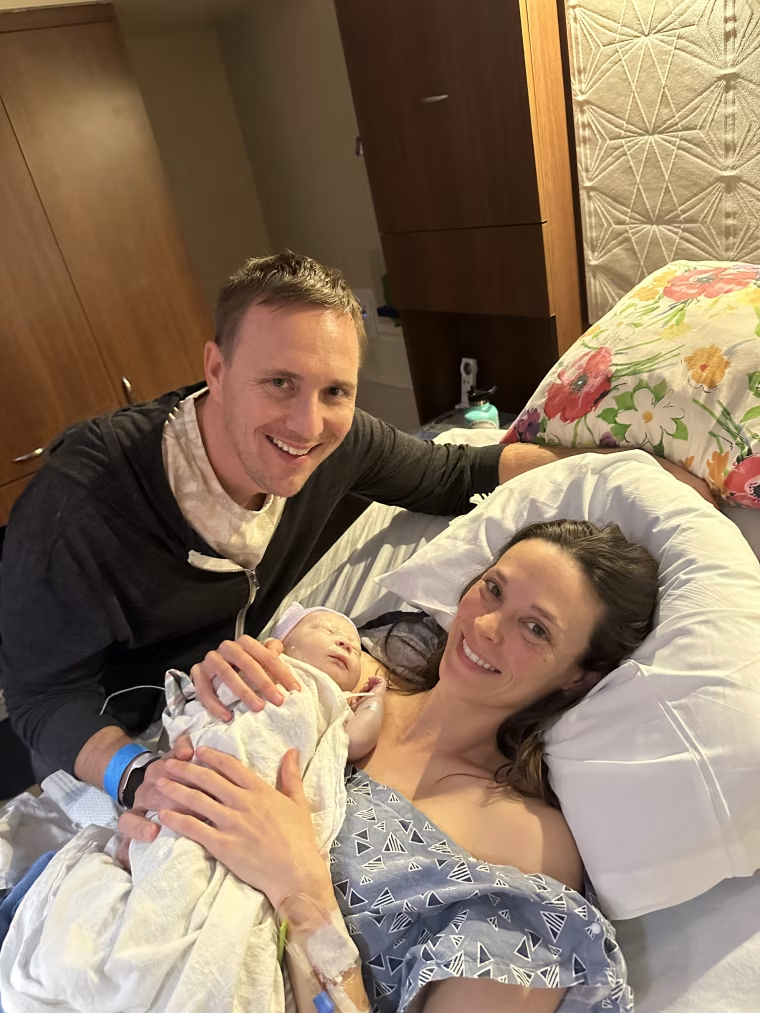
The Solomons said seeking treatment in another country also requires a certain spirit of adventure. But, for them, all the logistics and travel were worth it. A cycle of IVF and two trips to Greece allowed them to welcome a healthy baby boy to the family this summer.
