
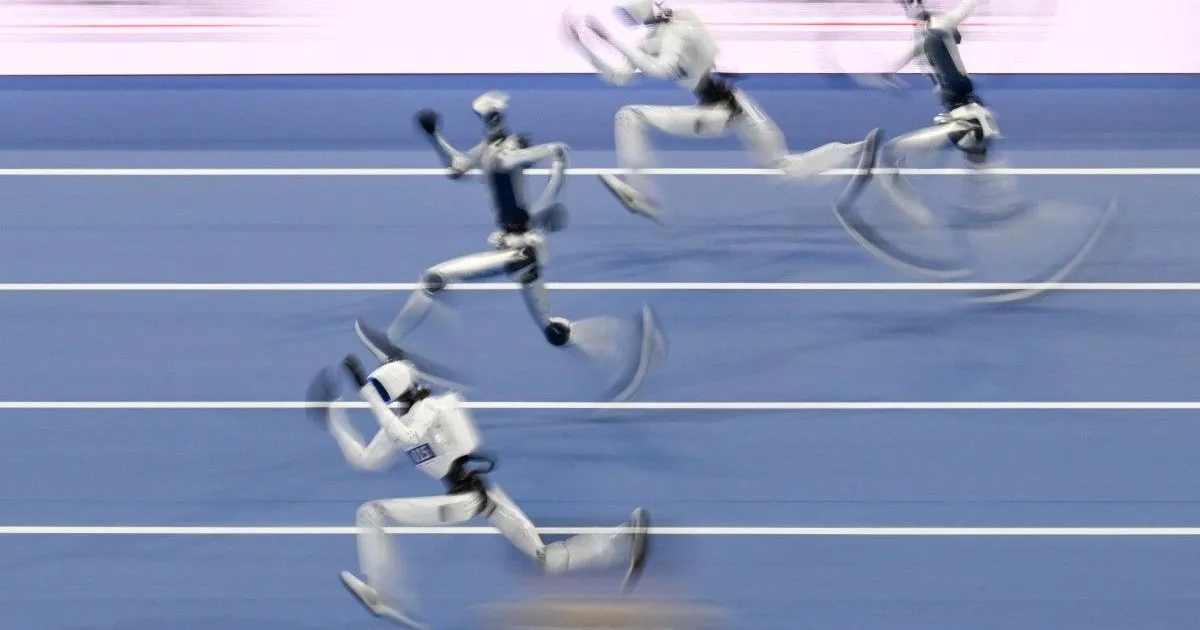
A Chinese humanoid robot made history this Tuesday in Beijing by completing the 100 meters in 8.86 seconds, setting a new world record for robots and even surpassing the record time recorded by a human being.
The feat occurred during the World Humanoid Robot Games, an Olympic-style competition that brings together more than 2,000 robots in 51 disciplines in China.
The robot that ran faster than Usain Bolt
The new record of 8.86 seconds vastly improves the previous record for humanoid robots, of 9.39 seconds, set just three days earlier, on Saturday.
The mark is also below the men’s 100 meters world record, which belongs to Jamaican Usain Bolt, who stopped the clock at 9.58 seconds in 2009.
However, the demonstration also highlighted the technical difficulties that these types of machines still face. After crossing the finish line, the robot lost its balance and ended up crashing into a padded barrier, sparks flying from its waist area.
China boosts its humanoid robot industry
The World Humanoid Robot Games are held for the second consecutive year in Beijing and also serve as a showcase for China’s advances in robotics, amid growing technological competition with the United States.
The event includes more than 1,300 events, with disciplines such as racing, long jump and table tennis, as well as less conventional activities such as ballroom dancing.
Unlike the traditional Olympic Games, robots also participate in teams and face situations inspired by real scenarios, such as housework, hotel services and emergency response work.
The official Chinese newspaper People’s Daily pointed out that robots intended for tasks such as home cleaning and caring for people are still in the testing and validation phases, but highlighted that precisely these challenges are driving the development of the Chinese robotics industry.
The new mark of 8.86 seconds thus represents a significant advance for humanoid robots, although its fall after crossing the finish line also shows that there is still a considerable gap between reaching high speed and ensuring that these machines can run with stability and autonomy.
