
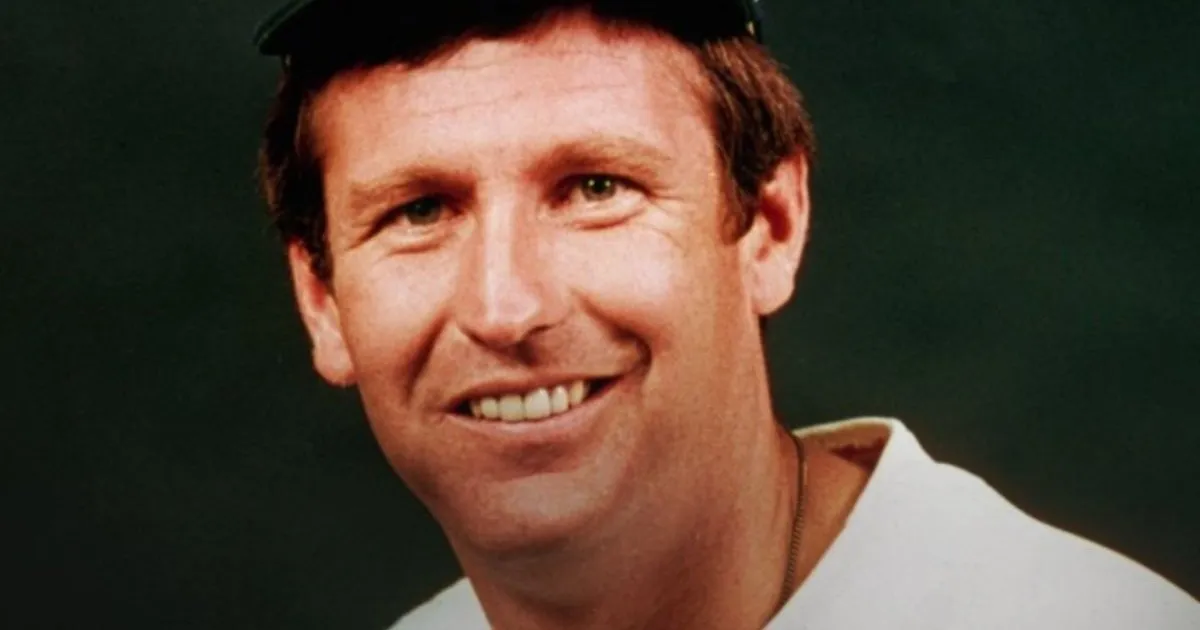
Tommy John, the pitcher who won 288 games during a 26-season career in the Major Leagues and whose name was forever linked to one of the most important operations in sports history, died Saturday night at his home in Bradenton, Florida. He was 83 years old.
His agent, Mike Maguire, confirmed the death on Sunday and said John was under palliative care. On August 8, the New York Yankees had published a message on their social networks in which the former pitcher himself said goodbye to friends and fans: “I will never forget you.”
John had a 288-231 record and a 3.34 ERA in a career that spanned from 1963 to 1989. He was a four-time All-Star and pitched for Cleveland, Chicago White Sox, Los Angeles Dodgers, Yankees, California Angels and Oakland Athletics.
However, his greatest legacy began in 1974, when he suffered a torn ulnar collateral ligament (UCL) in his left elbow. At that time, such an injury practically meant the end of a pitcher’s career.
Dodgers doctor Frank Jobe then proposed an intervention considered experimental: replacing the damaged ligament with a tendon removed from John’s right forearm. Jobe estimated just a 1% chance of success.
The operation was performed on September 25, 1974, and John spent four months with his arm immobilized. After a long rehabilitation process, he returned to the mound in 1976, becoming the first major league pitcher to compete after a UCL reconstruction.
Far from just returning, John regained his level. In 1977 he won 20 games for the first time and finished second in the National League Cy Young Award voting behind Steve Carlton.
John won 124 matches before the operation and 164 after it. His last appearance came a few days after turning 46, a sign of the extraordinary longevity that characterized his career.
Since that first intervention, more than 2,600 Major League players and thousands of amateur players have undergone UCL reconstructions. The so-called “Tommy John surgery” became a common procedure to treat one of the most serious injuries a pitcher can suffer and has extended the careers of numerous stars.
Among the players who have undergone this operation are Shohei Ohtani, Justin Verlander and Bryce Harper.
“His impact, on and off the field, has been felt by players of all ages and will continue for generations,” said Dodgers President and CEO Stan Kasten.
John finished his career with 2,245 strikeouts, but never led his league in wins or strikeouts. With 288 wins, he had the second-most wins among pitchers since 1900 who have not been elected to the Hall of Fame. He was on the ballot between 1995 and 2009, but never exceeded 31.7% of the vote, well below the 75% needed.
His name, however, was immortalized in another way. In 2019, Merriam-Webster added the term “Tommy John surgery” to its dictionary.
John also had a life linked to sports after retiring. He worked as a commentator for the Minnesota Twins and Yankees during the 1990s and managed the Bridgeport Bluefish from 2007-09.
In June 2022, he donated the original cast used after his historic 1974 operation to the Smithsonian Institution. His teammates from that Dodger team, as well as Jobe and the legendary narrator Vin Scully, had signed the piece.
Although over the years his name became more associated with surgery than with his achievements as a pitcher, John was much more than the patient of a pioneering operation. He was a competitor who returned from an injury that seemed permanent and managed to win more games after the intervention than before.
Tommy John thus leaves a unique mark on baseball: that of a great pitcher whose name ended up becoming synonymous with a second chance for thousands of athletes.
