
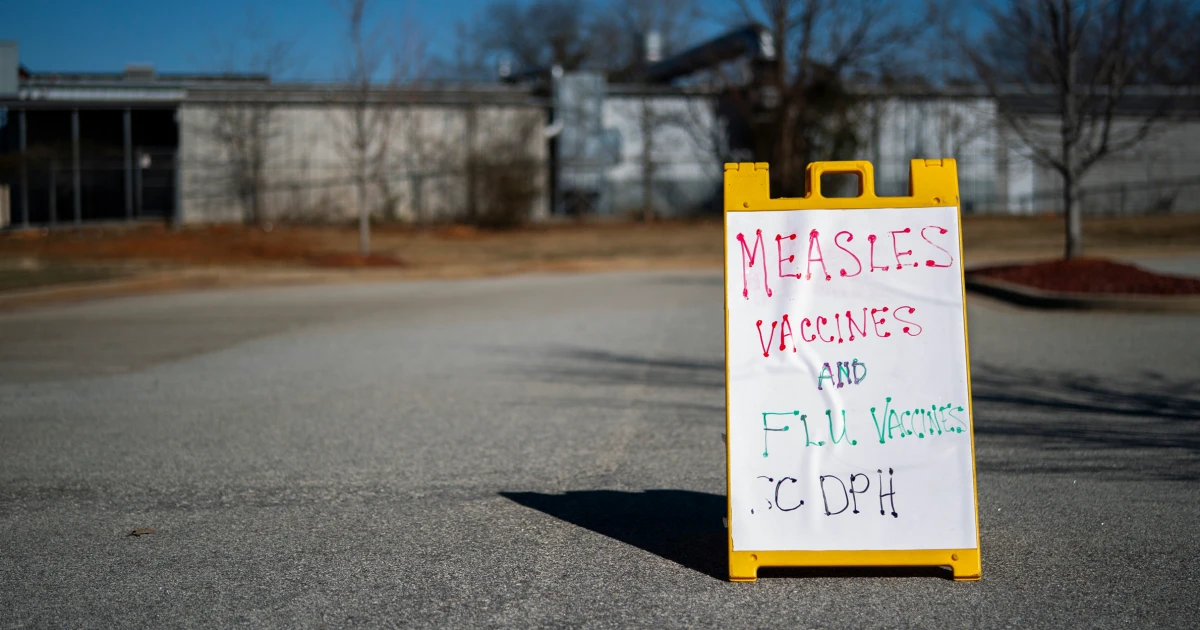
The Centers for Disease Control and Prevention (CDC) reported this Friday that the United States has recorded 2,318 cases of measles in the first seven months of this year, surpassing the total of 2025, which was 2,289.
It is the highest number of measles cases the country has seen in 35 years, and comes amid a decades-long decline in childhood vaccination rates. Most infected people — 93%, according to the CDC — are not vaccinated.
“We have joined the ranks of countries where vaccinations are not reaching the levels needed to protect all of our children against some of the most contagious diseases,” said Dr. Richard Besser, pediatrician and president of the Robert Wood Johnson Foundation. When vaccination levels decline, measles is often the first vaccine-preventable disease to rebound, as it is by far the most contagious.
“Measles is the canary in the coal mine. What it tells us is that our communities are vulnerable, not only to measles, but also to whooping cough, meningitis, chickenpox and other diseases that can be easily controlled with vaccines,” Besser said. “We are going down the wrong path.”
The wave has been intensifying since January 2025.
During that month, Dr. Richard Eby, a family medicine physician, was working a weekend shift at Permian Regional Medical Center in Andrews, Texas, about two hours south of Lubbock, when he saw his first case of measles. The boy had to be hospitalized for dehydration and difficulty breathing.
Eby knew there would be more cases. The girl’s mother told her that two days earlier, classes at her small private school had been canceled because many children were sick with measles. “At that moment I knew that the official case count only reflected a fraction of what was already spreading in the community,” he recalled. “Most people didn’t get tested unless they were very sick.”
It was too late to stop the outbreak, which reached 762 cases and led to the first measles deaths — including those of two little girls — in the United States in more than a decade. The West Texas outbreak would become the first major wave of rising measles outbreaks nationwide, which have since stretched into a second year and now threaten the nation’s status as having eliminated the virus in 2000.
New shoots
New measles outbreaks are emerging in Arizona, Delaware and Wyoming. The Pennsylvania Department of Health reports 132 cases, of which 27 were diagnosed in the last week alone.
Virginia’s outbreak, which began in May, appears to be subsiding. The state has recorded 177 cases, but has not reported any new cases since July 4.
The Piedmont Health District, located in central Virginia, has concentrated the majority of cases in that state. The district’s health director, Dr. Maria Almond, said her staff has been painstakingly going door-to-door, promoting vaccination to stop the outbreak.
“We visit the homes, we listen to their needs, we provide them with information and we continue to follow up with those families and visit them again because they are reluctant to seek medical care until they are ready and feel safe,” Almond said. “Very often, we are able to connect families with health care resources.”
(The United States records almost 1,000 cases of measles so far in 2026)
The CDC has sent staff to help with outbreaks in several states, including Virginia. However, the federal health response to the current measles outbreaks has been minimal. The CDC has been without a permanent director for most of President Donald Trump’s second term, and Health and Human Services Secretary Robert F. Kennedy Jr., a longtime vaccine skeptic, has distanced himself from news of ongoing outbreaks.
“Last year and this year wouldn’t be as bad if we had strong, well-funded local public health departments and a CDC that was well-staffed and prepared to respond to outbreaks,” said Dr. Adam Ratner, a pediatrician and member of the American Academy of Pediatrics Committee on Infectious Diseases.
Most children, 92.5%, receive the measles vaccine, according to CDC data from 2025. About 95% of the population needs to be vaccinated against the disease to achieve herd immunity.
“We are starting to pay the price for the decline in vaccination rates that we are seeing in some communities,” Ratner said.
“The flu on steroids”
The measles outbreak in Utah, which began in June 2025 in a small, close-knit community on the border with Arizona, remains active after spreading to all regions of the state, including the most populated area of Salt Lake City. To date, more than 700 people in Utah have contracted the disease, according to the state Department of Health, with 514 cases diagnosed this year.
But the increase in measles cases in 2026 has largely been due to an outbreak that affected the northwestern corner of South Carolina, in an area known as the Upstate. Cases began last fall and accelerated precipitously just after the holiday season.
“From the get-go, you’re thrown right into the fire,” said Dr. Stuart Simko, a pediatrician at Prisma Health in Greer, South Carolina. “Measles spreads much faster and more effectively than COVID-19 ever could, and that was the scariest thing.”
Simko had never seen a case of measles before the statewide outbreak that ultimately infected 997 people. He said he and his colleagues had to learn how to quickly identify a child with measles. “It looks like the flu on steroids,” he said. “They’re covered in a rash, they have a fever of 104, 105. They just have no energy.”
(Measles cases already affect university students, as infections increase)
While most measles cases have been in children and adolescents, Piedmont Health’s Almond noted that adults can also become seriously ill.
“This community has really felt it in their adults, with severe nausea, vomiting, diarrhea and dehydration,” he said. “It is terrible and serious.”
Adults have also been hit hard in Pennsylvania. Only 39% of cases have been recorded in children under 18 years of age, according to the state Department of Health.
It is unclear whether the current outbreaks will cause the United States to lose its status of having eliminated the virus from circulation in 2000. The Pan American Health Organization is expected to make a decision in November.
