
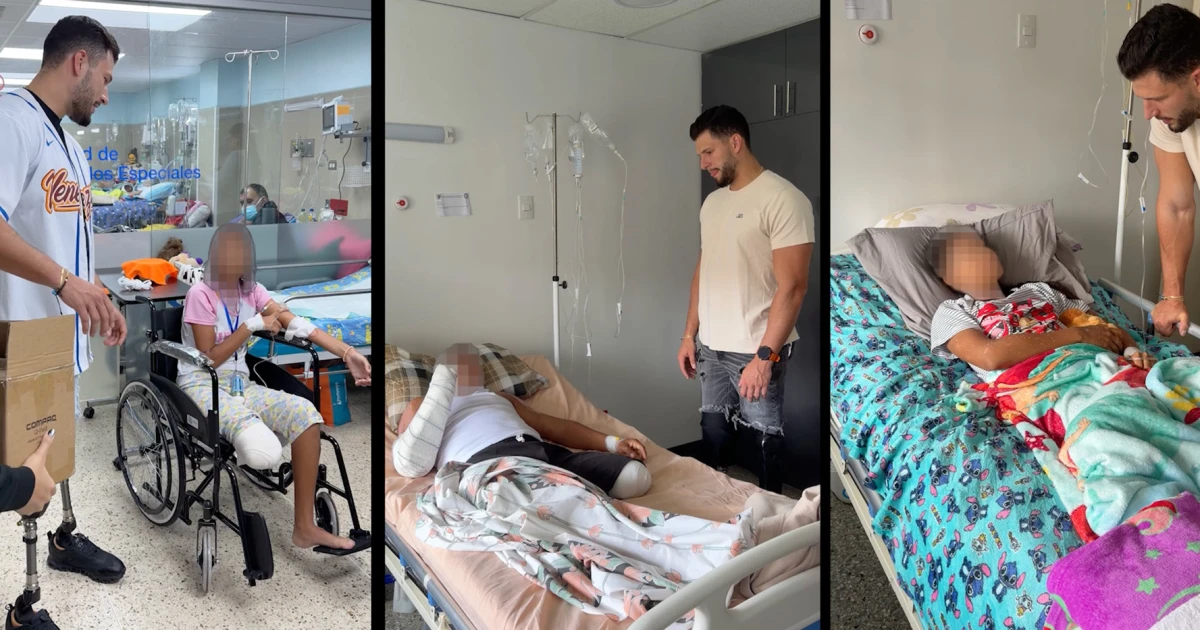
“You are the miracles of Venezuela,” says athlete, model and lecturer Juan Pablo Dos Santos to the dozens of people whose earthquakes not only took away their homes or loved ones, but also parts of their bodies.
Since that tragic June 24, the young content creator has been helping those affected, focusing on children, young people and adults who suffered the amputation of some of their limbs due to the earthquakes that shook the north of the country and devastated the coastal state of La Guaira.
He has been seen walking the hallways of hospitals carrying a message of encouragement to those who are now facing the process that he had to go through in 2019 when he lost both legs due to a traffic accident.
However, words of encouragement are not enough, because for these people the challenge is just beginning: they will need surgeries, prostheses, rehabilitation and multiple implements to resume their daily activities. And the panorama becomes even more complex in a country that before the disaster, access to health services was already limited.
“I know that the majority of Venezuelan families do not have the economic capacity to afford these treatments,” says Dos Santos in an interview with Noticias Telemundo, adding that none of the prostheses or components are made in the country and everything has to be imported, which is why it is very expensive.
(Venezuelans in the US transform helplessness into help after earthquakes: “I can do a lot from here”)
To respond to this crisis, the young man promotes the ‘Humanitarian Fund 77: Faith without borders’. An ambitious initiative born from an alliance between the Juan Pablo Dos Santos Foundation, the CIREC Foundation of Colombia, the Children’s Orthopedic Hospital and Fundaprocura of Venezuela. The project includes immediate care, comprehensive rehabilitation and continuous monitoring, including orthopedic surgeries on the stumps, delivery of prostheses, orthoses and specialized wheelchairs.
“But then comes the most complex part and for which we will need more resources and the support of all people, which is to make this sustainable,” says Dos Santos when talking about the plan to create a center in charge of ensuring the well-being of amputees in the long term. “And thus be able to guarantee each of the people who contributed that these children will be fulfilled, they will be happy, they will be going to school and their activities,” he points out.
What you see and hear in hospital rooms
Juan Pablo relates that the scenario is different depending on age and gender: children talk little and look a lot, women worry about their femininity and image, while men fear not being able to continue being the providers and protectors of their families. However, he highlights that “the most beautiful thing is that they are grateful to be alive.”
During his visits, he listens to them, hugs them, brings them gifts and even shows them how the prostheses that allow him to walk work, all in order to allay their fears and questions. “Most of the answers are yes, you will be able to, yes you will be able, but at a different pace, in another way, because people who have a condition have to relearn most things. But there is a way to be happy.”
The reason for the Juan Pablo Dos Santos Foundation
The non-profit organization was born six years ago after the accident that took away his lower limbs, but gave a new meaning to his existence. “I feel like a better person, I feel more fulfilled and I also have the ability and vision to want to help and add something positive to the lives of others.”
(Venezuelan doctor in the US feels helpless for not being able to travel to her country after the earthquakes: “It’s not that easy”)
Through his management, some 50 children have been able to get their prostheses and dozens more have received crutches, walkers and wheelchairs. The only mission, he assures, “is to help families who do not have the necessary resources to give them back a little bit of normality so that they can have the desire to take on the world.”
He says that his work is a way of thanking and giving back for the help he received at the time. When he went through this, his family did not have enough funds to pay for his treatment, but an anonymous benefactor covered all the expenses for him to receive the prostheses he needed in the country of his choice: “That is where this beautiful purpose begins, which is to see everyone walk towards their dreams,” he concludes.
