
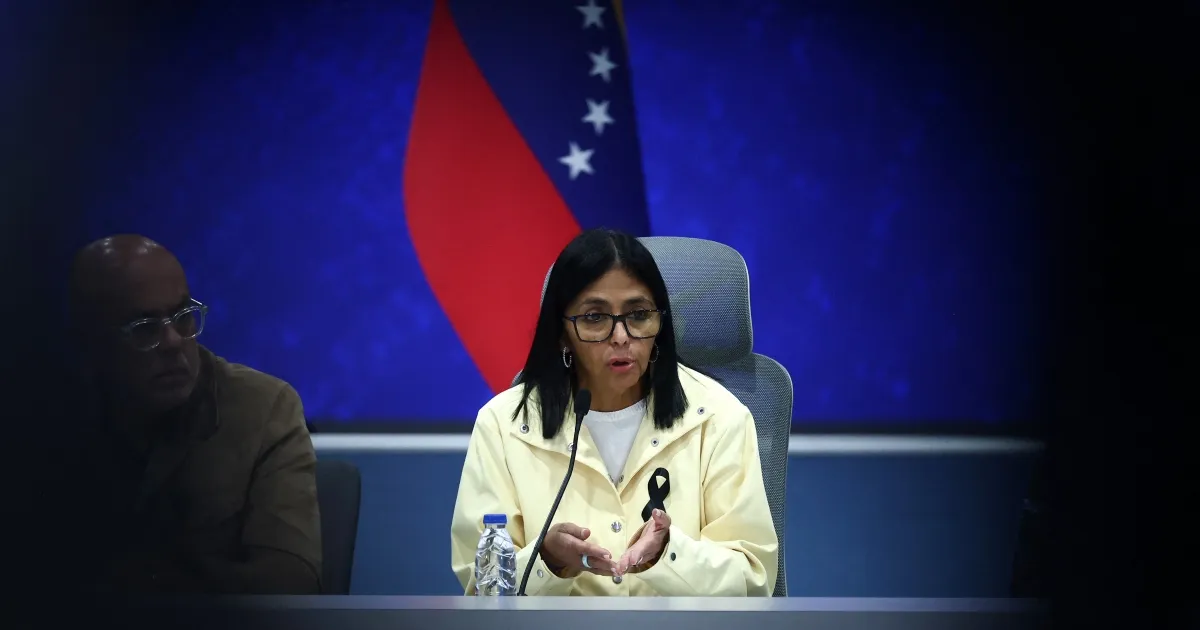
And it has nothing to do with the regime’s inability to provide timely and sufficient responses to the population affected by the two earthquakes on June 24, which destroyed a large part of La Guaira and left – so far – more than 3,500 dead, according to official figures.
On Sunday, July 5, the maximum period of 180 days established by the legal framework for Rodríguez to continue as the country’s leader expired, after being sworn in by the National Assembly six months ago, two days after the capture and transfer of Nicolás Maduro to US justice to face serious charges.
This implies, they indicate, that the Chavista-majority Parliament, chaired by Jorge Rodríguez, his brother, is obliged to declare Maduro’s absolute absence and call for an electoral process, according to the constitutional mandate. And there is no impediment to doing so.
Article 233 makes it clear that a state of emergency, such as the one declared after the two intense and consecutive earthquakes of last June 24, which left hundreds of thousands of victims and considerable losses in the north of the country, does not excuse constitutional expiration.
The population’s desire for new elections is reflected in the recent Latam Pulse Venezuela survey, prepared by AtlasIntel for Bloomberg on the tragedy.
The study reveals that 45.7% of Venezuelans consider holding elections more urgent than the reconstruction of devastated areas, while 21.6% respond that earthquakes do not alter the electoral process in the country.
Furthermore, Delcy Rodríguez’s management has 63.3% disapproval and 66% say they do not trust the governor in charge of the crisis compared to 24% approval, according to reports.
Delcy Rodríguez’s expired deadline
Whether or not Rodríguez fulfills the constitutional mandate under the tutelage of Donald Trump’s government is a crucial issue that would define the Venezuelan reality, according to experts.
“Venezuela would enter a phase of consolidation of authoritarianism, whose imprint will be its illegitimacy of origin and exercise, endorsed by foreign governments that serve as its guardian,” maintains the Constitutional Block, made up of Venezuelan jurists, and the citizen platform Ideas for Democracy.
However, jurist Miguel Ángel Martín Tortabu, professor and former Supreme Court judge in exile, maintains that Rodríguez will try to stay in power “at least for one more year,” despite the constitutional rule. And there is a factual reason for this: the three months have not really elapsed, in light of the facts and the court ruling.
“Chavismo itself built, within the Supreme Court ruling, the argument that there is a suspension, a temporary absence produced by a kidnapping that is not provided for in the Venezuelan Constitution. Under that premise, they can keep Delcy Rodríguez for a long time,” says the expert in procedural law.
“Rosary” of illegalities
Martín Tortabu points out that this process that began after Maduro’s capture is marked by “a string of illegalities” since the removal of the deposed dictator from office and that it would not be temporary, but permanent, but it was not declared by the National Assembly.
“The first thing to review is what the factual situation is and what the legal solution really is based on that factual situation,” he warns.
“The factual premise is that Maduro has been out of power permanently, not temporarily, since January 3, and that constitutionally meant that the
Vice President of the Republic, Delcy Rodríguez, had to take over as the person in charge—not interim—and call elections within the following 30 days.”
He explains that the National Assembly, as the head of the Legislative power, had to have assumed the consequences of the situation, that is, appoint a presidency in charge and direct the country towards the electoral process.
“Chavismo refused to comply with constitutional norms, as it has always done,” points out the expert.
And to do so, the regime resorted to the Supreme Court and the non-existent legal figure of presidential kidnapping, which has been the pillar of the regime’s unconstitutional narrative to stay standing during the last six months.
A kidnapping that does not exist
“The Supreme Court, in a political ruling, said that Rodríguez was in charge, as the only figure, of the temporary suspension that the Constitution establishes, for three months, but the body of the Judiciary at no time indicated that that time was passing, but rather that a kidnapping had occurred, something not contemplated in the Constitution,” he warns.
The legal situation in this case arose when the Supreme Court declared the temporary suspension, but not to call the election, since the maximum period can be extended for up to six months.
“This political ruling by a co-opted body like the Venezuelan Judiciary has the sole purpose of keeping the regime in power for as long as possible.”
Martín Tortabu insists that although Rodríguez and his cabinet “have been delegitimized for a long time,” they will try to maintain control of the country, at a time when President Trump maintains tutelage over the regime.
“There will logically be resistance, not only from a legal point of view, but also from an institutional point of view,” he says. And he adds: “Chavismo in the midst of the tragic situation will do so for two reasons. One, to not lose control of power; and two, to prevent justice in the future.”
Greater institutional crisis
The expert reaffirms that there is no doubt about the need to call elections within the “strictly constitutional” framework. “Since last January 3, today or tomorrow.”
He considers that if it does not happen in a short time, Venezuela would plunge into a deeper crisis, accentuated by the tragedy.
“We would enter a more severe institutional crisis, in addition to the effect of the earthquakes that caused so much damage to the population, which increases annoyance and restlessness and beyond the problem of legitimacy,” he specifies.
Martín Tortabu highlights that, given the expiration of Rodríguez’s term, a political solution is imposed: “The way out is political, it is to continue pressing to promote elections and, of course, the conditions to hold them.”
The technical commission on electoral matters led by opposition representative Dinorah Figuera, promoted by the Trump government to build a bridge between the regime’s Assembly and the opposition’s 2015 Assembly, has produced results, according to the lawyer.
“The process of choosing the new National Electoral Council is paralyzed and the two sectors will have to reach some agreements and issue a report in December 2026. This means that Chavismo could practically remain in power beyond this year. Although that will aggravate its legitimacy situation,” he maintains.
