
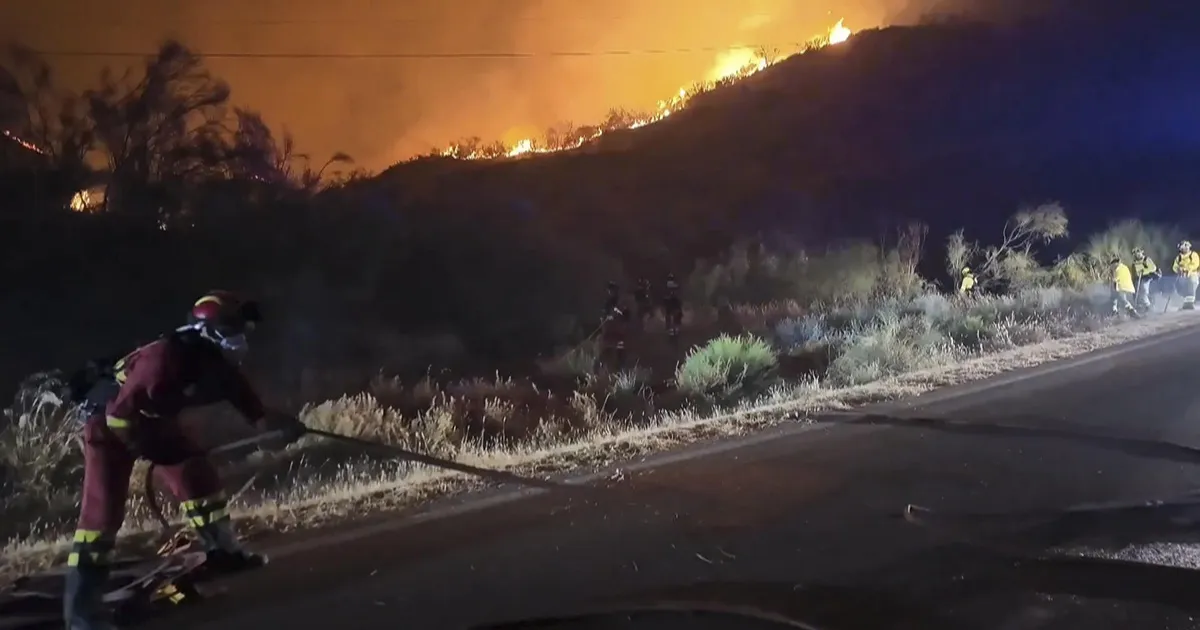
Blackened walls, vegetation reduced to ashes and almost all residents evacuated. The town of Bédar, epicenter of the destructive fire that left 12 dead in southern Spain, looks like a ghost town on Saturday, while firefighters work in the hope of soon controlling the flames.
The fire is evolving, however, favorably, after the “hell” experienced these days by the inhabitants of this area of the province of Almería where many foreigners reside.
“Today we can look with optimism,” said the regional head of Emergencies, Antonio Sanz, on Andalusian television, pointing out that, if good conditions persist, we could “start thinking about future stabilization.”
Hundreds of firefighters, with aerial and ground means, are working to put out this fast-moving fire that has so far devastated 6,600 hectares and is already one of the worst in the recent history of Spain.
The president of the government, Pedro Sánchez, will visit the area
The fire broke out on Thursday in Los Gallardos, an area of rugged terrain in the east of the southern region of Andalusia, full of ravines and scattered houses, trapping those who tried to flee. Eight people were injured and are hospitalized, four of them in serious condition, and almost 1,500 residents were evacuated.
“You could see the flames. This has been tremendous. A lot of fear. And we still have it in our bodies,” Manoli Ramos, councilor of the Bédar city council, told AFP.
On Saturday afternoon, the municipality was a ghost town, with practically all of its residents evacuated and the police cutting off access along the main road, AFP confirmed.
“Hell”
“In 2012 there was a big fire here in the town. They evacuated (…), but the next day they sent them to the town, to the houses, and good. But this has been horrible. It has been hell,” said the 72-year-old woman.
The 12 deceased were surrounded by a fire that was advancing at full speed when they tried to escape the flames by car or on foot, according to the authorities, who reiterated the obligation to follow the instructions of the emergency teams.
The victims are of different nationalities, as indicated the day before by the Minister of the Interior, Fernando Grande-Marlaska, who traveled to this area where numerous foreigners reside, who arrive attracted by the sun and tranquility.
“I was watching TV and I thought, ‘What is that? The wind has picked up.’ Then I opened the door to take a look and I saw a big black cloud,” said Austin Crilly, an 87-year-old British man evacuated from his home.
“Five minutes later: bang, bang, bang! ‘Take your money, take your cards and leave’ (…) It was the police and the neighbors,” he explained.
“I’ve never seen anything like it. You see it in the movies, but you don’t see it in real life,” recalls Martin Smith, a British tourist who evacuated with his wife from the campsite where they were on vacation.
“Encouraging”
After hours without finding more victims, the authorities remain hopeful of not receiving worse news.
“The Civil Guard had combed all the areas and told us that they had not found any more people. That does not prevent or mean that it cannot happen, but logically it is hopeful,” said the Andalusian head of Emergencies.
As the Minister of the Interior had done the day before, Sanz was cautious about the number of missing people.
“We must be cautious when it comes to reporting that there are 23 missing people, that’s not it,” he asked. “We’re talking about people whose family members can’t contact them, but they may be in shelters.”
At the moment, the Civil Guard has received seven reports of disappearance, he explained, but until the autopsies and identification of the bodies found are completed, a definitive balance cannot be established, since these people could be among the deceased.
Spain is a country on the front line of climate change, and has experienced increasingly frequent and prolonged heat waves in recent years, with temperatures often exceeding 40ºC, creating conditions conducive to large forest fires.
The fire “has had moments where it is estimated that it has been able to advance 100 meters per minute, which represents a virulence and severity that has never been known and is evidently as a consequence of the climate emergency,” considered the Spanish Minister of the Presidency, Félix Bolaños, from the affected area.
The fires devastated almost 400,000 hectares last year, the highest number recorded for the country by the European Forest Fire Information System, leaving eight people dead.
