
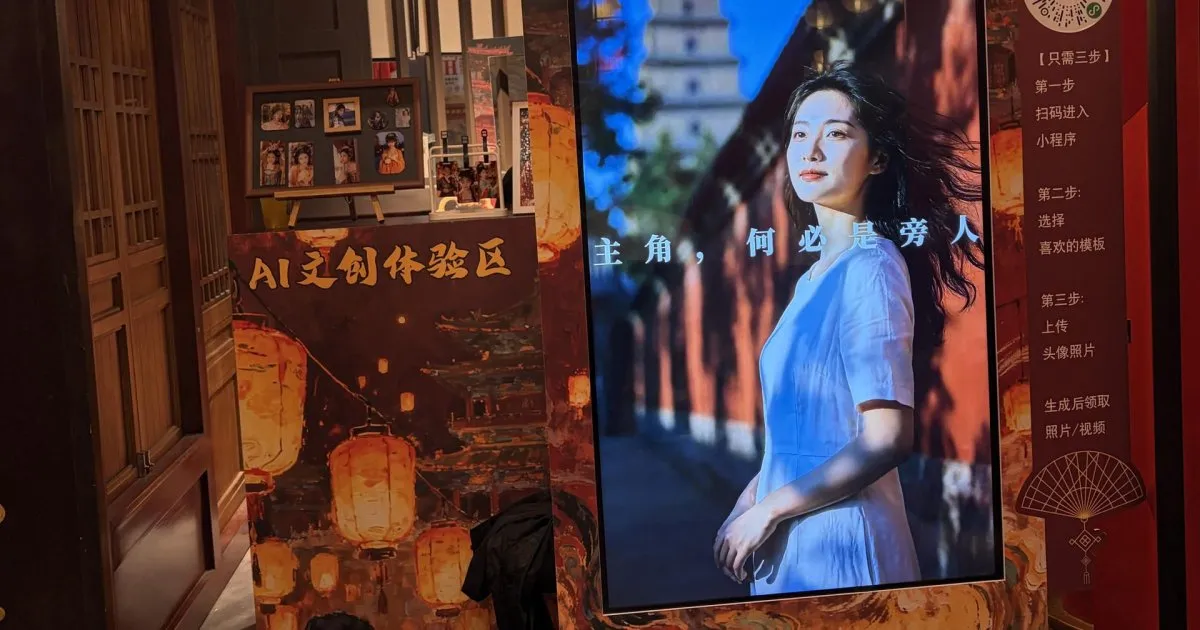
XIAN.- Taking a photo as an emperor of the Tang dynasty, examining a relic reconstructed pixel by pixel or consulting an artificial intelligence (AI) trained to master the local culture: this is the new tourism that the Shaanxi Cultural Investment Group (SCG) and Huawei seek to implement in the city of Xian.
To achieve this, both companies have jointly launched BoGuan, a large language model (LLM) that they have nourished with the cultural and intangible heritage of the province of Shaanxi (center) and designed to become the largest digital expert in one of the oldest cities in China.
In recent years, largely due to being home to the famous Terracotta Warriors, the region has seen an explosion in visitors with some 862 million domestic tourists recorded in 2025 and foreign tourism increasing by 98.14% year-on-year, according to figures provided by SCG deputy director-general Pang Bo in a recent media presentation.
The past inside the mobile
The most visible application for tourists is Zhiying Camera, through which they can merge their image into scenes that, with historical accuracy and in a few seconds, show them dressed in the clothing of the Tang Dynasty (618-907), when Xian—Changan then—was the capital and one of the most populated and cosmopolitan cities in the world.
“You are in a beautiful place and you want to take a good photo, but the place is full of people and it is not easy to get one. With AI you can take it anyway,” explains Wang Peng, director of Cultural Tourism Business at Huawei Computing Platform.
The LLM also functions as an intelligent travel assistant with which tourists can interact by message or voice to plan routes, answer questions in real time or obtain personalized recommendations.
Wang emphasizes that, while “previously you could only listen to explanations at fixed points, now you can interact with the model anytime, anywhere,” referring to its helping role in museums.
Among other applications, the model also supports the digital reconstruction of historical pieces or the generation of commercial videos based on the region’s heritage. The goal, in the manager’s words, is to “present the culture more accurately and share it more widely.”
Data, key piece
Behind these results is the way the model was built. To ensure the reliability of the responses, images or videos generated, BoGuan was fed with more than 1.2 billion data on the provincial heritage, using both video footage, audio recordings or three-dimensional models, in addition to pieces of text.
Jin Yan, president of SCG’s Digital and Intelligent Cultural Technology Group, highlights this database as a differentiating element of general models and a guarantee of historical rigor.
“The reproduction of the content is more precise and better adjusts to historical realities,” compared to general models, he explains, giving as an example details such as differences in clothing from different periods.
Jin also highlights the value of its “fully domestic” construction, in which Huawei’s Ascend 910C chips – alternatives to the Western processors that dominate the global market – are combined with existing open and closed source language models, on top of which the specialized cultural heritage layer has been lifted.
The new standard
The result is BoGuan, launched in September 2025 and presented by SCG and Huawei as the world’s first commercial multimodal model for cultural tourism, an industry that thus joins the global revolution of large language models.
Edric Chu, general director of Huawei’s Shaanxi office, predicted that artificial intelligence will become essential infrastructure and become “the standard” for museums and tourist attractions.
“AI is not simply a set of technologies,” says Chu, who claims that it has become a key factor capable of activating millennia of cultural heritage, transforming travel experiences and boosting the sector.
SOURCE: EFE
