
“We will be there for our new and great friends. The first reports are not good,” said the Republican president.
The United States has maintained a diplomatic presence in Venezuela since January of this year, after the capture of Nicolás Maduro, who is accused of narcoterrorism. Since then, the Trump Administration has remained vigilant over Delcy Rodríguez’s interim term and deployed its three-stage plan: Stability, recovery and transition.
On June 29, the United States Government increased emergency aid to more than $300 million to face the consequences of the double earthquake. Four days earlier, on June 25, aid valued at $150 million had been announced.
According to the State Department, $50 million of the additional amount will go to “fund critical operations of partner organizations”: World Vision, the International Organization for Migration (IOM) and the World Food Program (WFP), as well as the other half for the “common fund for Venezuela” of the United Nations Office for the Coordination of Humanitarian Affairs (OCHA).
The United States chargé d’affaires in Caracas, John Barrett, noted on June 27 that Washington’s response represents one of the largest assistance operations carried out by his country in the face of a catastrophe like the one Venezuela is experiencing.
Humanitarian tasks
Barret stressed that the priority is humanitarian tasks.
“I have seen with my own eyes the size of this disaster. The scenario is devastating,” the diplomat said in an interview with N+ Univision.
Barret also said that the US military forces work in coordination with the National Armed Forces (FAN), at a time when citizens have indicated that the performance of the Venezuelan military during the tragedy was insufficient.
The official referred to the management of the interim in the midst of the emergency: “I have seen total transparency and a concern to take care of the people, to continue working with us.”
The interim reported on July 2, 2,595 people have died after the earthquakes.
Regarding the effects of this catastrophe on the democratization plan in Venezuela, Commander Jesús Romero points out that the United States maintains the strategy.
“North American policy is cold, calculated, it does not take emotions into account, as Venezuelans especially see it, to make decisions,” Romero asserts. DIARIO LAS AMERICAS.
In fact, diplomat Barret said on July 1: “The president and Secretary of State, Marco Rubio, have outlined a three-phase plan for Venezuela that remains intact.”.
Commander Romero emphasizes that the foreign policy is clear. He explains that the US has a humanitarian arm that acted after the earthquake and that activated humanitarian aid worth millions of dollars, while temporarily lifting sanctions to make it more viable to address the emergency.
For this reason, Romero rejects the accusations that the Trump Administration “acts in the best interests of the regime.” He adds that this vision shows “a disconnection and an incongruity.”
The analyst He questions that Venezuelans think that, during humanitarian work, US representatives start fighting with them in the streetsor that the marines will go looking for leaders of the ruling party.
On the other hand, he asserts that US humanitarian aid arrived “with a military logistics chain much larger than what the Venezuelan media can appreciate.”
At the same time, he assumes that the humanitarian situation after the earthquakes “may have some type of delay towards phases 2 and 3 of the plan in Venezuela.”
On Monday, June 29, The State Department referred to the controversy between the Minister of the Interior and Justice, Diosdado Cabello, with an American rescue worker. Cabello is in command of operations in the Disaster Zone in La Guaira.
“There was an unfortunate misunderstanding between a member of a US urban search and rescue team and Venezuelan interim authorities,” the State Department told NTN24.
For his part, Republican congressman Mario Díaz-Balart said: “Delcy Rodríguez, Diosdado Cabello and the rest of the regime’s leadership must know that the United States is monitoring this situation very closely. “You better not interfere or sabotage these humanitarian efforts.”
Thanks from Delcy Rodríguez
On Monday, June 29, The State Department referred to the controversy between the Minister of the Interior and Justice, Diosdado Cabello, with an American rescue worker. Cabello is in command of operations in the Disaster Zone in La Guaira.
“There was an unfortunate misunderstanding between a member of a US urban search and rescue team and Venezuelan interim authorities,” the State Department told NTN24.
For his part, Republican congressman Mario Díaz-Balart said: “Delcy Rodríguez, Diosdado Cabello and the rest of the regime’s leadership must know that the United States is closely monitoring this situation. They had better not interfere or sabotage these humanitarian efforts.”
The interim president, Delcy Rodríguez, thanked the US for its help on June 27. “I received a call from President Trump and the Secretary of State, who reaffirmed the support of the United States Government during this difficult time for Venezuela. “We are deeply grateful for this gesture of friendship and cooperation,” he said.
Poor management of the crisis
Political consultant Ricardo Ríos points out that the handling of the tragedy by the Venezuelan interim government “has been disastrous, from an operational point of view and from a communication point of view.”
Ríos indicates to DIARIO LAS AMERICAS that public opinion has been very critical about the management of the crisis, “and the perception, from a communication point of view, is overwhelmingly negative.”
He adds that operationally the execution of the same Venezuelan State can be compared with the Vargas landslide. Point out that
“The Armed Forces have had a much less leading role on this occasion. In some cases, it has been an obstacle point.”
The analyst points out that, in these situations, “whoever controls the power, no matter how diminished it may be, has an advantage: in the face of fear, people generally seek higher protection.” He adds that, although the State is not offering that protection efficiently, it is the one who continues to be required to do so.”
Furthermore, Ricardo Ríos highlights: “Perhaps the most key point of all this is the almost unconditional support that the United States government has given to the interim, that is what it is about because it is a tutelage. And the statements of John Barrett, from the same State Department, have been quite in line with the ruling party.”
He also emphasizes: “This is defining the waters of precisely how the United States Government is associating itself with the interim.”
He notes that this situation has a geopolitical logic. “Without a doubt, this is going to be an excellent opportunity to postpone everything. And that famous phase three proposed by the United States remains in question,” he says.
The political consultant asserts that there is still a kind of idolatry on the part of a segment of Venezuelan society about what the United States and its values of freedom and democracy mean.
At the same time, he speaks of “a progressive disappointment about the United States, but I wouldn’t say it is widespread yet.”
Response in Venezuela
In this equation, analyst Ríos puts an important aspect on the table: the response of Venezuelan society.
“That response has initially been one of great solidarity and activation. Now that activation and mobilization can become, partially, a political action, but that requires leadership. If the opposition leadership remains blurred, then obviously this is going to be postponed in one way or another,” he maintains.
Likewise, he affirms that it would be expected that the leadership antagonistic to the interim, which is fundamentally concentrated in María Corina Machado, “would do something about this situation, remaining silent with crossed arms will also be judged.”
Machado, Nobel Peace Prize 2025, denounced on June 29 that the interim closed “Venezuela’s commercial airspace to prevent” their entry.
He added: “They had to reverse it, but they have threatened those who want to facilitate my return.”
“It is very clear to me that there was a plan for María Corina to return to Venezuela these days. Unfortunately, there was the earthquake event, but the organization that helped her leave Venezuela to receive the Nobel Prize in Norway is in Curacao,” says Commander Jesús Romero.
US commitment
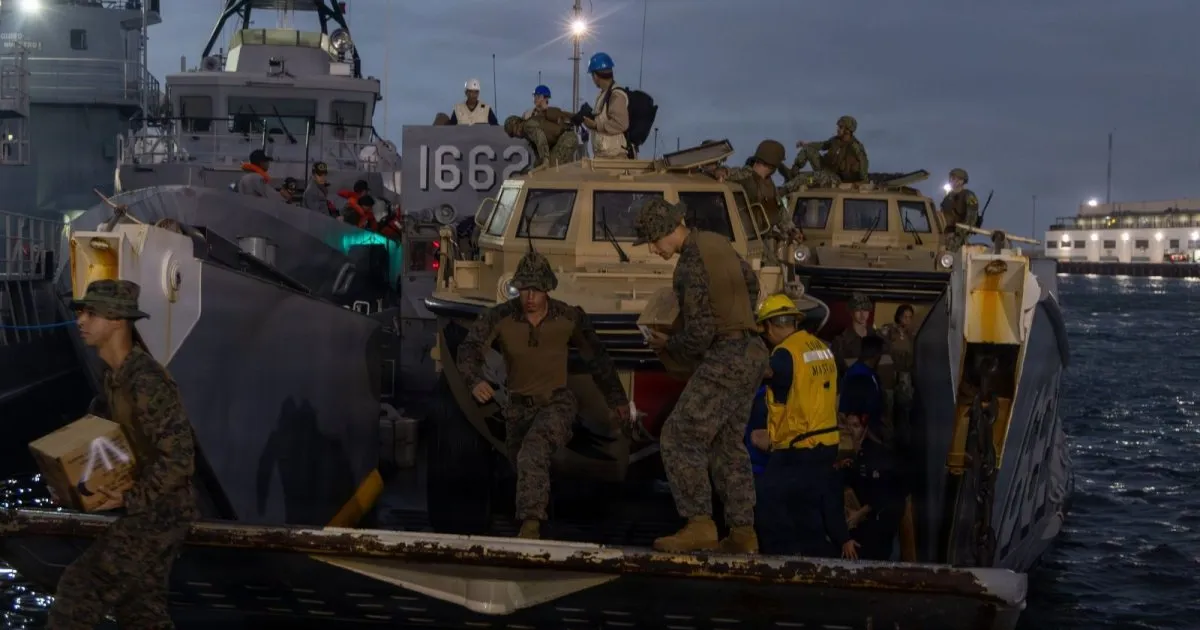
The United States sent more than 2,000 soldiers to Venezuela to reinforce search and rescue efforts after the earthquakes.
“Under the leadership of President Trump, the United States is fully mobilized to support the Venezuelan people in the wake of these devastating earthquakes. The State Department is working around the clock to lead a large-scale response, with the support of the War Department,” the Southern Command said.
They stressed that the interim authorities are cooperating “fully” to accelerate this large-scale humanitarian response.
In this sense, the Chief of Mission “continues to lead efforts to mobilize response teams from the United States and the international community, reach the most affected communities, restore vital infrastructure and deliver life-saving assistance.” We remain firm in our commitment to be at the side of the Venezuelan people.
U.S. Marine Corps Major General Kevin J. Jarrard arrived in Caracas on June 26. A team of about 100 airmen with experience in airport management arrived in Venezuela on Sunday, June 28, to assist authorities in “increasing the vital flow of arrival and departure air traffic.”
Within the deployment, an Air Force C-130 Hercules cargo plane and MV-22 Osprey aircraft from the United States Marine Corps have been used to transport personnel, equipment and supplies.
Additionally, Navy UH-1Y Venom helicopters have been used for aerial identification of areas affected by the earthquakes.
@snederr
