
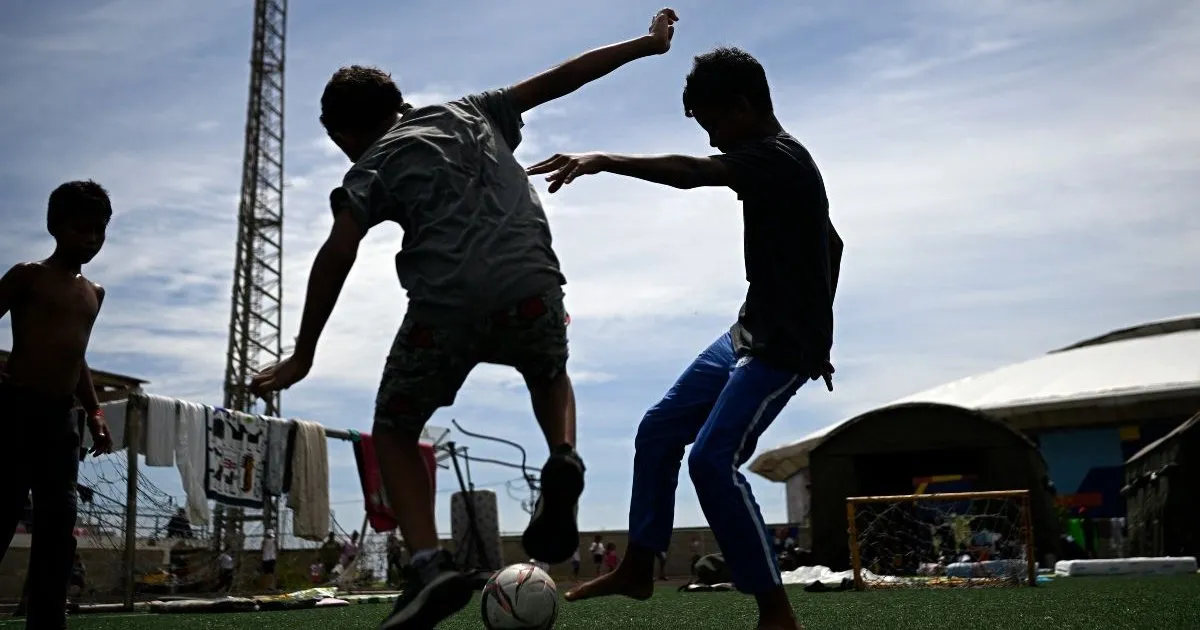
CATIA LA MAR.- “What do we want to play?” he asks. Juan Cordero to encourage a group of children who were left homeless after the earthquakes in Venezuela. “Football!” the children’s voices respond in chorus as they start a race between tents and ambulances.
Bricklayer and soccer coach in the nursery for the eight to 12 year old category, Cordero now seeks to cheer up the children who have been out in the open for days in the parking lot of a pharmacy in Catia la Mar, a town devastated by the double earthquake.
“No push (pushing). This is as if we were playing soccer, we score one by one,” instructs the 45-year-old athlete to the little ones who run in circles in the improvised camp.
Adjacent to the international airport that was partially destroyed, Catia La Mar is one of the areas of the coastal state La Guaira most affected by the earthquakes of magnitude 7.2 and 7.5 on June 24 that have caused more than 1,700 deaths.
Cordero was left on the street like thousands of others who lost their homes in the earthquakes that devastated entire blocks.
The first thing he asks for is sports equipment for the children. “They are all my children,” he says tenderly and jokingly.
“There are many (things) that one would like to say or ask, like life. But hey, help me with sports materials (…) with what we work on in football,” he says. “We are doing this for them, so that they can clear their minds,” he explains.
He lost his sister and several of his neighbors. “I’m not asking for real (money), or anything,” he says. They hope they will donate balls to play soccer, vests, cones and shoes for the children in the seedbed.
More than 58,000 buildings were damaged or destroyed by the earthquakes, according to a preliminary assessment of satellite data by US researchers.
Critical situation
The situation in the state of La Guaira, near Caracas, is catastrophic. Hundreds sleep in the streets. Others dig day and night among mountains of rubble in search of their dead to bury them. The hope of finding survivors is practically fading.
“Round, turn, turn, turn,” Cordero shouts at the top of his lungs to encourage the children to run in circles. “Grab the doctor,” he says to the little ones who, laughing, rush to hug one of the volunteer doctors.
Cordero’s wife, who suffered injuries, rests in a makeshift tent while he plays with the children. His three children accompany him. “Let’s go step by step, now to live one day at a time,” he consoles himself.
