
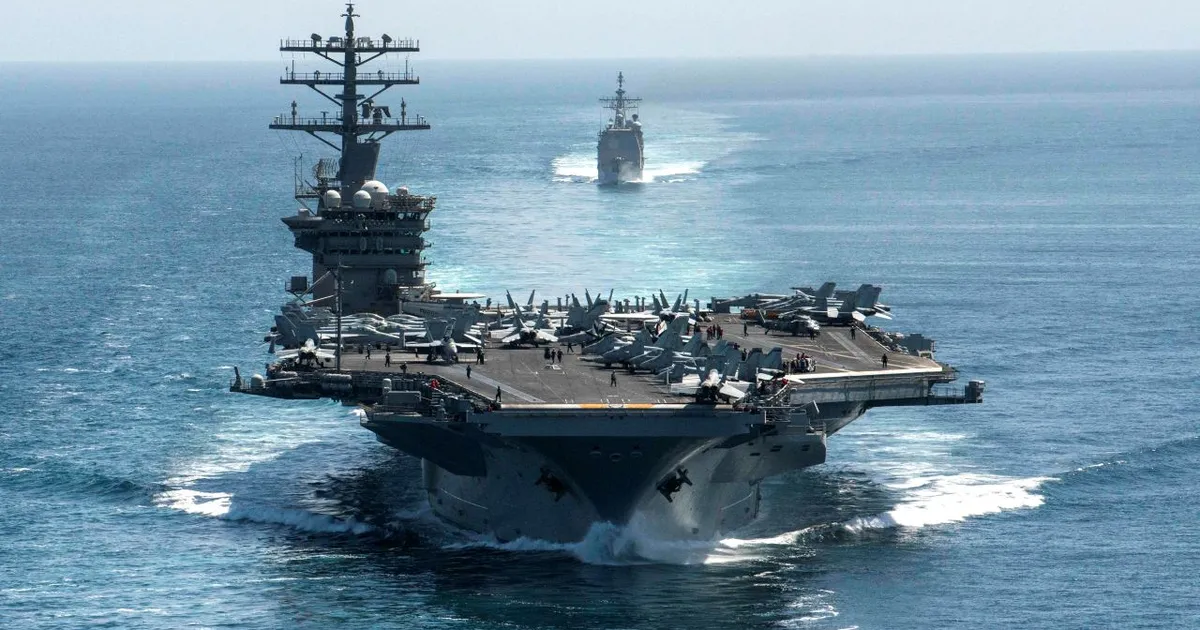
MIAMI — The US military deployment at this time in Caribbean waters, which has been reported as breaking news, does not represent a symbolic message, retired commander of the United States Naval Force Adam Gutiérrez, an expert in military intelligence and political analyst, warned in statements to Diario Las Américas.
“The first thing to understand is that American naval combat groups are not deployed simply to send political or symbolic messages,” he said.
And he expanded, “the presence of an aircraft carrier represents a complete architecture of military options, intelligence, surveillance, electronic warfare, deterrence and yes, of course rapid response. Its main function is to give the president of the United States a vision of capabilities and courses of action, from strategic pressure and intelligence operations, to limited precision actions, evacuations, maritime blockade, interdiction, air control or neutralization of specific threats.”
In the expert’s opinion, it does not represent that Washington is planning a military offensive in Cuba tomorrow; However, he acknowledged, the US military buildup in the Caribbean seems designed precisely to avoid running out of options if the situation deteriorates rapidly in Cuba, or if threats that Washington considers intolerable emerge within 90 miles of the US mainland, and here is a fundamental point,” the officer warns.
He then specifies, “We are not seeing preparations for a massive Iraq-style ground invasion. That would be extremely costly both politically and strategically at this time and is probably not the main option on the table.”
National security
In Gutiérrez’s opinion, if the execution of the military option in Cuba was being planned one hundred percent, “we would be seeing a massive military mobilization much larger than what we see at the moment; for example, the heavy troops training in Puerto Rico or Guantánamo itself, or simply from Florida. We are not seeing movement of heavy army troops, at this moment,” the commander noted.
And he warned that “the strategic perception of Cuba in Washington has changed. It is no longer seen solely as an ideological or human rights problem. Increasingly, within the framework of national security, Cuba is (an objective of interest) and for the defense of the nation. It is within the national security strategy of the United States, where the Caribbean is no longer a series of diplomatic relations only, but basically part of the defense strategy of the United States and the hemisphere. In simple terms, this deployment does not mean that Washington decided to attack tomorrow.”
In addition to the visible military component, national security specialists have been warning for years that the Caribbean has regained strategic importance for Washington amid growing global geopolitical tensions. The increase in ties of some governments in the region with Russia, China and Iran, together with the economic and social deterioration in Cuba, is part of the concerns that analysts increasingly link with US hemispheric defense.
Experts consulted on security issues point out that, in scenarios of accelerated crisis in Cuba, the US also evaluates factors linked to mass migration, evacuation operations, regional stability, drug trafficking and protection of strategic maritime routes in the Caribbean.
In this context, the Guantánamo Naval Base continues to be considered a key facility for US operational projection in the region, while the deployment of naval groups allows maintaining surveillance, intelligence and immediate response capabilities in the event of any scenario that may arise near the US continental territory.
Although there are no public signs of preparations for a large-scale ground intervention, analysts consider that Washington seeks to avoid being limited by a possible sudden deterioration in the Cuban situation or by threats that could alter the regional security balance.
The perception of Cuba within certain strategic sectors of Washington has also begun to appear more frequently associated with discussions about national security, foreign influence in the hemisphere and regional stability.
