
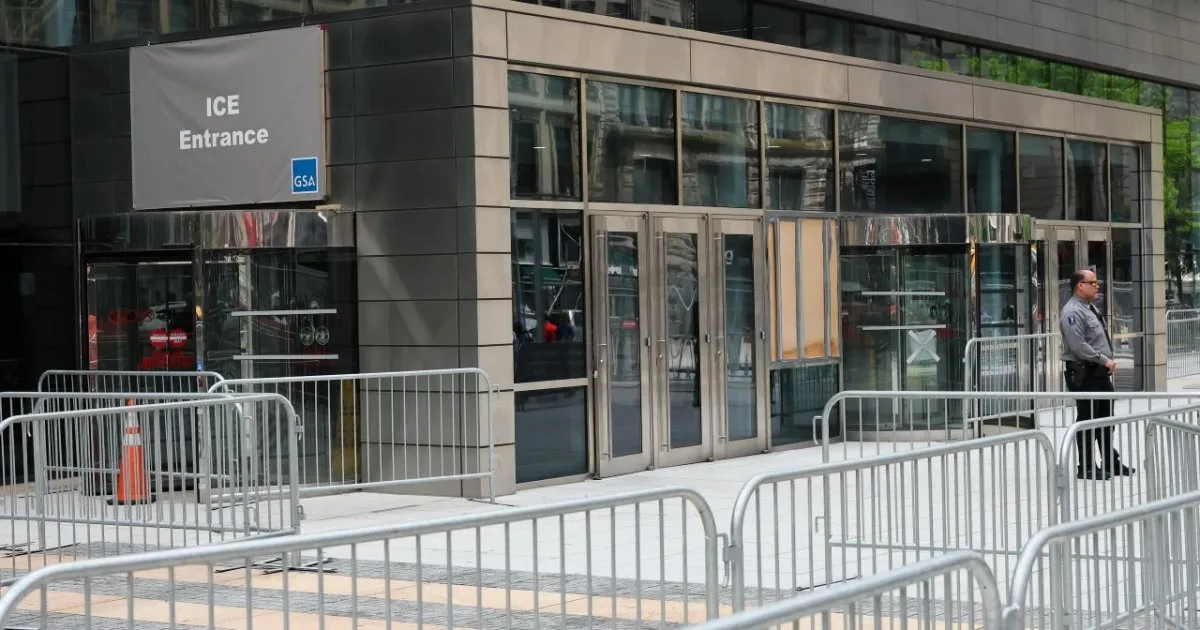
WASHINGTON — The United States Department of Homeland Security (DHS) ordered this Tuesday that immigration lawyers accused of submitting false asylum applications for their clients be vigorously pursued, according to a memo cited by CBS News.
DHS General Counsel James Percival directed Immigration and Customs Enforcement (ICE) to develop “anti-fraud policies” to prevent immigration attorneys from filing baseless asylum cases, the latest step in the administration’s push to speed up deportations, expand law enforcement and challenge immigration-related legal infrastructure, according to the document cited by the television station.
In a memo dated May 26, DHS General Counsel James Percival directed ICE attorneys within the Office of Chief Counsel to develop “anti-fraud policies” designed for the “rigorous application” of existing federal anti-fraud law.
The order is part of the latest measures taken by US President Donald Trump in his campaign to promote mass deportations and reduce undocumented immigration in the United States.
“Common practice”
The directive states that asylum applications have become a “standard practice” used by immigration attorneys who argue that “virtually every undocumented immigrant” faces persecution or torture in their home country because of a protected characteristic, such as race or political opinion.
The memo states that ICE’s efforts against asylum claims “should include action against immigration attorneys who file false asylum claims in immigration courts.”
Although the guideline does not create sanctions against lawyers, it indicates that ICE will begin to use existing administrative enforcement tools more frequently to act more forcefully against them.
Last week the Trump Government announced a new measure that will require certain immigrants to leave the country to apply for permanent residence, known as a ‘green card’, which is also a challenge for immigration lawyers who usually appear with their clients in processes within the United States.
Courts clogged by asylum cases
According to the Transactional Records Access Clearinghouse (TRAC) organization at Syracuse University in New York, as of March of this year, there were 3,288,186 cases pending in the Immigration Courts, of which 2,318,797 are asylum applications that have not been reviewed and/or resolved.
Asylum seekers are awaiting hearings or a final decision on their asylum claims in immigration courts. That wait could take up to 10 years.
The Executive Office of Immigration Review (EOIR), a DOJ agency, appointed 77 immigration judges; This is the largest promotion of new magistrates in the history of the country.
EOIR has hired 153 permanent immigration judges this fiscal year, the highest number in a single year in the agency’s records. In total there are now 700 immigration judges nationwide to respond to more than three million cases.
Florida with the longest delay
According to geographical distribution, Florida is where there is the greatest delay in the review of cases, with 518,639. Then there is Texas, where 361,760 migrants are waiting for a decision; followed by California with 348,273; New York with 316,199 and New Jersey with 230,090 requests.
According to the Florida Immigration Court, in 2022 the backlog doubled to reach 300,000 cases when in 2021 there were 150,000. While in 2024 the highest peak of unresolved requests was recorded when more than 550,000 cases were exceeded in a status of lack of resolution.
Among the five countries whose nationals prefer the state of Florida are: Cubans: 90,274, followed by 53,907 Haitians; 36,359 Venezuelans; 27,693 Nicaraguans and 20,105 Guatemalans, all awaiting resolution of their cases.
But it’s not just Hispanics who gravitate towards the warmth of Florida, there are also Russians, with 2,742 applications recorded. They are the last link in the chain of 13 nationalities registered by the Miami Immigration Court.
The measure is in the middle of the debate between those who affirm that President Donald Trump is on the path to restoring the rule of law in the immigration field and those who believe that immigration policies are being tightened with deportations and imposing greater restrictions on the figure of asylum.
The White House has pushed to tighten the criteria for immigration judges to review foreigners’ applications, especially those in asylum cases.
EOIR noted that, since President Trump’s arrival, immigration courts have reduced their backlog of cases in those courts by more than 447,000 cases, reducing the backlog from approximately 4 million to less than 3.53 million.
