
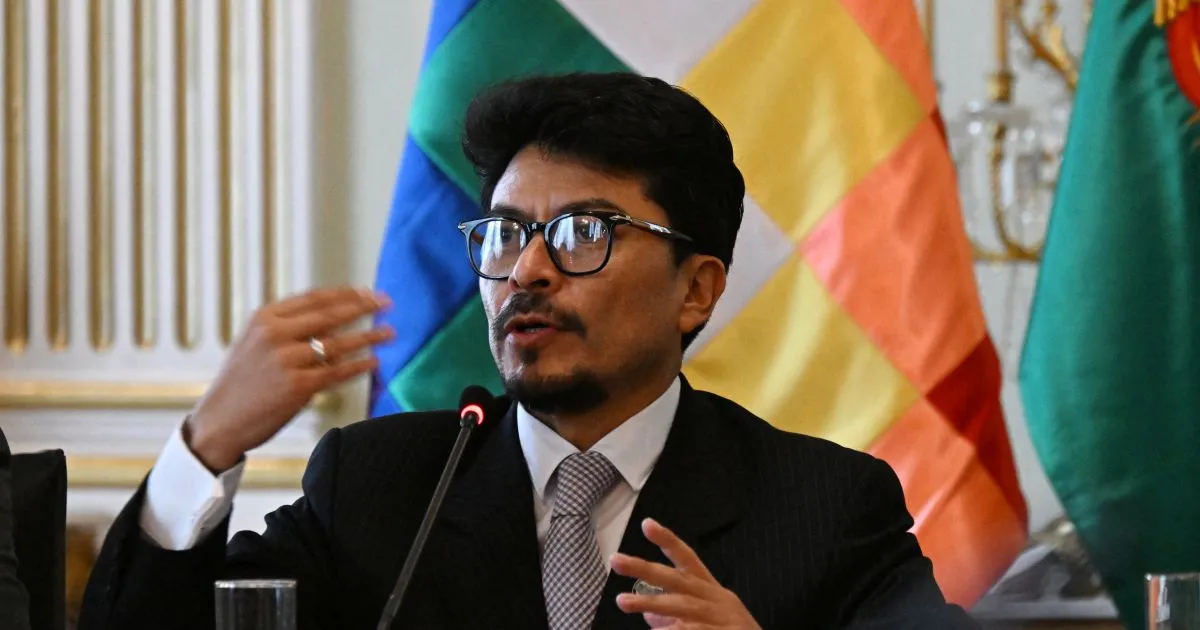
LA PEACE.- Bolivia is seeking a technological cooperation agreement with the United States to develop its lithium industry, after the signing at the end of April of a memorandum of understanding on critical minerals, Bolivian Foreign Minister Fernando Aramayo reported this Wednesday.
The Andean country remains behind in the exploitation of this mineral, despite being the second with the largest resources in the world, according to the United States Geological Survey (USGS). The so-called white gold, key to the energy transition, is strongly in demand for the manufacture of electric batteries.
At the end of April, the government of Rodrigo Paz and Washington signed a first memorandum of understanding on critical minerals, including lithium, to share knowledge and explore forms of cooperation. The leading world power then expressed its interest in securing supply chains.
“With the United States we are very interested in the technological issue (…), generating an agreement that allows us to see how we can take steps in the industrialization of lithium,” Aramayo said in a conference with the foreign press in La Paz.
In 2025, during the administration of leftist Luis Arce (2020-2025), Bolivia signed contracts to build mineral extraction plants with the Russian Uranium One and the Chinese state-owned CATL, the world’s largest producer of batteries.
The projects were not started because they must be ratified by Parliament, where they are questioned for an alleged lack of transparency in the negotiations.
The chancellor acknowledged that Bolivia still does not have the human resources to operate its own extraction plants and that it first needs hydrogeological studies to know where to install them, since lithium processing requires a lot of water.
Raw material
Meanwhile, he expressed his objective for Bolivia to be a “participant” in the world innovation scene, hand in hand with foreign industries that use lithium as a raw material.
“Why not bring them? They have fast technology, they can install themselves here (…) it is convenient for them to be close to the minerals to reduce costs,” he said.
The nation, he noted, will also seek cooperative approaches with other countries such as Brazil and Germany.
In 2025, Bolivia produced just 2,400 tons of lithium, according to the Ministry of Mining. The USGS estimates that its neighbor Chile, the world’s third largest producer, extracted 56,000 tons.
