
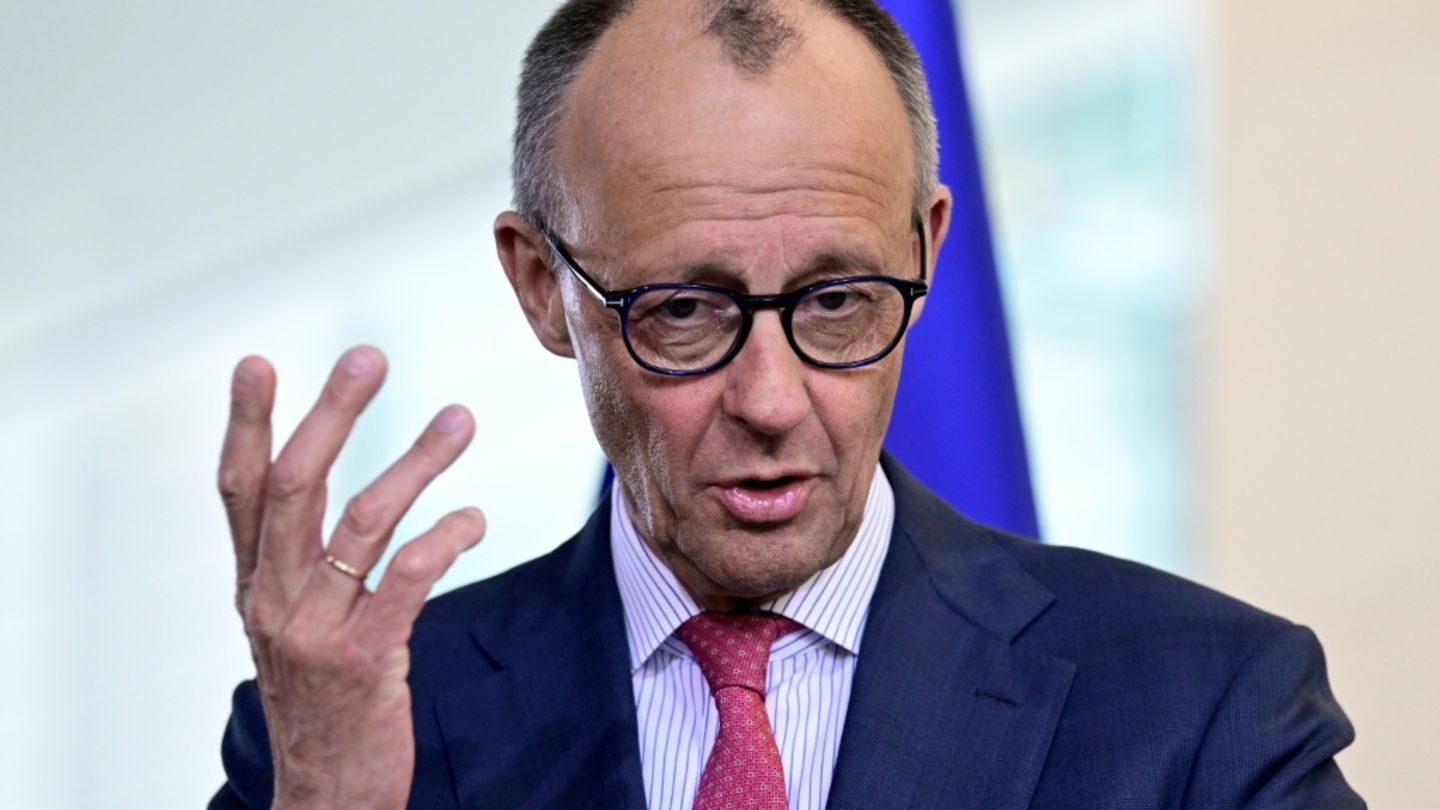
He remains convinced that “the Americans are important partners for us, the most important in the North Atlantic alliance,” said Merz. He had to “accept” that the US President had a different opinion than the federal government on issues such as the Iran War. Regardless, Europe and the USA have a “common interest” in “walking the path together to end this conflict and then, for example, to end the conflict and the war in Ukraine.”
Regarding the announced troop withdrawal, Merz said: “It may be a little more tense, but it’s not new.” The Chancellor also confirmed that the deployment of Tomahawk cruise missiles promised by Trump’s predecessor Joe Biden would not initially take place. “The Americans don’t have enough themselves at the moment,” said Merz. However, the train for stationing medium-range missiles “has not left”.
When asked, NATO initially did not comment on the lack of stationing of US medium-range missiles in Germany. The Federal Ministry of Defense also did not want to comment on this when asked by AFP.
Before Merz’s appearance, US President Trump had further tightened his announcement of a troop withdrawal from Germany. While there was talk of 5,000 soldiers on Friday, Trump said on Saturday: The USA would reduce the number of its soldiers stationed in Germany “significantly more, by far more than 5,000.” He initially did not give an exact number.
According to official information, a good 36,000 US soldiers were stationed in Germany at the end of December – more than in any other European country. The Defense Ministry spoke on Saturday of “a total of almost 40,000” US soldiers who are “currently” stationed in Germany.
Trump had already threatened a partial withdrawal from Germany in his first term in 2020. Since the start of his second term in office in January 2025, he has insisted that Europe should take more responsibility for its own security.
Now Trump seems determined to punish those allies who criticize the US and Israel’s war against Iran or who do not contribute to securing the Strait of Hormuz, which is important for global trade and has been largely blocked by Tehran since the start of the war. However, Chancellor Merz denied there was a connection between his criticism of the US’s conduct of the war and the troop withdrawal. He reiterated his offer that Germany would be ready to secure a peace settlement after the end of the Iran war.
The USA and Israel started the Iran war with air strikes at the end of February. Tehran responded with missile and drone attacks on Israel as well as several Gulf states and US facilities in the region. Iran is also blocking the Strait of Hormuz while the US is blocking Iranian ports.
NATO spokeswoman Allison Hart said on Saturday in the online service X that the military alliance was working with the USA “to better understand the details of its decision on the troop contingent in Germany.” The US decision underlines that Europe must do more for transatlantic security.
Federal Defense Minister Boris Pistorius (SPD) made similar statements. Europeans must “take more responsibility for our security.” Germany is “on the right track,” assured Pistorius.
In Washington, two leading Republicans expressed criticism of the US government’s plans. In a joint statement, the chairs of the Senate and House defense committees, Roger Wicker and Mike Rogers, warned that withdrawing troops from Germany risked “sending the wrong signal to Vladimir Putin.”
Wicker and Rogers also emphasized that Germany had met Trump’s demands for increased defense spending and that US aircraft could use bases in Germany and German airspace during the ongoing conflict with Iran.
