
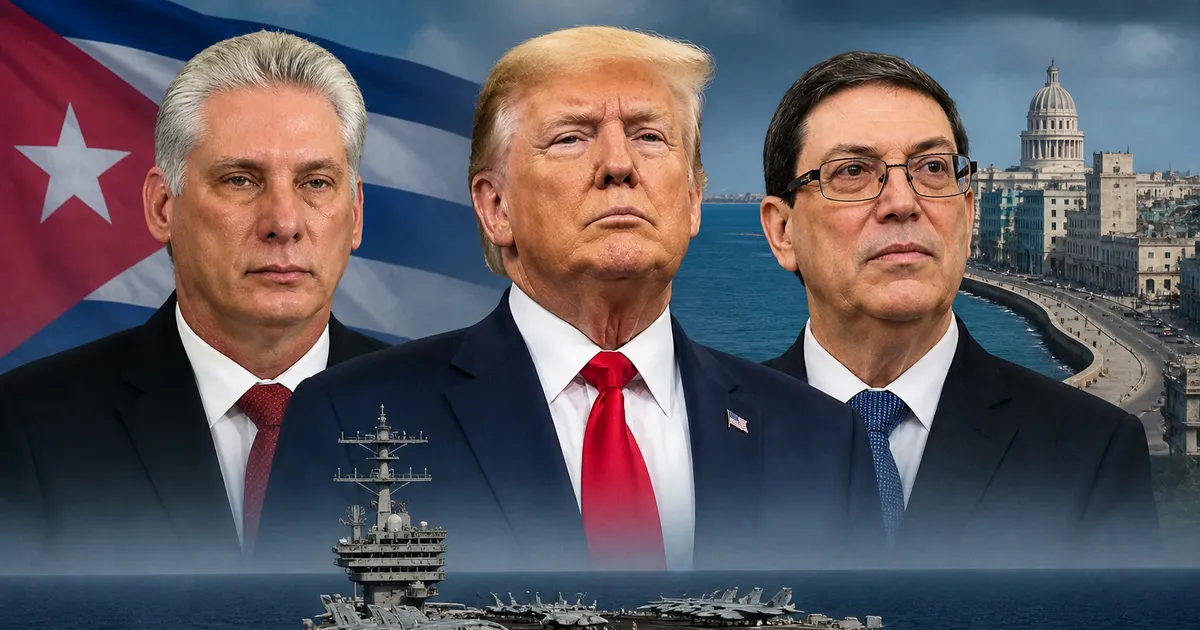
MIAMI. – The designated Cuban leader Miguel Díaz-Canel responded this Saturday to the statements of President Donald J. Trump, who on Friday night stated during an event in West Palm Beach, Florida that the United States “will take over Cuba almost immediately,” in a speech that raised the tone towards the Cuban government apparatus.
Díaz-Canel assured that “no aggressor, no matter how powerful, will find surrender in Cuba” and maintained that the country would respond with “a people determined to defend sovereignty and independence in every inch of the national territory.”
The representative of the Castro regime described the comments as a “dangerous and unprecedented” threat and took the message to the international level by questioning: “Will the international community allow such a drastic criminal act?”, in an attempt to expand the scope of the conflict beyond the bilateral sphere.
For his part, Foreign Minister Bruno Rodríguez Parrilla stated that this is a “clear and direct threat of military aggression” and warned that Washington’s actions “raise the tension against Cuba to dangerous levels.”
Rodríguez added that Cubans “do not allow themselves to be intimidated” and linked this scenario with a hardening of US policy towards the island, in line with the official narrative of the dictatorship.
The statements of both officials occur in a context of persistent friction between Washington and Havana, marked by sanctions, diplomatic tensions and long-standing political differences.
In parallel, different sectors have questioned the internal situation on the island and its impact on the population, an element that is part of the debate that exists on a global scale about current Cuban affairs.
On social networks, some reactions reflected skepticism towards the official discourse. “The people are prepared, but to receive even if it is electricity and food,” wrote one user, in a criticism that summarizes the discomfort in the face of the daily crisis that the communist leaders try to hide.
In summary, Trump’s statements and the immediate response of the Cuban government reactivate a scenario of high political tension that once again places the relationship between both nations at a sensitive point.
Meanwhile, a large number of Cubans inside and outside the island maintain their focus on the outcome of this issue, and the hope it confers on Cuba’s freedom.
