
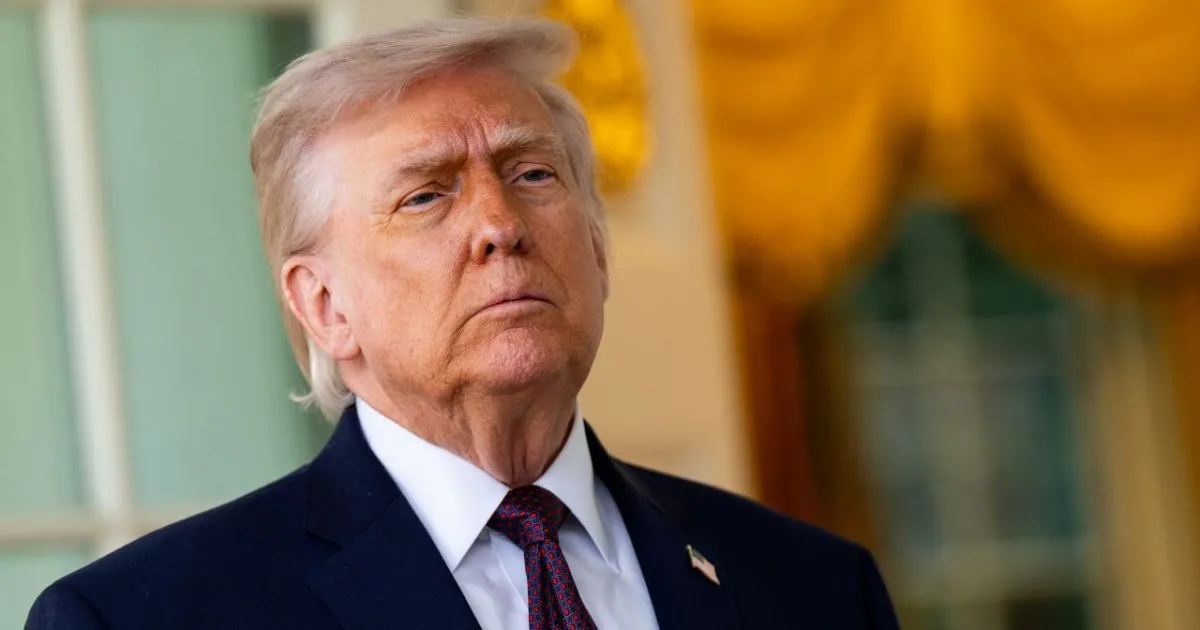
WASHINGTON — The president of the United States, Donald Trump, announced this Tuesday that, at the request of Pakistan, he has decided to extend the ceasefire that was due to expire on Wednesday until Iran presents a proposal for an agreement.
“I have ordered our Armed Forces to maintain the blockade and, in all other respects, remain prepared and operational, and, consequently, I will extend the ceasefire until your proposal is presented and negotiations are concluded, whatever the result,” he announced on his social networks.
The tenant of the White House has made this decision at the request of the Pakistani authorities, as he indicated, so that the Government of Iran, of which he has said thatis “severely divided”can “present a unified proposal” to the talks planned in Islamabad.
Trump assured on his Truth Social platform that the decision was made “from the fact that the government of Iran is seriously fractured, which is not surprising.”
Naval blockade remains
Despite extending the ceasefire, Trump affirmed that he maintains the US naval blockade against Iranian ships that he ordered after the failure of the first round of negotiations with Iran on April 11 and 12.
US Vice President JD Vance was scheduled to travel to Islamabad on Tuesday morning for a second round of negotiations, but suspended the visit as Tehran did not officially confirm its participation.
Trump met at the White House with the country’s National Security leadership hours before the two-week ceasefire declared in early April expired on Wednesday.
In addition to Vance, the Secretary of State, Marco Rubio, was at the meeting; the Defense, Pete Hegseth, and the White House envoys, Steve Witkoff and Jared Kushner, the president’s son-in-law.
Indefinite truce?
Trump decided to extend the truce indefinitely despite the fact that this Tuesday he declared in an interview with CNBC that he did not intend to extend it.
“I don’t want to do that. We don’t have that much time,” the president responded. “Iran can put itself in a very strong position if they reach an agreement,” he added of the negotiations.
Trump also warned that if there was no agreement he would resume “bombing” against the Islamic Republic.
The speaker of the Iranian Parliament, Mohamad Baqer Qalibaf, who leads the Tehran delegation, warned early Tuesday that his country does not accept “negotiations under the shadow of threat.”
Iran’s threat to its neighbors
Earlier, Iran’s Revolutionary Guards threatened on Tuesday to destroy oil production in the Middle East if the Islamic Republic receives attacks launched from the territories of its Gulf neighbors.
“The southern neighbors must know that if their geography and facilities are used in the service of the enemies to attack the Iranian nation, they will have to say goodbye to oil production in the Middle East,” declared the commander of the Guardian Aerospace Force, Majid Mousavi, quoted by the Fars news agency.
New sanctions
President Donald Trump’s administration announced Tuesday the imposition of financial sanctions on a network linked to Iran’s drone program, as uncertainty grows over a possible second round of negotiations between the United States and Iran in Pakistan.
The Treasury Department sanctions affect 14 people, companies and aircraft in Iran, Turkey and the United Arab Emirates that would, according to Washington, be involved in the acquisition of weapons, such as drones, from the Iranian Revolutionary Guard.
These sanctions, the State Department said in a statement, support Operation Epic Fury, the offensive launched by the United States on February 28 that sparked the current war, to “counter Iran’s weapons programs.”
The announcement comes as uncertainty grows over whether the second round of negotiations between the two countries will take place in Pakistan this Wednesday, when the two-week ceasefire declared in early April expires.
